If you’ve lined up at coastal marathons like Quy Nhon, Nha Trang, Da Nang, or summer races in Hanoi and HCMC, you know the drill: The 3:30 AM start is relatively comfortable at 25°C. But once the clock hits 6:00 AM, the sun rises, and the temperature quickly climbs to 31°C–34°C, accompanied by a stifling relative humidity of 85%–95%.
By kilometer 28 to 42, the course becomes a “mobile pressure cooker.” Sweat pours down your body but refuses to evaporate, sticking to your skin. Your heart rate skyrockets, your legs feel like lead, and around you, runners are stumbling, cramping, or seeking emergency medical help.
Running in hot and humid conditions is a physiological challenge unlike running in a dry desert or a temperate climate. This guide, based on sports medicine and practical training experience, provides you with a scientific “survival manual”: from understanding heat dissipation mechanisms and electrolyte strategies to prevent brain edema, to active cooling techniques and pace adjustment rules to help you finish strong and safe.
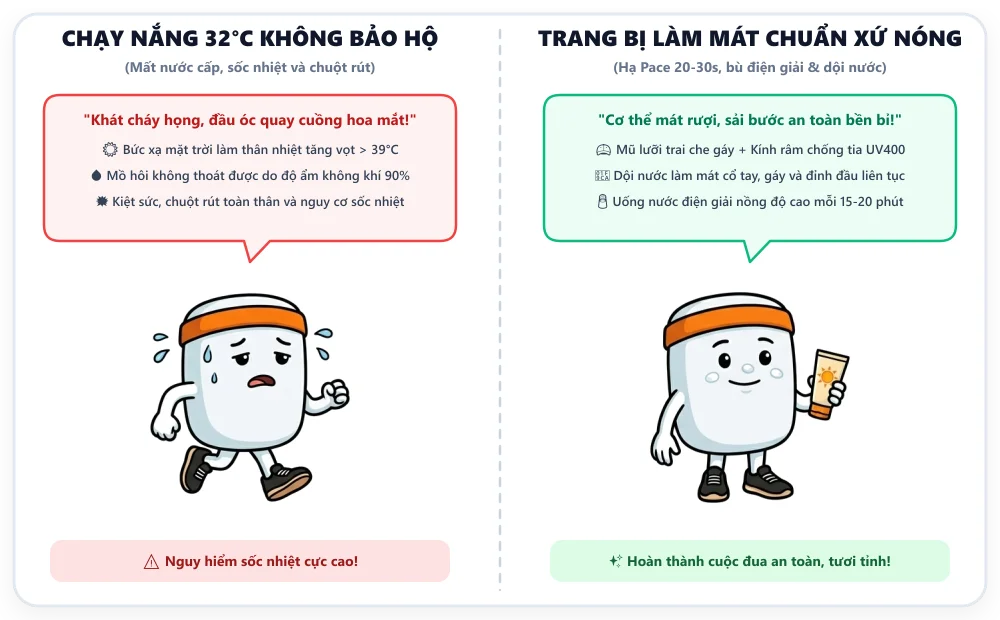
1. Biology: Why Tropical Humidity is a Performance Killer
The human body operates like a heat-generating engine. When you run, only about 20%–25% of expended energy converts into mechanical work (moving you forward), while the remaining 75%–80% is lost as HEAT.
To maintain a safe core temperature (around 37°C–37.5°C), the body releases heat via 4 mechanisms:
- Radiation: Emitting heat waves into the surrounding environment.
- Conduction: Direct contact with colder objects (ice, cold air).
- Convection: Wind carrying heat away from the skin surface.
- Evaporative Cooling: The body’s ultimate cooling mechanism.
┌─────────────────────────────────────────────────────────────────────────────┐
│               THE HEAT DISSIPATION PARADOX IN HOT/HUMID CONDITIONS          │
├─────────────────────────────────────────────────────────────────────────────┤
│ • Ambient temp > 30°C: Radiation & Conduction are largely neutralized.      │
│ • The body relies 85% – 90% on [EVAPORATIVE COOLING] to stay cool.          │
│                                                                             │
│   HIGH HUMIDITY (RH > 85%)                                                  │
│   ├── Air is saturated with moisture ➔ Sweat CANNOT EVAPORATE               │
│   ├── Sweat just drips off (dehydration without cooling)                    │
│   └── Core temperature builds up ➔ Surpasses 39°C – 40°C                    │
└─────────────────────────────────────────────────────────────────────────────┘
[!WARNING] Sweat only cools you if it EVAPORATES from the skin. If it’s dripping off you onto the pavement, you are losing water and salt rapidly while your core temperature continues to climb!
Cardiac Drift & The Battle for Blood Flow
When temperatures rise, the sympathetic nervous system triggers Cutaneous Vasodilation to push hot blood from the organs to the skin surface for cooling.
This creates a fierce “internal fight for blood”:
- Legs: Need high volumes of oxygenated blood to maintain muscle contraction.
- Skin: Needs high blood flow to the periphery for cooling.
Simultaneously, fluid loss through sweat reduces Plasma Volume, which decreases Stroke Volume (the amount of blood pumped per beat). To compensate, your heart must beat 10–20 bpm faster just to maintain the same pace.
                  ┌─────────────────────────────────────┐
                  │    HOT & HUMID WEATHER (32°C, 90% RH)│
                  └──────────────────┬──────────────────┘
                                     │
           ┌─────────────────────────┴─────────────────────────┐
           ▼                                                   ▼
┌─────────────────────────────┐                     ┌─────────────────────────────┐
│  Dehydration & Decreased    │                     │  Cutaneous Vasodilation     │
│       Plasma Volume         │                     │  (Blood shunted to skin)    │
└──────────────┬──────────────┘                     └──────────────┬──────────────┘
               │                                                   │
               ▼                                                   ▼
┌─────────────────────────────┐                     ┌─────────────────────────────┐
│  Stroke Volume              │                     │  Less Blood for Muscles &   │
│     DECREASES SHARPLY       │                     │     Rising Core Temp        │
└──────────────┬──────────────┘                     └──────────────┬──────────────┘
               │                                                   │
               └───────────────────────┬───────────────────────────┘
                                       │
                                       ▼
                     ┌───────────────────────────────────┐
                     │   CARDIAC DRIFT                   │
                     │  (+10 to +25 bpm at same pace)    │
                     └───────────────────────────────────┘
[!TIP] To manage your heart rate in the heat, use a Heart Rate Zone Calculator to accurately identify your Zone 2 aerobic threshold and avoid drifting into the anaerobic zone too early.
2. Medical Hydration Protocol
 Caption: One electrolyte salt capsule every 45 minutes to stave off muscle cramps.
A common mistake among amateur runners is slamming plain water whenever they feel hot or thirsty.
The Danger of EAH (Exercise-Associated Hyponatremia)
In the heat, sweat contains significant minerals, especially Sodium. Tropical runners typically lose 800mg to 1,500mg of sodium per liter of sweat.
If you drink too much plain water without adequate salt:
- Blood sodium levels dilute below safe levels (< 135 mmol/L).
- Osmotic pressure causes water to shift from the blood into cells, causing Cellular Edema.
- Brain edema symptoms include: Severe headache, nausea, confusion, spatial disorientation, seizures, pulmonary edema, and potentially death.
┌─────────────────────────────────────────────────────────────────────────────┐
│             SCIENTIFIC ELECTROLYTE REPLACEMENT PER HOUR OF RUNNING          │
├─────────────────────────────────────────────────────────────────────────────┤
│ • Sodium:    500mg – 1,000mg/hour (Maintains blood pressure)                │
│ • Potassium: 150mg – 300mg/hour (Stabilizes neuromuscular transmission)     │
│ • Magnesium: 25mg – 50mg/hour (Prevents muscle spasms)                      │
│ • Calcium:   30mg – 60mg/hour (Supports muscle contractions)                │
│ • Fluid:     500ml – 800ml/hour (Sip consistently)                          │
└─────────────────────────────────────────────────────────────────────────────┘
Water Station Protocol
- Don’t gulp: The stomach’s Gastric Emptying Rate is roughly 600–800ml/hour. Overloading it causes bloating and side stitches.
- Small sips (100–150ml): Every 2km–2.5km (10–15 minutes), take small sips, holding the water in your mouth for 2 seconds before swallowing.
- Alternating Strategy:
- Odd stations (km 2, 6, 10…): Electrolyte drink.
- Even stations (km 4, 8, 12…): Plain water + salt tablet or high-sodium energy gel.
3. Active Cooling Techniques
 Caption: Use ice from water stations for immediate core temperature relief.
Don’t wait until you’re overheating to cool down. Active cooling should start at the first station.
Arterial Cooling Points
Avoid drenching your shoes, which leads to blisters. Target areas where major blood vessels are close to the skin surface:
- Back of the neck: Cools blood traveling to the brain and the hypothalamus.
- Inside of wrists: Where radial and ulnar arteries are superficial.
- Temples & Forehead: Reduces nervous system stress.
- Armpits & Groin: Primary cooling zones in cases of severe overheating.
4. Pace Adjustment (The WBGT Factor)
One of the biggest mistakes is trying to hit your “winter morning” target pace in 33°C heat. Use the WBGT (Wet Bulb Globe Temperature) as a safety guideline:
| WBGT / Heat Sensation | Risk Level | Pace Adjustment Strategy |
|---|---|---|
| < 18°C (Cool) | Very Low | Run at 100% Target Pace |
| 18°C – 23°C (Warm) | Medium | Subtract 5 – 10 seconds / km |
| 23°C – 28°C (Hot/Humid) | High | Subtract 15 – 30 seconds / km (5% - 8% slower) |
| > 28°C – 31°C (Very Hot) | Dangerous | Subtract 30 – 60 seconds / km, add Run-Walk |
| > 31°C (Red Alert) | Deadly | Switch to walking or DNF for safety |
Coach’s Tip: Slowing down by 20 seconds/km for the first 10km saves you from “paying back” 2 minutes/km in the final 10km!
5. Heat Exhaustion vs. Heat Stroke
| Clinical Sign | Heat Exhaustion | Heat Stroke (Emergency) |
|---|---|---|
| Core Temp | < 40°C (38°C - 39.5°C) | > 40°C - 41°C |
| Skin | Pale, clammy, sweaty | Hot, dry (or stopped sweating) |
| Mental State | Alert, dizzy, tired | CONFUSED, DISORIENTED, DELIRIOUS |
| Action | Stop, shade, electrolytes | CALL EMERGENCY, ICE IMMERSION |
[!CAUTION] Heat Stroke Rule: If a runner is stumbling, disoriented, or collapsing:
- Call emergency medical help immediately.
- Cool them down by any means in the first 30 minutes (ice water, ice packs on neck/pits/groin).
- DO NOT force water on someone who is semi-conscious or unconscious; they may aspirate it.
6. 5-Step Survival Checklist
- Heat Acclimatization: Spend 10–14 days before the race doing light runs during the 8:00 AM–9:00 AM window.
- Smart Carb/Hydration Loading: Increase complex carbs and electrolyte intake 2 days before.
- Disciplined Salt Intake: Carry salt tabs and take one every 45–50 minutes.
- Cool at Every Station: Take two cups—one to sip, one to pour on your neck and arms.
- Respect the Heat: A finisher medal is only worth it if you cross the line healthy.
🛠️ Scientific Tools at Thích Chạy Bộ:
- 💧 Gel & Water Calculator: Calculate precise hydration and fuel needs.
- ❤️ Heart Rate Zone Calculator: Manage intensity and monitor Cardiac Drift.
- 🩺 Injury Diagnosis Tool: Identify and recover from race-day soreness.
