3:00 AM. Laser lights scan the night sky, thumping EDM bass vibrates through your chest, and the MC’s voice roars over the massive PA system. Around you, thousands of runners are decked out in vibrant race gear, fueled by adrenaline and laser-focused on crushing a new Personal Record (PR).
“10… 9… 8… 3… 2… 1… GO!”
Flares ignite, the starting gun pierces the darkness, and the sea of humanity surges forward like a tsunami. The rhythmic beep-beep-beep of timing chips crossing the mat, the sound of thousands of carbon-plated shoes hitting the wet pavement—it’s electrifying. Your heart rate spikes, your legs feel like they’re powered by jet fuel, and you feel invincible.
But stay sharp! Those first five minutes of pure adrenaline are where 80% of amateur runners accidentally sign their own “physical death warrant” for the final 10km of the race.
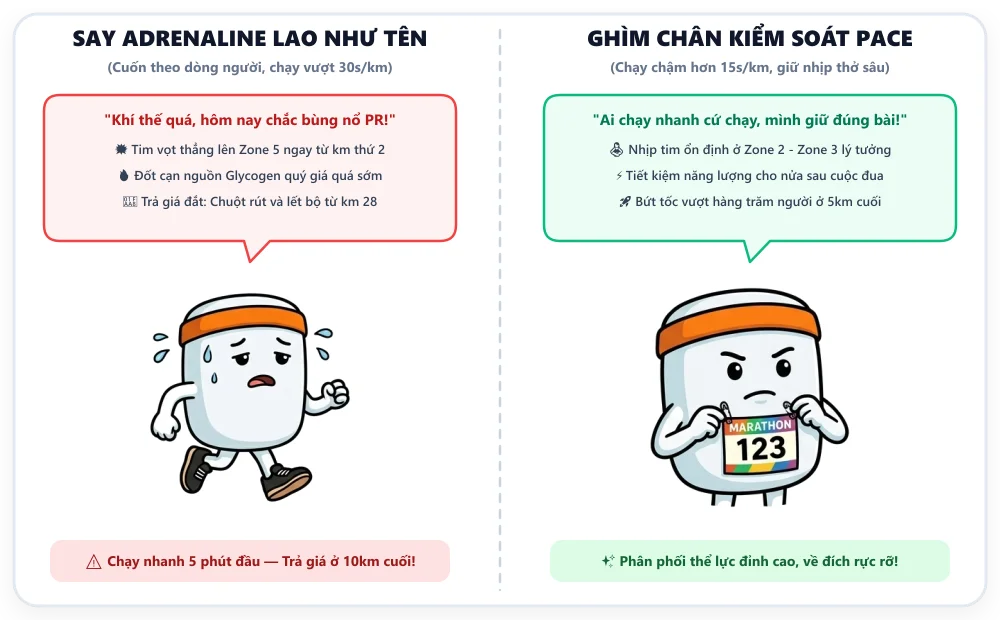
1. The “Adrenaline Rush” & The 3km “Physical Debt” Trap
Think back to your last race:
- You spent four months training to hold a 6:00/km pace to hit a Sub-4:15 Marathon or Sub-2:06 Half Marathon.
- But once you cross the start line, swept up by the crowd, you subconsciously floor it.
- You glance at your watch at km 1 and km 2: You’re clicking off 5:25 – 5:30/km—30–35 seconds faster per kilometer than your plan!
┌─────────────────────────────────────────────────────────────────────────┐
│                    THE START-LINE BRAIN ILLUSION                        │
├─────────────────────────────────────────────────────────────────────────┤
│  💭 "The weather's cool, I'm definitely in the zone today!"            │
│  💭 "My legs feel weightless—I'll bank some time now!"                   │
│  💭 "Everyone is moving fast, I can't let them block me!"              │
└─────────────────────────────────────────────────────────────────────────┘
This is the “Adrenaline Rush,” the silent assassin of long-distance running.
Physiology: What’s really happening under the hood?
At the start line, your Sympathetic Nervous System shifts into “Fight or Flight” mode, flooding your blood with Adrenaline and Cortisol:
- Pain & Fatigue Masking: Adrenaline dilates your bronchioles to intake more oxygen, increases heart contractility, and temporarily suppresses fatigue signals. You feel like you’re flying, but this is a natural anesthetic with a shelf life of only 15–20 minutes.
- Burning Glycogen via Anaerobic Metabolism: Running faster than goal pace before your muscles are warm forces your heart rate from Zone 2/Zone 3 straight into Zone 4 and Zone 5 (Anaerobic). Your body stops burning fat and switches to 100% carbohydrate oxidation at 3–4 times the normal rate.
- Lactate Debt: When lactate and $H^+$ ions accumulate faster than your liver and heart can clear them, your muscles become “acidic.” You might not feel the pain yet, but the cellular damage has begun.
                  THE "HITTING THE WALL" MECHANISM

   Starting too fast ➔ HR hits Zone 4/5 ➔ Glycogen depletion
                           │
                           ▼
             Lactate buildup & Oxygen Debt
                           │
                           ▼
 [Km 30-35] Muscle failure ➔ Total cramps ➔ "Hitting the concrete wall"
[!WARNING] The Marathon Golden Rule: Every 1 second you run faster than goal pace in the first 5km costs you 4 to 5 seconds in the final 10km! Unlike a bank account, “time banking” at the start of a marathon is a predatory loan with devastating interest rates.
2. The 5-Minute Survival Guide: 4 Steps to “Pulling the Reins”
 Caption: Check your watch, breathe deep, stick to the right, and relax your shoulders so you aren’t led by the crowd.
To avoid becoming another victim of start-line fever, use these “mental brakes” the second you cross the timing mat.
Step 1: Commit to the “+10/+15 Second” Rule
Make this an iron-clad rule: The first 3km MUST be 10–15 seconds/km slower than your goal pace.
- If your goal is 5:40/km, run the first km at 5:55/km, the second at 5:50/km, and the third at 5:45/km before settling into your 5:40 rhythm from km 4 onward.
- Why? Treat the first 3km as an official Dynamic Warm-up. This allows synovial fluid to lubricate your joints, capillaries to gradually dilate, and your heart to adjust without a sudden blood pressure spike.
Step 2: Choose the Right Corral & Pacer Position
A classic rookie mistake is crowding the front:
- Don’t crowd the front: If you’re a Sub-4 or Sub-5 runner, never start with the Sub-3 pack. You’ll be shoved, tripped, or forced into an unsustainable pace.
- Pacer Strategy: Find your target pacer, but don’t hug their back. Pacers are always surrounded by a swarm of 40–50 runners, leading to bottlenecks and tripping hazards. Stay 15–25 meters behind the pacer group to maintain space and clear vision of the road.
Step 3: Set Pace & Heart Rate Alerts
Don’t trust your legs; trust your sensors:
- Pace Alert: Set a pace cap on your Garmin/Coros/Apple Watch. If you go faster than your limit (e.g., 5:35), the watch will vibrate incessantly to remind you to slow down.
- Heart Rate Alert: Set a cap at 80% of your $HR_{max}$ for the first 5km.
Step 4: Activate the Parasympathetic System with 4-4 Breathing
If your heart is pounding from nerves, use rhythmic breathing:
- Inhale through the nose for 4 steps.
- Exhale through the mouth for 4 steps.
Deep breathing stimulates the Vagus Nerve, sending a calming signal to the brain that can drop your HR by 5–8 bpm instantly.
[!TIP] Coach’s Mantra: When hundreds of runners fly past you in the first 3km, smile, wave, and think to yourself: “Go ahead, guys, I’ll see you at km 35!”
3. Pacing Strategy: Negative Split vs. Even Split
Every great record by Eliud Kipchoge or the late Kelvin Kiptum was set using Negative Split or Even Split tactics.
┌─────────────────────────────────────────────────────────────────────────┐
│                    MARATHON PACING STRATEGIES                           │
├─────────────────┬───────────────────────────────────────────────────────┤
│ Positive Split  │ Fast start — Slow finish ("The Slow Death")            │
│                 │ ❌ 90% fail rate, hitting the wall at km 32.          │
├─────────────────┼───────────────────────────────────────────────────────┤
│ Even Split      │ Steady as a machine from start to finish.             │
│                 │ ⚖️ Requires iron discipline and a flat course.        │
├─────────────────┼───────────────────────────────────────────────────────┤
│ Negative Split  │ Cautious start — Faster finish ("The Ultimate Weapon")│
│                 │ 🏆 Saves glycogen, lets you pass hundreds at the end.  │
└─────────────────┴───────────────────────────────────────────────────────┘
Why is Negative Split the “Ultimate Weapon”?
By running the first half 1–2 minutes slower than the second:
- Musculoskeletal System: Your joints and tendons have time to adapt to the load without early micro-trauma.
- Digestive System: You absorb gels and electrolytes much better without stomach distress.
- The Hunter Effect: During the final 10km, as others are walking and cramping, you’ll be passing them one by one. The rush of endorphins will carry you to a massive PR.
4. Real-World Comparison: The Cost of a Hot Start

| Race Stage | Runner A (Adrenaline - Positive Split) | Runner B (Disciplined - Negative Split) |
|---|---|---|
| Km 0 – 3 | 5:15 pace (Zone 4 spike) | 5:55 pace (Zone 2 cruise) |
| Km 4 – 15 | 5:30 pace (Feels “great”) | 5:40 pace (Steady) |
| Km 16 – 21 | 5:40 pace (Fatigue creeping in) | 5:38 pace (Half marathon @ 2h00) |
| Km 22 – 30 | 6:00 pace (Thirst/Stiffness) | 5:35 pace (Increasing effort) |
| Km 31 – 35 | 7:30+ Walk (HIT THE WALL) | 5:30 pace (Passing people) |
| Km 36 – 42.2 | 8:45+ Walk (Pain/Frustration) | 5:25 pace (The Kick) |
| RESULT | 4:28 (Injured/Missed goal) | 3:56 🏅 (PR SUCCESS!) |
5. Race-Day Checklist
Confidence at the start line isn’t about emotion; it’s about preparation.
┌─────────────────────────────────────────────────────────────────────────┐
│                 60 MINUTES BEFORE THE START GUN                         │
├─────────────────────────────────────────────────────────────────────────┤
│  [ ] Wake up 2.5 - 3 hours before start.                                │
│  [ ] Eat light, easy carbs (banana, white bread, honey).                │
│  [ ] Bathroom break done 45 minutes before start.                      │
│  [ ] Gentle warm-up and mobility work.                                 │
│  [ ] Drink electrolytes, take 1 gel 15 minutes prior.                  │
│  [ ] GPS locked, pace/HR alerts set.                                    │
│  [ ] Stand in the correct Corral.                                       │
└─────────────────────────────────────────────────────────────────────────┘
Final Thoughts: The Marathon Starts at Km 32
A marathon is a 42-kilometer symphony of will and physiology. The race is not decided in the first 5 minutes; it truly begins at kilometer 32.
Stay consistent with your pace, control your heart rate, and don’t let temporary excitement steal the rewards of your months of hard work. Good luck, hold those reins tight early on, and cross that finish line with pride!
