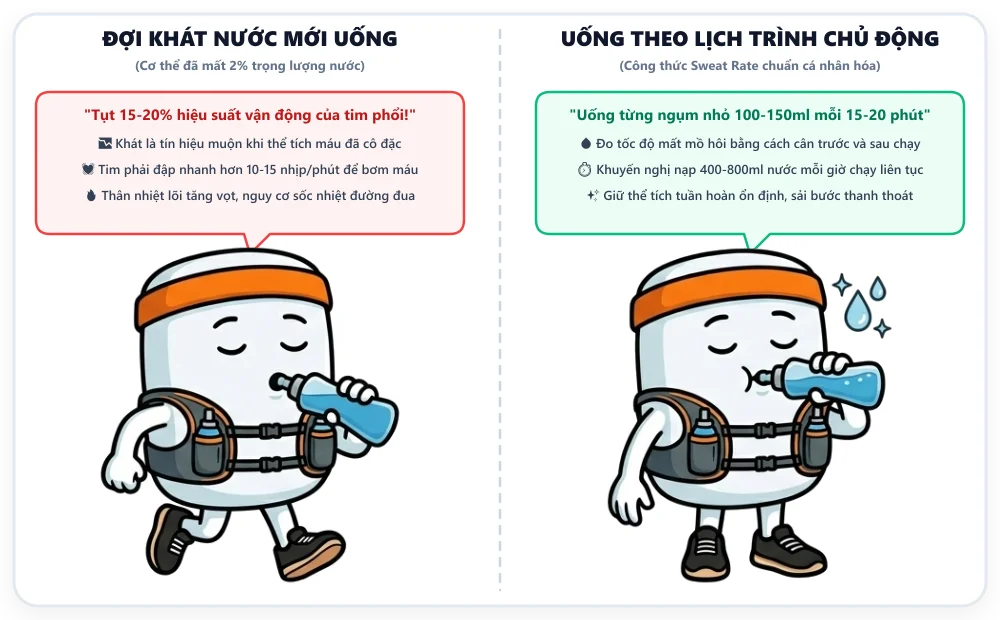
In endurance sports, water and electrolytes are survival essentials that dictate your ability to regulate core temperature and maintain cardiac output. Research from the American College of Sports Medicine (ACSM) shows that losing just 2% of your body weight through fluid loss causes plasma volume to drop, heart rate to spike by 10–15 bpm (Cardiac Drift), and running performance to plummet by 7% to 12%.
Conversely, excessive, mindless fluid intake (Overhydration) is just as dangerous. It can lead to Exercise-Associated Hyponatremia (EAH)—a serious medical complication that can cause cerebral edema and, in severe cases, fatality.
So, how do you determine exactly how many milliliters of water and electrolytes your body needs per hour?
Thermoregulation: How Sweat Cools You Down
When you run, only about 20% to 25% of the energy expended is converted into mechanical work, while the remaining 75% to 80% becomes metabolic heat. To keep your core temperature from exceeding the dangerous $40^\circ\text{C}$ threshold (which leads to heat stroke and brain cell damage), the body must trigger its primary cooling mechanism: evaporative cooling via sweat.
[Metabolic Heat Generated by Muscle Contraction]
                  │
                  ▼
[Blood Transports Heat to Subcutaneous Capillaries]
                  │
                  ▼
[Sweat Glands Secrete Water & Minerals (Sodium, Chloride, Potassium)]
                  │
                  ▼
[1 Gram of Evaporated Sweat ➔ Dissipates 2.43 kJ (0.58 kcal) of Heat]
If you fail to replenish this fluid, blood volume decreases, forcing the body to constrict blood vessels under the skin to prioritize blood flow to the heart. This causes core temperature to skyrocket, leading to heat exhaustion.
The Sweat Rate Test: A Scientific Approach
Hydration needs are unique: a heavier runner with more muscle mass or one running in humid conditions might lose 1.5 – 2.5 liters/hour, while a smaller runner in cool weather might only lose 0.6 – 0.8 liters/hour.
┌────────────────────────────────────────────────────────────────────────┐
│                      4-STEP SWEAT RATE TEST                            │
├────────────────────────────────────────────────────────────────────────┤
│ Step 1: Empty your bladder and weigh yourself naked: W1 (kg).          │
│ Step 2: Run for 60 minutes at target race pace in realistic conditions.│
│ Step 3: Measure the total fluid consumed during that hour: Vintake (L). │
│ Step 4: Wipe off all sweat and weigh yourself again naked: W2 (kg).    │
└────────────────────────────────────────────────────────────────────────┘
The Calculation Formula:
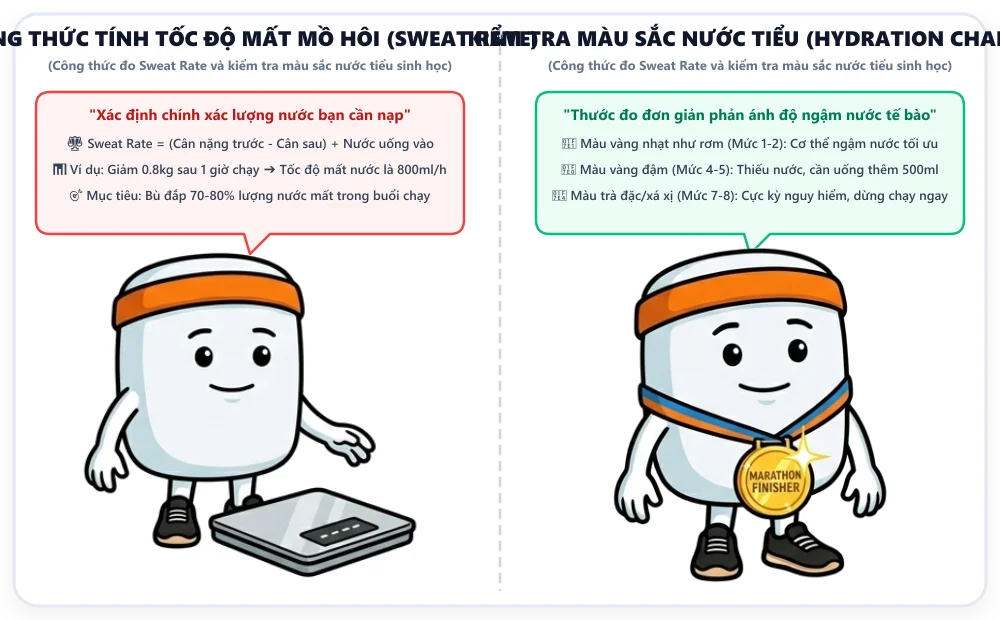
$$\text{Sweat Rate (Liters/hour)} = (W_1 - W_2) + V_{\text{intake}} - V_{\text{urine}}$$
Example:
- Weight before run: $W_1 = 62.5\text{ kg}$
- Weight after 60 min run: $W_2 = 61.6\text{ kg}$
- Fluid consumed: $V_{\text{intake}} = 0.4\text{ Liters}$
- No urination ($V_{\text{urine}} = 0$)
- $\text{Sweat Rate} = (62.5 - 61.6) + 0.4 = 0.9 + 0.4 = \mathbf{1.3\text{ Liters/hour}}$.
[HYDRATION TARGET]
- Never try to replace 100% of sweat loss (the stomach can only empty 800–1000ml/hour).
- AIM FOR 60% TO 80% REPLACEMENT:
  ➔ With a 1.3 L/h Sweat Rate: Aim to ingest 780ml to 900ml/hour
     (split into 5–6 doses, 150ml every 10–12 minutes).
3-Phase Hydration Protocol (Pre, During & Post Run)
┌────────────────────────────────────────────────────────────────────────┐
│ PHASE 1: PRE-HYDRATION                                                 │
├────────────────────────────────────────────────────────────────────────┤
│ • 4 hours before: Drink 5–7 ml of water / kg of body weight.           │
│ • 2 hours before (if urine is dark): Drink an additional 3–5 ml/kg.    │
│ • STOP DRINKING 45 MINUTES BEFORE START to empty the bladder.          │
├────────────────────────────────────────────────────────────────────────┤
│ PHASE 2: IN-RUN HYDRATION                                              │
├────────────────────────────────────────────────────────────────────────┤
│ • Runs under 45 min: Drink to thirst.                                  │
│ • Runs over 60 min: Drink 100ml – 150ml every 15–20 minutes.           │
│ • Humid conditions: MUST USE ISOTONIC ELECTROLYTES                     │
│   (containing 300–600mg sodium/liter) instead of plain water!          │
├────────────────────────────────────────────────────────────────────────┤
│ PHASE 3: POST-RUN REHYDRATION                                          │
├────────────────────────────────────────────────────────────────────────┤
│ • 150% Rule: For every 1kg of body weight lost, replace with 1.5 LITERS │
│   OF FLUID PLUS ELECTROLYTES over the next 4–6 hours.                  │
└────────────────────────────────────────────────────────────────────────┘
You can calculate your specific needs using our Gel & Electrolyte Calculator.
The Danger of EAH: The Price of Over-Drinking Plain Water
Exercise-Associated Hyponatremia (EAH) occurs when blood sodium levels drop below the critical < 135 mmol/L threshold.
[CONTINUOUS CONSUMPTION OF LARGE AMOUNTS OF PLAIN WATER]
                         │
                         ▼
[Diluted Plasma Sodium Concentration]
                         │
                         ▼
[Osmotic Imbalance: Fluid rushes from bloodstream into cells]
                         │
                         ▼
[CEREBRAL EDEMA (BRAIN SWELLING)]
├── Early symptoms: Severe headache, nausea, swollen fingers, facial puffiness.
└── Critical symptoms: Confusion, seizures, coma, and acute respiratory distress.
EAH Prevention Principle: Do not force-feed water if you aren’t thirsty, especially if only drinking plain water. Always supplement with salt or electrolyte tablets during runs lasting over 3 hours.
The “Pinch & Sip” Technique at Aid Stations
Trying to drink from an open cup while running at race pace often leads to choking. Use this pro technique:
[PINCH & SIP TECHNIQUE]
├── 1. Grasp: Hold the cup firmly with thumb and forefinger.
├── 2. Pinch: Squeeze the rim of the paper cup to form a POINTED FUNNEL.
├── 3. Pour: Place the funnel at the corner of your mouth; pour in small, controlled sips.
└── 4. Swallow: Hold in the mouth for a second, then swallow rhythmically with your breath.
Armstrong Pee Chart
| Urine Color | Hydration Status | Action Needed |
|---|---|---|
| Levels 1–2 (Pale Straw) | Optimal Hydration | Maintain current intake |
| Levels 3–4 (Bright Yellow) | Mild Dehydration | Drink 250ml–350ml water or coconut water |
| Levels 5–6 (Dark/Tea) | Serious Dehydration | Drink 500ml electrolytes, stop hard effort |
| Levels 7–8 (Cola) | Dangerous/Rhabdo Risk | Immediate rehydration and seek medical help |
| Level 0 (Clear) | Over-hydrated | Stop plain water, add electrolytes |
FAQs
1. Is ice-cold water better than room temperature?
Cool water ($10^\circ\text{C}$ to $15^\circ\text{C}$) has the fastest gastric emptying rate and helps lower core temperature more effectively. However, avoid ice-cold water ($<5^\circ\text{C}$) on an empty stomach to prevent cramping.
2. Should I drink soda for hydration?
No. Sodas are hypertonic, which slows fluid absorption in the gut and causes bloating. Prioritize isotonic electrolyte drinks with 4% to 6% carbohydrate concentration.
3. How do I stop needing to pee during a long run?
Follow this rule: Hydrate well 2–3 hours before, then stop heavy fluid intake 45 minutes before the start. This window allows the kidneys to filter excess water so you can empty your bladder before crossing the start line.
💧 Recommended Hydration Resources:
- Personalized calculation: Gel & Electrolyte Calculator.
- Salt supplementation: Electrolytes & Salt for Runners: When to Supplement?.
- Muscle cramping: Preventing Cramps: Causes & Solutions.
- Side stitches: Managing Side Stitches While Running.
- Using Gels: Energy Gels: A Guide to Avoiding Stomach Issues.
*Pro Tip: “Hydration is a precise art of measurement. Listen to your body, calculate your sweat rate, and make fluid intake an effective, refreshing part of your race strategy.”
