Have you ever finished a 5km run at sunrise, feeling refreshed and energized, only to open Strava or Garmin Connect and, upon seeing a 7:30/km pace, hesitate to hit that “Share” button?
Or perhaps you’ve stumbled upon someone else’s 5:00/km easy run, looked at your own effort, and thought, “I’m so slow. Am I even a real runner?”
If the answer is YES, you aren’t alone. You’re experiencing a common psychological phenomenon in the modern running community: “Pace Shame.”
1. How Social Media Turned Running into a “Fitness Test”
 Cartoon: Hiding behind a tree to conceal an 8:30 pace for fear of being called slow.
Running is the most democratic, accessible sport on the planet. You just need a pair of shoes that fit, a door to walk out of, and the rhythm of your own breath.
But since the rise of Strava, Facebook, and various running groups, the road has become an invisible “stage”:
- The Pressure of Orange Numbers: We’ve become obsessed with what others think of our average pace, heart rate, and cadence.
- FOMO and Imposter Syndrome: Seeing friends chase PRs, Sub-4 marathons, or Sub-2 half marathons makes it easy to fall into the trap of pushing harder than our bodies are ready for in every single session.
- The Tragedy of “Easy Runs” Turned Tempo: Instead of running at an easy effort for cardiovascular recovery, many runners strain themselves just to make their tracklog look “impressive.”
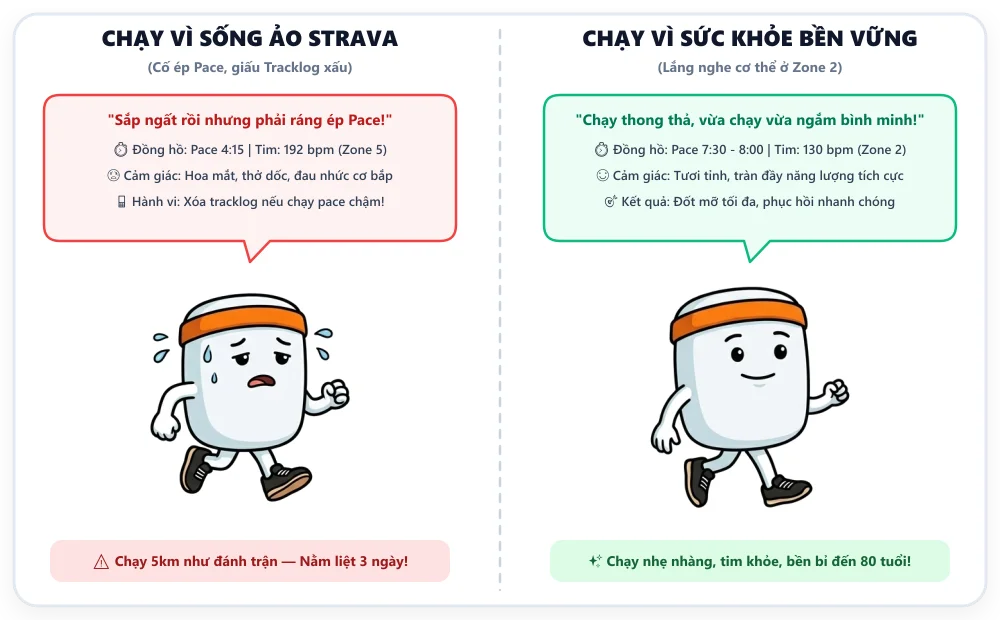
The result? Soft tissue injuries (IT Band issues, Shin Splints), chronic overtraining, and worst of all, losing the pure joy of running.
2. Physiology: Why “Slow Running” is the Key to “Fast Running”
Most of the world’s elite marathoners (including the legendary Eliud Kipchoge) spend up to 80% of their weekly mileage running at an extremely slow pace—a speed many amateur runners jokingly call “turtle pace.”
Why?
┌─────────────────────────────────────────────────────────────┐
│                   THE 80/20 GOLDEN RULE                     │
├──────────────────────────────┬──────────────────────────────┤
│    80% OF VOLUME (ZONE 2)    │    20% OF VOLUME (ZONE 4-5)  │
│ • Slow, nasal breathing      │ • Intervals, speed work      │
│ • Increased mitochondria     │ • Lactate threshold gains    │
│ • Fat-burning efficiency     │ • Explosive power            │
└──────────────────────────────┴──────────────────────────────┘- Building Capillary Networks: Running at Zone 2 heart rate stimulates the body to grow dense capillary networks around your muscle fibers, allowing for better oxygen and nutrient delivery.
- Boosting the “Power Plants” (Mitochondria): Low-intensity training teaches your muscles to rely on fat stores as a primary fuel source, preserving precious glycogen for those long race miles.
- Protecting Your Skeletal System: Slow running allows your tendons, Achilles, and bones to adapt and strengthen without being subjected to sudden, high-impact overload.
Simply put: If you can’t be patient enough to run at a 7:30 or 8:00 pace now, you’ll never build the aerobic foundation required to maintain a 5:00 pace for 42.195 km on race day.
3. 3 Golden Rules to Free Your Mind from Pace Shame
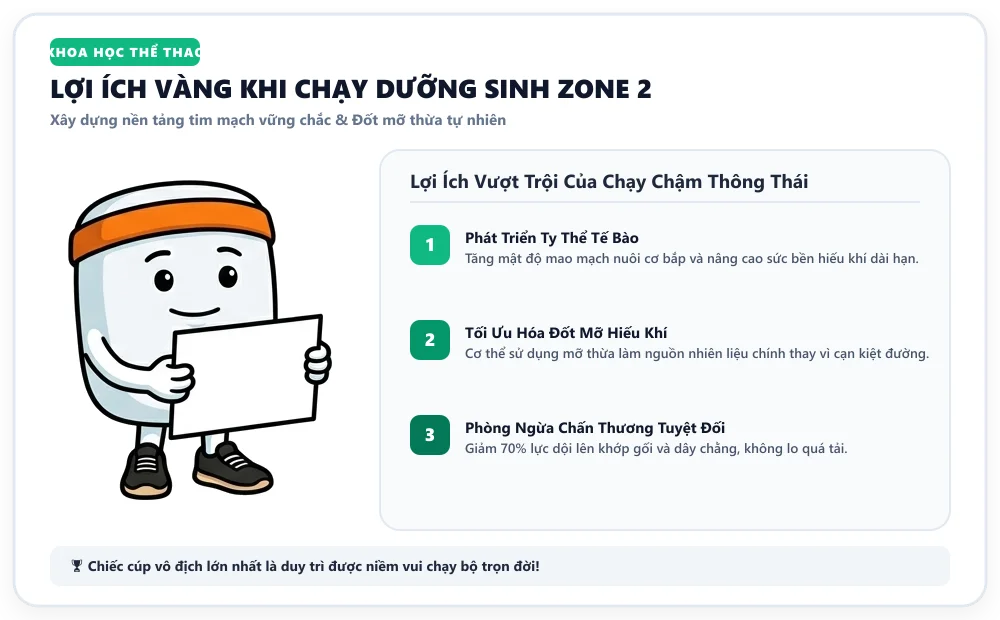 Cartoon: The priceless reward of sticking to the 80/20 rule.
Rule 1: Compare yourself to who you were yesterday, not the leaderboard
Every runner has a different starting line: height, weight, age, training history, work stress, and sleep quality all matter.
- A 5km at a 7:30 pace for a 9-to-5 worker is just as impressive as a 4:30 pace for a pro.
- Your biggest daily victory isn’t beating someone else—it’s overcoming the temptation of a warm bed to step out the door.
Rule 2: Hide your pace during Easy Runs
On recovery or easy days, change your watch screen to show Heart Rate or Elapsed Time instead of obsessing over real-time pace.
- Run by feel: The right speed is a pace where you can hold a full conversation without gasping for air.
Rule 3: Be proud of every run
Don’t be afraid to share that 7, 8, or 9-minute pace on social media. Your authenticity and consistency will inspire thousands of others who are currently too intimidated to lace up because they think they’re “too slow.”
4. What Kind of Runner Are You?
There is no one-size-fits-all formula for running. Some are born to conquer speed milestones, while others view running as a form of moving meditation to greet the sunrise and reset the mind.
- 👉 To understand your personal Running DNA and style, try our quiz: Running DNA Assessment.
- 👉 To determine your scientific Zone 2 heart rate range, use our: Karvonen Heart Rate Zone Calculator.
💬 Final Thoughts
Next time you lace up, take a deep breath, hold your head high, and smile. Pace is just a number on a watch, but your health, joy, and peace of mind are the real medals for anyone who loves to run.
🔗 Related Articles & Tools:
- Build your aerobic base: What is Zone 2 Training? A Guide to Running Slow to Run Fast.
- A stress-free start: Couch to 5K (C25K): An 8-Week Plan for Beginners.
- Calculate your personal pace zones: Pace & Running Metrics Calculator.
