Think back to your first runs: legs heavy as lead, gasping for air, heart hammering against your ribs, and that constant, nagging question: “Why does anyone willingly torture themselves with this sport?” Back then, your 5:00 AM alarm was your mortal enemy, and you could invent a hundred excuses just to hit snooze for another fifteen minutes.
But after a few months of consistency, something strange happens.
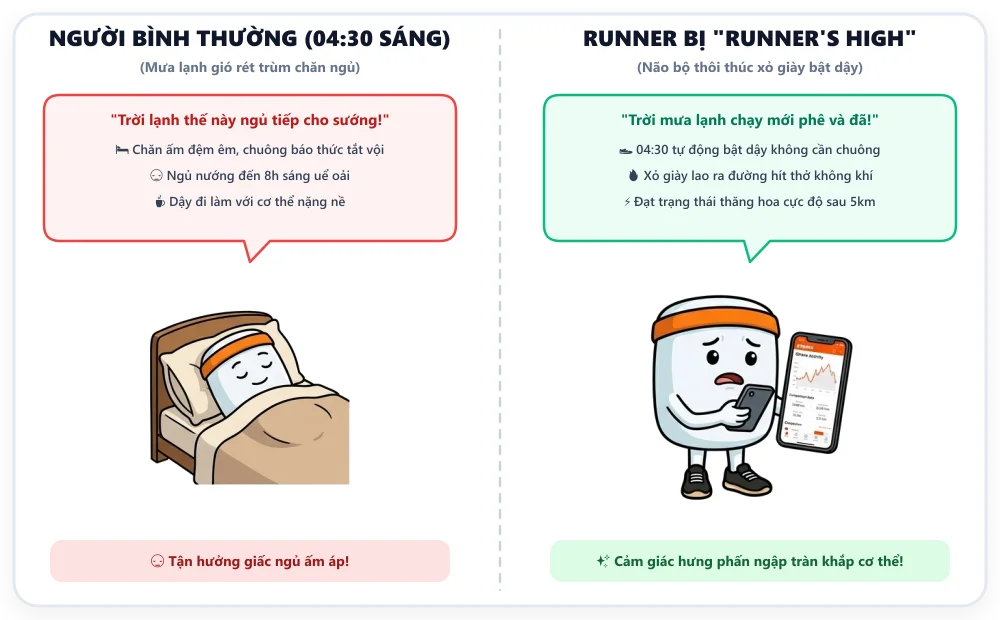
It’s 4:30 AM, there’s a light drizzle and a cold wind whistling through the window, but you don’t hesitate for a second. You’re up, lacing up your shoes, zipping up your windbreaker, and heading out. If a hectic work week forces you to take two consecutive rest days, you suddenly feel restless, twitchy, and agitated—like someone going through withdrawal.
Then, the magic happens at the 7km or 10km mark: your body feels weightless, like you’re gliding through air. Muscle soreness evaporates, and your mind turns strangely quiet and clear. You feel a wave of joy, peace, and raw power surging through every cell—a euphoric state the world calls: Runner’s High.
[!NOTE] Is running a form of “natural narcotics”? What biochemical mechanism has hijacked our brain—a machine naturally wired to be lazy and seek comfort—and turned us into bonafide “stride addicts”?
Let’s join Thích Chạy Bộ to debunk the century-old Endorphin myth and explore the groundbreaking neuroscience behind this magical high!
1. Debunking the Myth: Are Endorphins or Endocannabinoids the Real Culprit?
 The brain naturally synthesizes the happiness molecule Anandamide after 45-60 minutes of easy running.
For over four decades, popular health articles and sports motivation pieces have parroted the same message: “Running releases endorphins—the feel-good hormones that reduce pain and create euphoria.”
However, neuroscientists have discovered a surprising truth: Endorphins are likely not responsible for that runner’s high in your mind!
The Biological Hurdle: The Blood-Brain Barrier (BBB)
For a chemical to create euphoria, reduce anxiety, and shift your mental state, it must travel through the bloodstream and cross the Blood-Brain Barrier (BBB)—a strictly selective biological filter for the brain.
┌─────────────────────────────────────────────────────────────────────────┐
│               BLOOD-BRAIN BARRIER (BBB) PERMEABILITY                     │
├─────────────────────────────────────────────────────────────────────────┤
│                                                                         │
│   [ PITUITARY GLAND & BLOOD ]           [ BLOOD-BRAIN BARRIER (BBB) ]   │
│                                                                         │
│   ● ENDORPHINS (Large, polar peptides) ──► ⛔ BLOCKED AT PERIPHERY      │
│     (Pain relief for muscles/joints)       (Cannot enter the brain)     │
│                                                                         │
│   ◈ ENDOCANNABINOIDS / ANANDAMIDE      ──► ✅ EASILY DIFFUSES            │
│     (Small, lipid-soluble)                 │                            │
│                                            ▼                            │
│                                   [ CENTRAL NERVOUS SYSTEM ]            │
│                                   • Binds to CB1 / CB2 receptors        │
│                                   • Reduces anxiety (Anxiolytic)        │
│                                   • Releases Dopamine & Euphoria        │
│                                   ➔ TRUE RUNNER'S HIGH!                 │
└─────────────────────────────────────────────────────────────────────────┘- Endorphins (Beta-endorphin): Essentially large, water-loving peptide chains (approx. 3,465 Daltons). Due to their size, Endorphins CANNOT cross the blood-brain barrier. When you run hard, your pituitary gland releases endorphins into the blood to block pain signals at your peripheral muscle nerve endings—helping your legs feel less sore—but they don’t reach the brain to give you that “euphoric” mental boost.
- Endocannabinoids (eCBs): This is the gold key! Specifically Anandamide—a compound derived from the Sanskrit word “Ananda” (meaning bliss). Anandamide is a tiny, lipid-based molecule that can pass straight through the blood-brain barrier with ease.
Groundbreaking Research: Heidelberg & Johns Hopkins
In 2015 and 2021, sports neurology teams led by Prof. Johannes Fuss at the University of Heidelberg (Germany) conducted landmark experiments on both mice and human runners:
- Blocking Opiate Receptors (using Naloxone): Even with endorphins completely neutralized, runners still experienced the full high, reduced anxiety, and increased pain thresholds.
- Blocking Cannabinoid Receptors (CB1 & CB2): The Runner’s High disappeared instantly! Runners felt fatigued and stressed despite sky-high endorphin levels in their blood.
[!IMPORTANT] Scientific Conclusion: Your body produces its own safe, healthy, and perfect version of an “endogenous cannabis” compound. The happiness molecule Anandamide, combined with the neurotransmitter Dopamine, is the true architect of the Runner’s High!
2. Why Humans are Programmed to be “Running Addicts” (Evolutionary Perspective)
Why would nature be so generous as to gift us such a sophisticated chemical reward system for running?
The answer lies in the Persistence Hunting Hypothesis from Harvard anthropologists:
- Millions of years ago, human ancestors (Homo erectus and Homo sapiens) lacked sharp claws and couldn’t sprint like cheetahs or lions.
- Our ultimate weapon was extraordinary aerobic endurance and the ability to dissipate heat through sweat. We hunted by persistently tracking prey for 4–6 hours under the scorching African sun until the animal collapsed from heatstroke.
- To drive a hunter to keep going for miles between life and starvation, the brain evolved the Endocannabinoid system: it dulled joint pain, suppressed fear, and flooded the mind with excitement to maintain the pace.
In other words: We were born to run, and the Runner’s High is the evolutionary reward that ensured our survival.
3. The Formula for Triggering a Runner’s High
It’s not as simple as lacing up and jogging around the block. The Endocannabinoid system requires specific “activation conditions”:
A. The “Sweet Spot” Heart Rate: Zone 2 – Zone 3 (70% – 80% MHR)
This is the most common mistake for new runners: trying to sprint at max effort (Zone 4–5) in hopes of reaching a “high.”
- If you run too fast (Anaerobic Zone 4-5): Your body enters acute biological stress. Cortisol and Adrenaline spike, lactic acid accumulates. The sympathetic nervous system is overloaded and immediately locks down Anandamide synthesis to prioritize survival signals.
- If you run too easy (Zone 1): The physical stimulation isn’t enough to trigger the release of natural sedatives.
- The Optimal Zone: Aerobic intensity (Zone 2 to low Zone 3), where you can breathe through your nose or hold a short conversation without gasping.
[!TIP] Don’t know your Zone 2 aerobic threshold? Use our Personalized Karvonen Heart Rate Zone Calculator to set your watch alerts!
B. Minimum Duration: 40 to 60 Minutes of Continuous Movement
Unlike neurotransmitters stored in synaptic vesicles, Endocannabinoids are synthesized “on-demand” from cell membranes when under sustained physical pressure.
Studies show that Anandamide levels in the blood and cerebrospinal fluid only spike after 35–45 minutes of continuous running. That’s why 15-minute runs are great for cardiovascular health but rarely offer the deep, blissful “high” of a long weekend run.
C. Flow State & Rhythmic Breathing
Runner’s High is deeply linked to Transient Hypofrontality:
- When you maintain a steady cadence (170–185 bpm) combined with rhythmic breathing (3-step inhale/3-step exhale), the brain region responsible for logical analysis, work stress, and self-criticism (Prefrontal Cortex) temporarily downshifts.
- Your mind enters a Flow State: No regrets about the past, no anxiety about the future—just the synchronization of breath, stride, and environment.
4. The Thin Line: Healthy Passion or Negative Addiction?
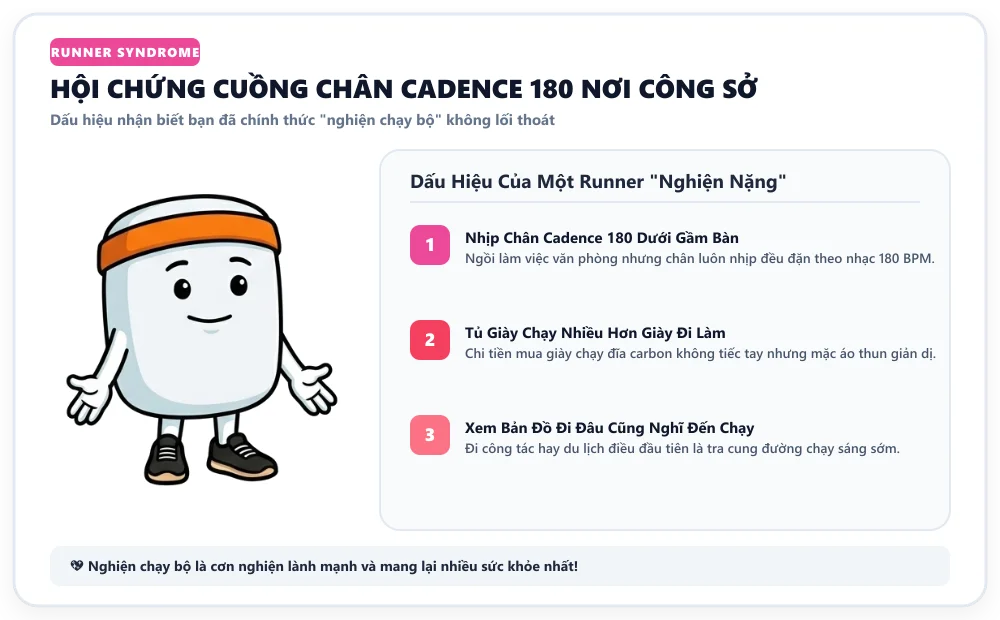 Caption: Typing on the keyboard, but feet tapping at 180 bpm under the desk.
Running brings extraordinary health and pure joy. But like any dopamine-triggering mechanism, it can be a double-edged sword if you lose control.
In sports psychology, scientists distinguish between these two states:
┌───────────────────────────────────┬────────────────────────────────────┐
│ 🟢 HEALTHY PASSION                │ 🔴 OBSESSIVE ADDICTION             │
├───────────────────────────────────┼────────────────────────────────────┤
│ • Run to improve quality of life  │ • Run to escape reality            │
│ • Listens to the body & rests     │ • Runs through injury              │
│ • No guilt on rest days           │ • Agitated/irritable when resting  │
│ • Balanced with work & family     │ • Sacrifices family/work           │
│ • Master of the run               │ • Slave to mileage & Strava data   │
└───────────────────────────────────┴────────────────────────────────────┘
Red Flags of “Negative Running Addiction”
Be honest with yourself:
- Running through injury: Ignoring Achilles tendinitis or shin splints to hit your daily mileage goal.
- Withdrawal Syndrome: Feeling restless, irritable, or depressed when forced to take a rest day.
- Neglecting life priorities: Skipping family meals or work responsibilities to run.
- Social media/Performance slavery: Running only to keep up your Strava ranking or fear of judgment for slowing down.
[!WARNING] When running shifts from a life-enhancing tool to an oppressive obligation, you are pushing yourself toward Overtraining Syndrome.
5. 3 Golden Rules for a Lifetime of Runner’s High
How do we immerse ourselves in the bliss of Anandamide while keeping our legs healthy?
Rule 1: Respect Rest Days (Rest Days Are Training Days)
Remember: Your muscles and nervous system don’t grow while running; they grow and recover while you rest (The Supercompensation Principle).
- If you run 7 days a week, your Anandamide receptors (CB1/CB2) and Dopamine receptors become desensitized. You’ll need to run further and harder just to feel a fraction of the high.
- Take 1 to 2 complete rest days per week. Rest days recharge your receptors for your next breakthrough run.
Rule 2: Follow the 80/20 Rule & Cross-Train
- 80% Easy Running: Keep most of your runs in Zone 2. It protects joints and triggers endocannabinoid release sustainably.
- 20% High Intensity: For speed and threshold work.
- Cross-training: Swim, bike, or do Strength Training to build core and glute stability, reducing the risk of knee and ankle injuries by 80%.
Rule 3: Mindful Running & Finding Joy
- Unplug: Leave the headphones and watch screen behind occasionally. Listen to the birds, the wind, and your breathing.
- Green Exercise: Studies show running in nature (parks, lakes) increases endocannabinoid levels twice as much as running on a treadmill in a gym.
6. Discover Your Unique Runner DNA with Thích Chạy Bộ
Every runner has a different physiology and psychology. To keep your journey safe, scientific, and joyful, check out our toolset:
- 🧬 What is your Running DNA? Take the Running DNA Quiz to discover your fitness tendencies and foot strike.
- ❤️ Optimize your Zone 2: Use the Karvonen Heart Rate Zone Calculator.
- ⚖️ Monitor health: Calculate your vitals with our BMI / BMR / TDEE Calculator.
Final Word from Thích Chạy Bộ
Runner’s High isn’t a media myth. It is a miracle biological gift—a subtle reward system gifted to us by evolution.
When you lace up, you aren’t just burning calories or hunting for a digital medal. You are freeing your mind from the weight of modern life, activating the Anandamide molecule, and reconnecting with your purest, most primitive self.
Run with appreciation, listen to your heart, love every step, and enjoy that magical happiness on every path you take!
🔗 Related Articles & Tools:
- Relieve performance pressure: Pace Anxiety & The Pressure of Achievement.
- The magic of running: Benefits of Running: 15 Body Changes After 90 Days.
- Persistent easy running: What is Zone 2? The Secret to Running Slow to Get Fast.
