Are you a 9-to-5 professional, a business owner buried in meetings, or a parent juggling KPIs and childcare? You love running and dream of crossing the finish line in under 2:00:00 for the half marathon (21.0975km), but looking at traditional training plans—demanding 5–6 days and 50–60km per week—makes you sigh in frustration.
The sad reality: Many busy runners try to “cram” a heavy training load into limited time, leading to severe sleep deprivation, burnout at work, and persistent injuries like plantar fasciitis, ITBS, or shin splints.
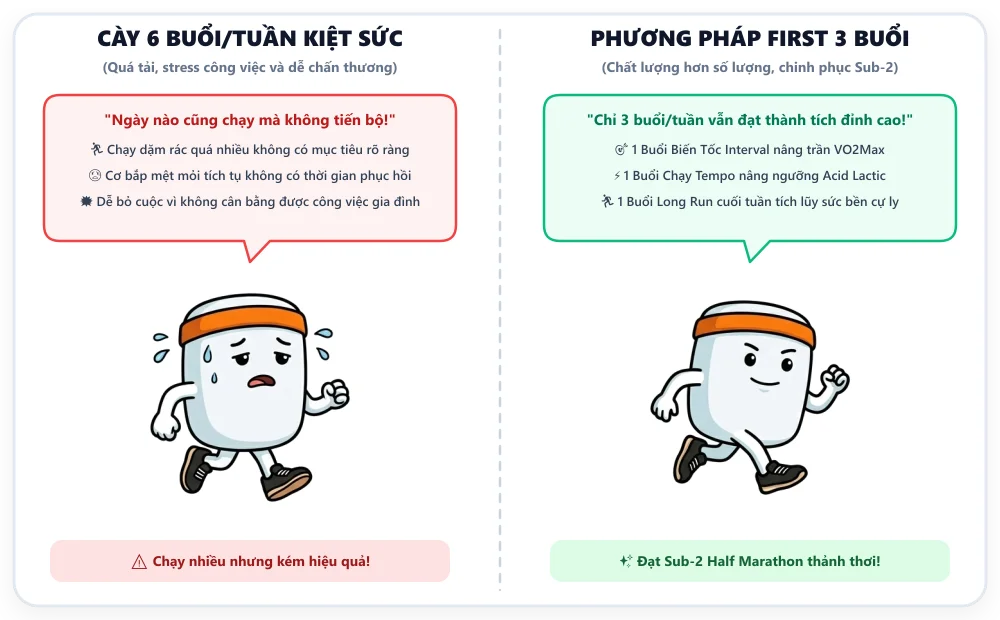
Good news from sports science: You do NOT need to run 5–6 days a week to go Sub-2. Using the FIRST (Furman Institute of Running and Scientific Training) method, you only need 3 high-quality runs per week combined with 2 cross-training sessions to smash your 21K goal, feeling strong and injury-free.
1. The FIRST Philosophy: Quality Over Quantity
The FIRST program was developed by sports physiologists at Furman University (USA) with a core motto: “Run Less, Run Faster.”
┌─────────────────────────────────────────────────────────────────────────┐
│                    THE FIRST 3+2 TRAINING PHILOSOPHY                    │
├─────────────────────────────────────────────────────────────────────────┤
│  • 3 HIGH-QUALITY KEY RUNS:                                             │
│    1. Tuesday: Interval Workout (VO2Max & Stride Efficiency)            │
│    2. Thursday: Tempo/Threshold Run (Lactate Tolerance)                 │
│    3. Sunday: Long Run (Aerobic Endurance & Mental Toughness)           │
│                                                                         │
│  • 2 CROSS-TRAINING (CT) SESSIONS:                                      │
│    Wednesday & Saturday: Cycling / Swimming / Core (Low Impact)         │
│                                                                         │
│  • 2 FULL RECOVERY DAYS:                                                │
│    Monday & Friday: Muscle repair, quality sleep, work-life balance     │
└─────────────────────────────────────────────────────────────────────────┘
❌ Say “No” to Junk Miles
“Junk miles” are aimless: they aren’t slow enough to serve as recovery, but they aren’t fast enough to stimulate cardiovascular or speed gains. They only fatigue your muscles, accumulate lactic acid, and spike your risk of overuse injuries without yielding performance improvements.
🏃 How the 3 Key Runs Work
-
Run 1 (Tuesday) – Speed Intervals:
- Goal: Increase VO2Max, optimize running economy, and train your neuromuscular system for a high cadence (180+ spm).
- Training Pace: Faster than 5K race pace (approx. 4:45 – 5:00 min/km).
- Structure: 1.5km warm-up + Intervals (400m, 800m, 1000m, or 1200m) with walk/jog recoveries + 1.5km cool-down.
-
Run 2 (Thursday) – Tempo / Threshold Run:
- Goal: Improve your Lactate Threshold. This is the most critical workout to ensure you can hold a 5:35 – 5:40 pace for 21km.
- Training Pace: “Comfortably Hard” (Zone 4, approx. 5:15 – 5:30 min/km).
- Structure: 1.5km warm-up + 5km–8km at threshold pace + 1.5km cool-down.
-
Run 3 (Sunday) – Long Run:
- Goal: Develop capillary density, increase mitochondrial efficiency, and improve fat metabolism (lipolysis).
- Training Pace: Strict Zone 2 effort (6:00 – 6:15 min/km). In peak weeks (Week 7 & 8), use a Fast-Finish Long Run (the final 3km at your 5:35 min/km half marathon race pace).
🚴 2 Cross-Training Sessions: The Secret Weapon Against Injury
On Wednesdays and Saturdays, instead of pounding the pavement (where ground reaction force is 2.5–3x body weight), do this:
- Cycling or Swimming: 40–45 minutes in easy Zone 2. This keeps the heart rate up without joint impact.
- Core & Glute Work: 15–20 minutes of planks, glute bridges, single-leg deadlifts, and calf raises to stabilize your gait and prevent misalignment.
2. Weekly Scheduling for Busy Runners
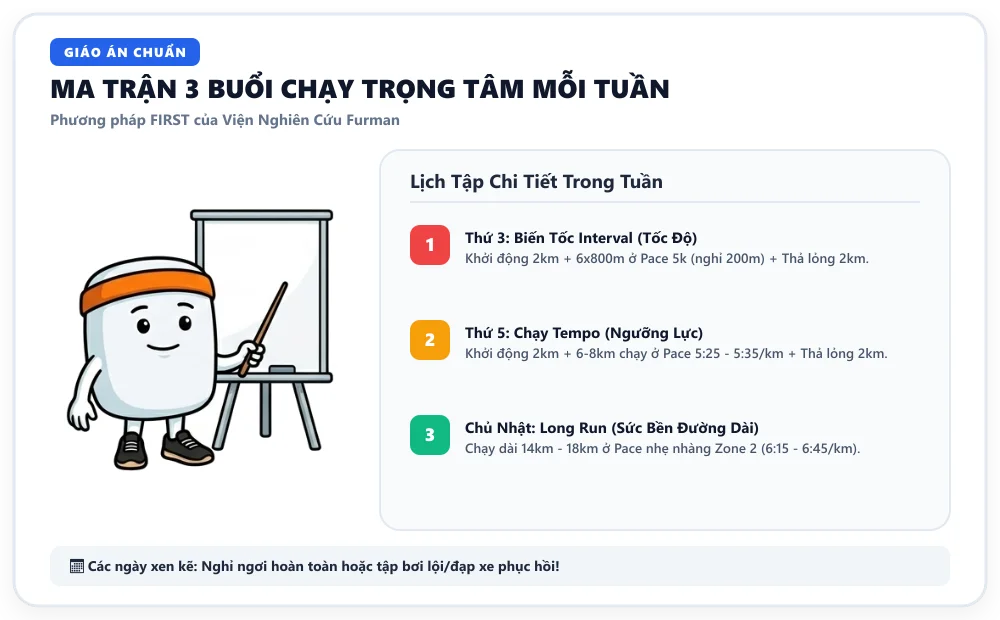
┌───────────┬──────────────────────────────────────────┬──────────────┐
│ DAY       │ SESSION                                  │ DURATION     │
├───────────┼──────────────────────────────────────────┼──────────────┤
│ Monday    │ FULL REST (Foam Rolling)                 │ 0 min        │
│ Tuesday   │ KEY RUN 1: Intervals (Speed)             │ 45 - 50 min  │
│ Wednesday │ CROSS-TRAINING: Easy Cycle + Core        │ 40 min       │
│ Thursday  │ KEY RUN 2: Tempo / Threshold             │ 45 - 55 min  │
│ Friday    │ FULL REST (Muscle Recovery)              │ 0 min        │
│ Saturday  │ CROSS-TRAINING: Swim / Yoga              │ 30 - 40 min  │
│ Sunday    │ KEY RUN 3: Long Run (Endurance)          │ 75 - 110 min │
└───────────┴──────────────────────────────────────────┴──────────────┘
💡 Pro Tip: Do your Tuesday and Thursday runs first thing in the morning (5:15 – 6:15 AM). This clears your mind and ensures that unexpected meetings don’t ruin your training.
3. 10-Week Training Cycle: From Base to Finish Line
Weeks 1-3: BASE ➔ Weeks 4-6: BUILD ➔ Weeks 7-8: PEAK ➔ Weeks 9-10: TAPER- Phase 1 (Weeks 1 – 3) - Base: Introduce speed with short intervals and build mileage with 12km–14km long runs.
- Phase 2 (Weeks 4 – 6) - Build: Extend intervals to 1000m–1200m, Tempo runs to 6km–7km, and long runs to 15km–16km.
- Phase 3 (Weeks 7 – 8) - Peak: Highest weekly volume (32–35km). The 18km long run with a fast finish simulates race day pressure.
- Phase 4 (Weeks 9 – 10) - Taper: Reduce volume by 30% and 50% respectively, but maintain intensity to keep muscles glycogen-loaded and ready for race day.
4. 10-Week Sub-2 Half Marathon Schedule
| Week | Mon | Tue (Key 1: Interval) | Wed (Cross) | Thu (Key 2: Tempo) | Fri | Sat (Cross) | Sun (Key 3: Long Run) | Total km |
|---|---|---|---|---|---|---|---|---|
| 1 | Rest | 1.5k Wup + 8×400m (4:40) + 1.5k Cdown | Cycle + Core | 1.5k Wup + 5k Tempo (5:30) + 1.5k Cdown | Rest | Swim/Yoga | 12km Long Run (6:10) | ~26.2 km |
| 2 | Rest | 1.5k Wup + 5×800m (4:50) + 1.5k Cdown | Cycle + Core | 1.5k Wup + 6k Tempo (5:28) + 1.5k Cdown | Rest | Swim/Yoga | 13km Long Run (6:05) | ~29.0 km |
| … | … | … | … | … | … | … | … | … |
| 10 | Rest | 1.5k Wup + 4×400m (4:40) + 1.5k Cdown | Rest/Yoga | 4km Easy Run + Strides | Rest | Rest | 🏁 RACE DAY: SUB-2 (5:35-5:40 Pace) | ~32.7 km |
(Table truncated for brevity; follows the principles outlined above)
5. Sub-2 Pace Analysis & The “Negative Split” Strategy
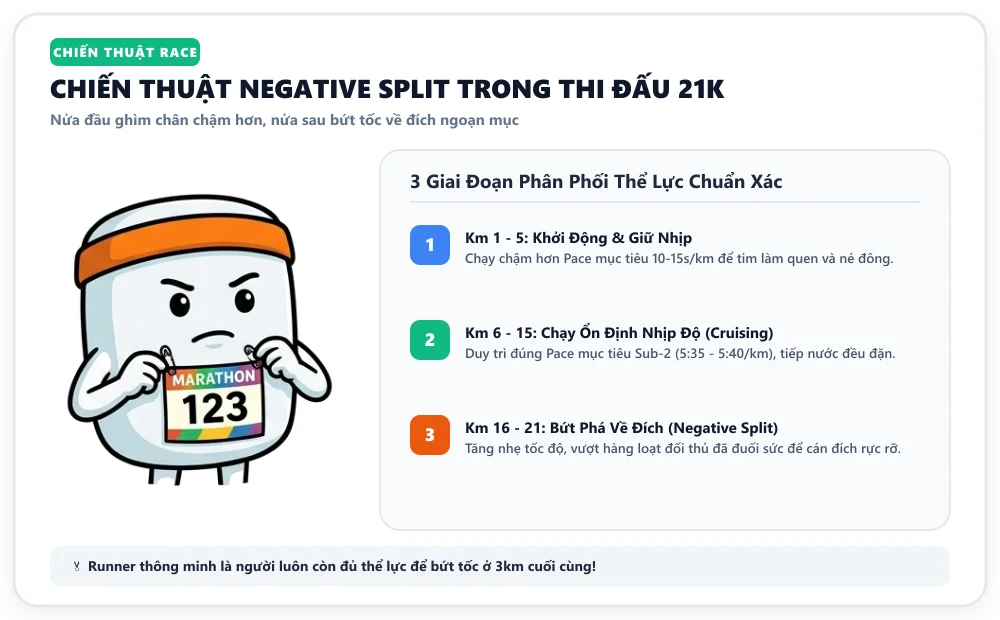
To run 21.0975km under 2:00:00, the theoretical average pace is 5:41 min/km. However, due to crowd congestion and water station stops, your GPS will likely show 21.3km–21.5km. Aim for a real-world pace of 5:35 – 5:38 min/km.
🏆 The 4-Phase “Negative Split” Strategy
- Km 1 – 5: 5:45 – 5:50 min/km. Start slow, conserve energy, don’t get caught up in the start-line adrenaline.
- Km 6 – 14: 5:35 – 5:38 min/km. Cruise control. Focus on 178–182 spm cadence and steady breathing.
- Km 15 – 19: 5:28 – 5:32 min/km. Increase intensity. Pick off the runners who started too fast.
- Km 20 – 21.1: < 5:15 min/km (All-out). Empty the tank to hit that 1:58:xx goal.
6. Essential Nutrition for Busy Runners
- Daily Split: 55-60% complex carbs, 20-25% lean protein, 15-20% healthy fats.
- D-3 to D-1: Increase complex carb intake. Add coconut water for natural electrolytes.
- Race Day Fueling:
- T-15min: 1 gel + 100ml water.
- Km 7-8: 1 gel + 150ml water.
- Km 14-15: 1 caffeine gel + 150ml water.
7. Survival Tips for the Busy Runner
[!WARNING] Golden Rule: Never double up! If you miss a Tuesday session, do not cram it into Wednesday. Skip it or adjust your week. Doubling up leads directly to injury.
[!TIP] Treadmill Use: If you must use a treadmill, set the incline to 1.0% – 1.5% to simulate outdoor air resistance and natural gait.
- Prep the night before: Lay out your kit. Wake up and go.
- Prioritize 7 hours of sleep: It’s better than any supplement.
- Foam roll: 10 minutes before bed prevents office-induced stiffness.
8. Conclusion: Your Sub-2 Medal Awaits!
Conquering the 21K Sub-2 doesn’t require sacrificing your career or family. It requires smart, physiology-driven training. With the FIRST method, you reclaim your time while pushing your performance boundaries.
Lace up, stay consistent, and enjoy the journey to your next PR!
