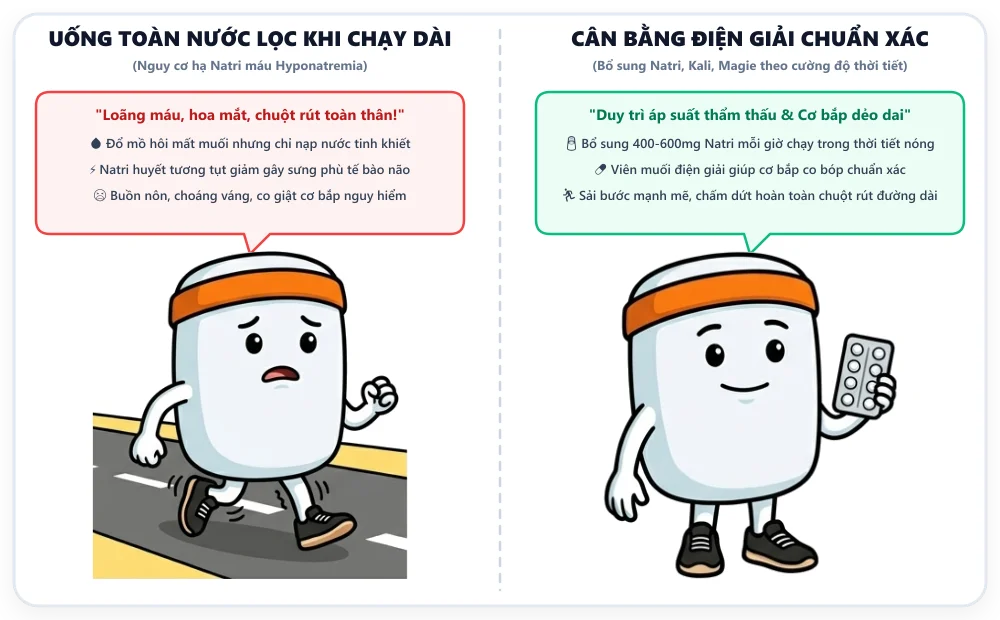
In the $32^\circ\text{C}$ heat and 85% humidity typical of Vietnam’s tropical climate, you can lose between 1.0 and 2.0 liters of sweat in just 60 minutes of running. Along with that massive fluid loss, thousands of milligrams of essential electrolytes—most notably Sodium ($Na^+$)—are flushed out of your bloodstream.
Many recreational runners stick to a simple habit: chugging plain bottled water whenever they feel thirsty. However, from an evidence-based sports medicine perspective, consuming excessive plain water during long runs can lead to Exercise-Associated Hyponatremia (EAH)—a leading cause of fainting, seizures, and acute cerebral edema at marathons worldwide.
Understanding the physiology of electrolytes and how to replenish them accurately will help you maintain optimal blood volume and keep your legs from “crashing” due to cramps.
Decoding the 4 Core Electrolytes Governing Running Performance
Electrolytes are electrically charged minerals dissolved in plasma and intracellular fluid, responsible for maintaining osmotic pressure and conducting nerve impulses:
[SODIUM - POTASSIUM PUMP (Na+/K+-ATPase PUMP)]
                    │
                    ▼
┌───────────────────┴───────────────────┐
│                                       │
▼                                       ▼
[SODIUM - Na+ (EXTRACELLULAR)]      [POTASSIUM - K+ (INTRACELLULAR)]
• Maintains blood plasma volume     • Repolarizes nerve cell membranes
• Triggers thirst mechanism         • Muscle relaxation & Heart rhythm
• Glucose co-transport (SGLT1)      • Stored with muscle glycogen
│                                       │
└───────────────────┬───────────────────┘
                    │
                    ▼
┌───────────────────┴───────────────────┐
│                                       │
▼                                       ▼
[MAGNESIUM - Mg2+ (REGULATOR)]      [CALCIUM - Ca2+ (CONTRACTION)]
• Stabilizes Mg-ATP energy complex  • Initiates Actin-Myosin contraction
• Prevents nerve over-stimulation   • Increases bone mineral density
Why Sodium is the “King of Electrolytes” for Runners
In human sweat, sodium concentration ranges from $20\text{ to }80\text{ mmol/L}$ (equivalent to $460\text{mg to }1,840\text{mg of sodium per liter of sweat}$). Meanwhile, the loss of potassium, magnesium, and calcium through sweat is negligible (<5%). Therefore, electrolyte replacement for runners is essentially a battle to replenish Sodium.
Are You a “Salty Sweater”?
Every body has a different density of salt-secreting channels in their sweat glands, dictated by genetics:
┌────────────────────────────────────────────────────────────────────────┐
│             SIGNS YOU ARE A "SALTY SWEATER"                            │
├────────────────────────────────────────────────────────────────────────┤
│ 1. White Salt Crust: After sweat dries, your running gear, heart rate   │
│    strap, and hat show visible white salt lines.                       │
│ 2. Gritty Skin: Rubbing your face or arms feels like there is sand     │
│    stuck to your skin.                                                 │
│ 3. Stinging Eyes: Sweat running into your eyes causes intense burning. │
│ 4. Salt Cravings: Intense desire for salty foods (broth, fries, pickles)│
│    immediately after finishing a run.                                  │
└────────────────────────────────────────────────────────────────────────┘
If you are a Salty Sweater, your sodium needs can be double that of an average person, reaching up to $800\text{mg to }1,000\text{mg of sodium/hour}$ when running in hot weather.
Guide: When to Use Plain Water vs. Electrolytes?
| Duration & Intensity | Environmental Conditions | Electrolyte Needs | Recommended Product |
|---|---|---|---|
| Under 45 mins | Cool, air-conditioned | Plain water only (Daily diet is sufficient) | Plain water |
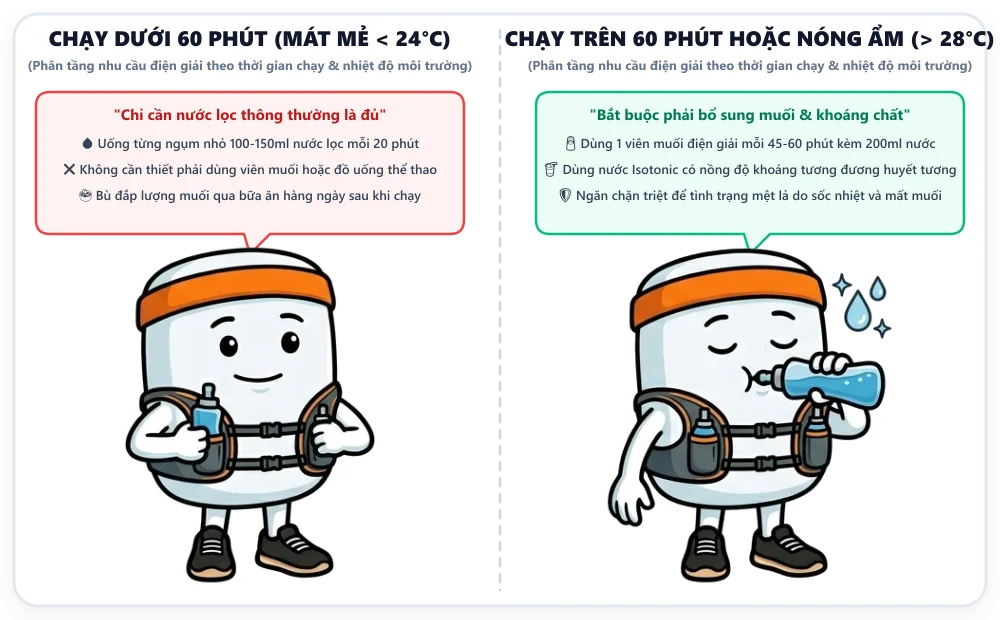
| 45 – 90 mins | Normal weather ($<26^\circ\text{C}$) | Light electrolyte replenishment | Isotonic drinks (Pocari, Oresol) |
| 90 – 180 mins | Hot & Humid ($>28^\circ\text{C}$) | MUST replace $300 - 600\text{mg}$ Sodium/hr | Electrolyte powder + 1 salt tab / 45m |
| Ultra Marathon / 42K | Harsh tropical climate | HIGH CONCENTRATION $600 - 1000\text{mg}$ Sodium/hr | Tailwind/Maurten + SaltStick tabs |
How to Use Salt Capsules (SaltStick / Electrolyte Caps)
Salt capsules are the optimal solution for runners because they are compact, portable, and provide precise dosing:
[PROPER SALTSTICK USAGE RULES]
├── Standard capsule: Contains ~215mg Sodium, 63mg Potassium, 11mg Magnesium, 22mg Calcium.
├── Dosage: Take 1 TO 2 CAPSULES EVERY 45 TO 60 MINUTES OF CONTINUOUS RUNNING.
├── TECHNIQUE: SWALLOW THE CAPSULE WHOLE WITH 100ML – 150ML OF WATER.
└── WARNING: DO NOT CHEW the capsule; the concentrated salt can irritate your stomach lining and cause immediate nausea!
Comparison of Electrolyte Sources for Runners
| Source | Sodium / Serving | Potassium / Serving | Pros | Cons |
|---|---|---|---|---|
| SaltStick (1 cap) | 215 mg | 63 mg | Compact, precise, zero calories | Requires water to swallow |
| Tailwind Endurance (1 pack) | 606 mg | 150 mg | Combines carbs (50g) and electrolytes | Needs a large bottle to dissolve |
| Standard Oresol (1 pack) | 350 mg – 500 mg | 100 mg – 150 mg | Very cheap, easy to find | Salty/medicinal taste |
| Fresh Coconut Water (300ml) | ~75 mg (Very low) | ~600 mg (Very high) | Natural, refreshing, simple sugars | Too little sodium for race hydration |
Frequently Asked Questions (FAQ)
1. Will taking multiple salt capsules raise my blood pressure?
In healthy individuals during high-intensity exercise, the sodium intake is used to replace sweat loss and maintain plasma volume, so it does not cause acute hypertension. However, if you have a history of cardiovascular disease, kidney issues, or chronic high blood pressure, consult your doctor before using high-dose sodium supplements.
2. Should I drink electrolyte water all day when not running?
Not necessary. A standard diet already provides $3,000\text{mg to }5,000\text{mg of sodium/day}$—well above basic resting needs. Drinking electrolytes on rest days only forces your kidneys to work harder to excrete the excess.
3. Can coconut water replace sports drinks during a Marathon?
Coconut water is rich in potassium but contains too little sodium (only 1/5 of sweat needs). If you only drink coconut water during a 42km race in the sun, you are still at risk of cramping and hyponatremia. Save coconut water for post-race recovery!
💧 Hydration & Nutrition Guide for Runners:
- Calculate your personalized water, electrolyte, and gel needs: Water & Energy Gel Calculator.
- Hydration formulas based on body weight: Hydration for Runners: The Precise Formula.
- Handling sudden muscle cramps: Preventing Cramps While Running: Causes & Solutions.
- How to use fast-absorbing gels without stomach pain: Energy Gels: How to Use Them Without Stomach Issues.
- Nutrition plan for race week: Marathon Race Week Nutrition.
Expert Tip: “Don’t let your salty sweat wash away your finish line dreams. Proactively replenish the sodium your body needs to turn every stride into sustained, explosive power!”
