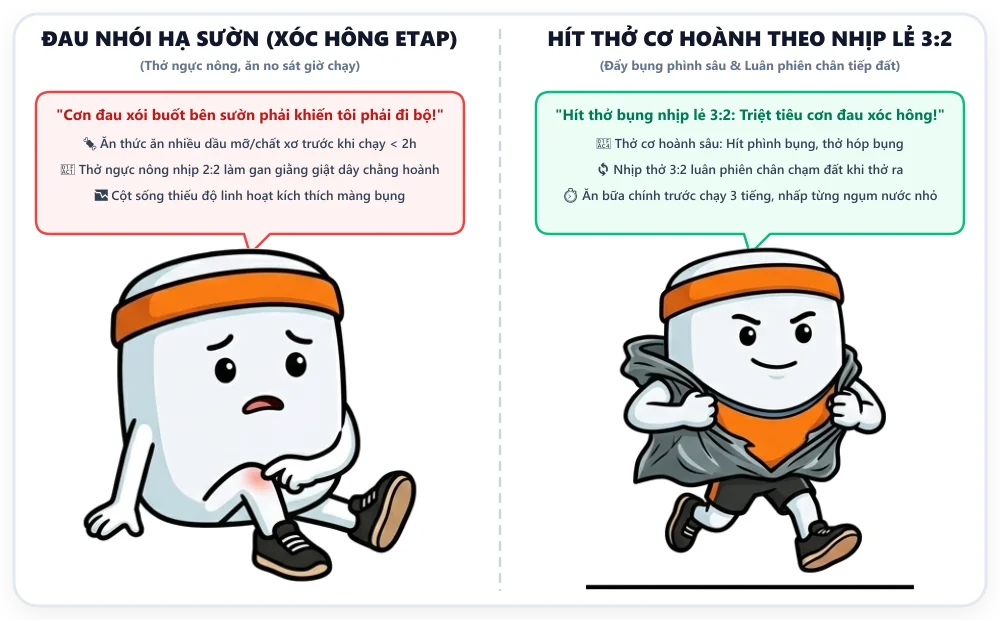
That sharp, stabbing sensation—like a knife plunged into your side just below the ribs—is a rite of passage for runners. In fact, 70% of runners have dealt with it at least once. It usually hits when you surge, spike your heart rate, or gulp down too much water at an aid station. Suddenly, every deep breath is impossible, and you’re left hunched over, walking in frustration.
In sports medicine, this is formally known as ETAP (Exercise-related Transient Abdominal Pain), or what we commonly call a side stitch.
While usually benign and temporary, ETAP can completely derail your race day strategy if you don’t understand the biology behind it and how to manage it on the fly.
The Biology of the Stitch: A Modern Medical View
Historically, theories about side stitches ranged from diaphragmatic ischemia to abdominal muscle cramps. However, leading research by Dr. Darren Morton and Robin Callister (University of Newcastle, Australia) has clarified the true pathogenesis of ETAP.
[Vertical Oscillation/Jouncing] + [Full Stomach]
                                 │
                                 ▼
         [Friction against the Parietal Peritoneum]
                                 │
                                 ▼
            [Phrenic Nerve Stimulation (C3-C5)]
                                 │
                                 ▼
┌────────────────────────────────┴────────────────────────────────┐
│                                                                 │
▼                                                                 ▼
[LOCALIZED STABBING PAIN]                         [REFERRED SHOULDER PAIN]
(Side stitch sensation)                            (Pain near the collarbone)
1. Parietal Peritoneal Irritation
The abdominal cavity is lined with two thin membranes:
- Visceral Peritoneum: Wraps around internal organs (liver, stomach, intestines).
- Parietal Peritoneum: Lines the inner abdominal wall and the underside of the diaphragm.
These membranes are separated by a thin layer of lubricating fluid. When you run with repetitive vertical oscillation—especially with a full stomach—that space is compressed. The lubrication disperses, causing the two membranes to rub directly against each other. Because the parietal peritoneum is loaded with sensory nerve endings, this friction triggers sharp, localized pain.
2. Visceral Ligament Stress
The liver is the heaviest internal organ (~1.5kg). Located on the right side, it is anchored to the diaphragm by suspensory ligaments.
- When you land on your right foot, the ground reaction force pulls the liver downward.
- If you are exhaling at that exact moment, the diaphragm is moving upward.
- These opposing forces tug on the liver’s ligaments, creating that classic right-sided stitch.
3. Referred Shoulder Pain
Many runners experience a sharp pain in the tip of the shoulder alongside a side stitch. This is “referred pain.” The Phrenic Nerve (originating at spinal roots C3-C5) supplies both the diaphragm and the skin of the shoulder. When the peritoneum under the diaphragm is irritated, the brain misinterprets the signal as shoulder pain.
4 Steps to Kill a Side Stitch Mid-Run
When a stitch hits during a run or race, don’t panic or stop completely. Follow this 4-step biomechanical protocol:
┌────────────────────────────────────────────────────────────────────────┐
│                      4-STEP SIDE STITCH RELIEF                         │
├────────────────────────────────────────────────────────────────────────┤
│ Step 1: Slow down by 15–20% (shift to an easy jog or walk)             │
│ Step 2: Switch to rhythmic breathing (3:2 pattern)                     │
│ Step 3: Press 3 fingers into the pain + Pursed-lip exhale & lean      │
│ Step 4: Raise the arm on the affected side & stretch the oblique      │
└────────────────────────────────────────────────────────────────────────┘
1. Buddle’s Cadence Breathing
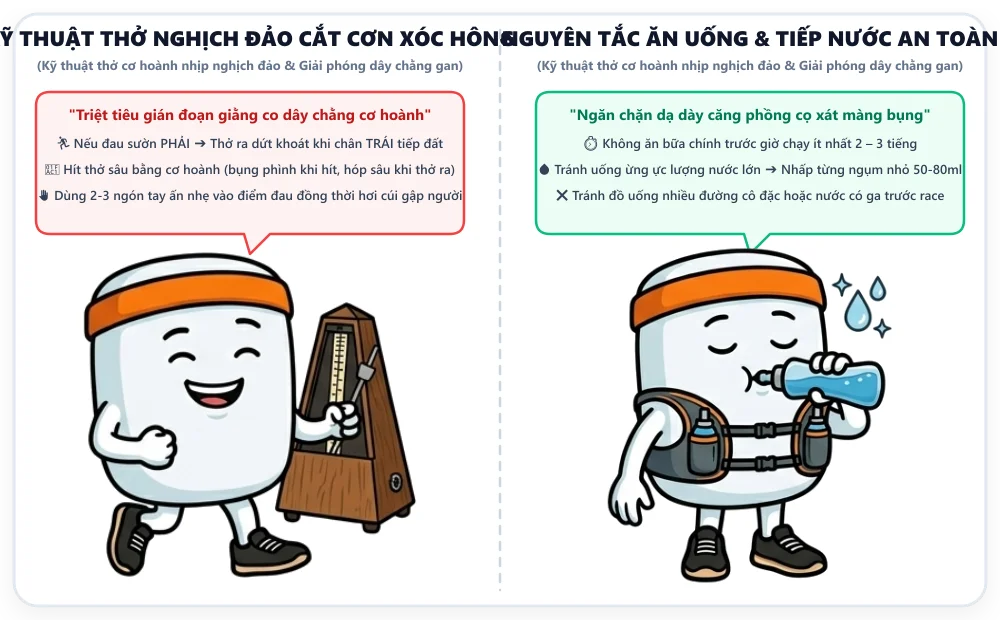
If you have a right-side stitch, time your exhales so they occur exactly when your LEFT FOOT hits the ground.
- Mechanism: When the left foot lands, the right-side liver is spared the direct impact, reducing ligament tension on the diaphragm.
- Recommended Pattern: Use a 3:2 rhythm (Inhale through the nose for 3 steps, exhale through the mouth for 2 steps). This odd-numbered rhythm forces you to switch your landing foot on every exhale, preventing unilateral mechanical loading.
2. Pursed-Lip Forced Exhalation
Inhale deeply through your diaphragm (expanding the belly), then purse your lips like you’re playing a flute. Exhale slowly but firmly using your core. This creates positive end-expiratory pressure, stabilizing the diaphragm and calming the peritoneal spasming.
3. Localized Pressure & Forward Flexion
Use your three middle fingers to press firmly into the painful spot under your ribs while leaning forward about 15 degrees during your exhale. This relaxes the abdominal wall and reduces friction between the peritoneal layers.
4. Oblique Stretches
Raise the arm on the side of the pain high above your head, then gently lean your torso toward the opposite side. Hold for 10–15 seconds to open the abdominal space and separate the peritoneal membranes.
Nutrition & Hydration Strategy
Research by Morton et al. shows that stomach contents are the biggest risk factor for ETAP:
| Nutritional Factor | Impact on ETAP | Best Practice |
|---|---|---|
| Hypertonic Drinks | Concentrated juices/sodas slow gastric emptying, leaving a heavy, sloshing stomach | Use isotonic drinks or electrolyte water with 4-8% carb concentration |
| Large bolus ingestion | A 300–500ml “water balloon” in your gut increases jouncing | Sip 60–100ml every 15–20 minutes throughout the run |
| Pre-run meal timing | Undigested food increases stomach volume | Eat a carb-rich, easy-to-digest meal at least 2.5–3 hours before running |
| Fat & Fiber | Slows digestion and causes gas/bloating | Avoid fried foods, high-fat dairy, and raw legumes before hard sessions |
Calculate your exact hydration and gel needs based on your body weight using our Gel & Electrolyte Calculator.
Physical Conditioning: Core Strength & Posture
Runners with thoracic kyphosis (rounded back) or lordosis (excessive lower back arch) are more prone to stitches because their rib cages compress the diaphragm.
[EXERCISE 1: DIAPHRAGMATIC BREATHING]
- Lie flat, one hand on chest, one on belly. Focus on expanding only the belly.
- 5 minutes every morning to optimize diaphragmatic mobility.

[EXERCISE 2: BIRD-DOG & PALLOF PRESS]
- Build deep core stability (Transversus Abdominis).
- Reduces excessive torso rotation and internal organ jouncing.

[EXERCISE 3: THORACIC EXTENSION]
- Use a foam roller on your upper back to open your chest and give your diaphragm room to operate.
Side Stitch (ETAP) vs. Serious Medical Conditions
Not all abdominal pain is a benign stitch. Know the difference:
| Condition | Pain Profile | Warning Signs |
|---|---|---|
| Side Stitch (ETAP) | Localized, sharp stabbing in the side | Disappears quickly after walking/stretching; no fever |
| Appendicitis | Starts near the navel, settles in the lower right quadrant | Increasing pain, fever, nausea, rebound tenderness |
| Ischemic Colitis | Intense cramping throughout the abdomen | Usually accompanied by diarrhea or blood in stool after long runs |
| Rib Stress Fracture | Localized on the rib bone, worsens with cough/deep breath | Sharp, pinpoint pain when touching the bone; persists for weeks |
Frequently Asked Questions (FAQ)
1. Why do beginners get stitches more often?
Beginners often lack the core and diaphragmatic conditioning of veteran runners and often rely on shallow “chest breathing.” As you accumulate miles, your diaphragm strengthens and your landing becomes smoother, typically reducing stitch frequency by 80%.
2. Does ice-cold water increase the risk?
Cold liquid in an empty stomach can trigger sudden gastric or intestinal smooth muscle spasms, slowing absorption and increasing membrane irritation. Aim for water at 15–20°C (room temperature or cool).
3. Should I DNF (Do Not Finish) if I get a stitch during a race?
Don’t drop out immediately. Calmly reduce your pace by 30–45 seconds per km, switch to the 3:2 breathing pattern (exhaling on the opposite foot), and apply manual pressure. In 90% of cases, the stitch will subside within 500–800 meters, and you can slowly ramp your pace back up.
Medical Note: If abdominal pain persists for hours after your run, or is accompanied by vomiting, high fever, or blood in your stool, seek medical attention immediately.
