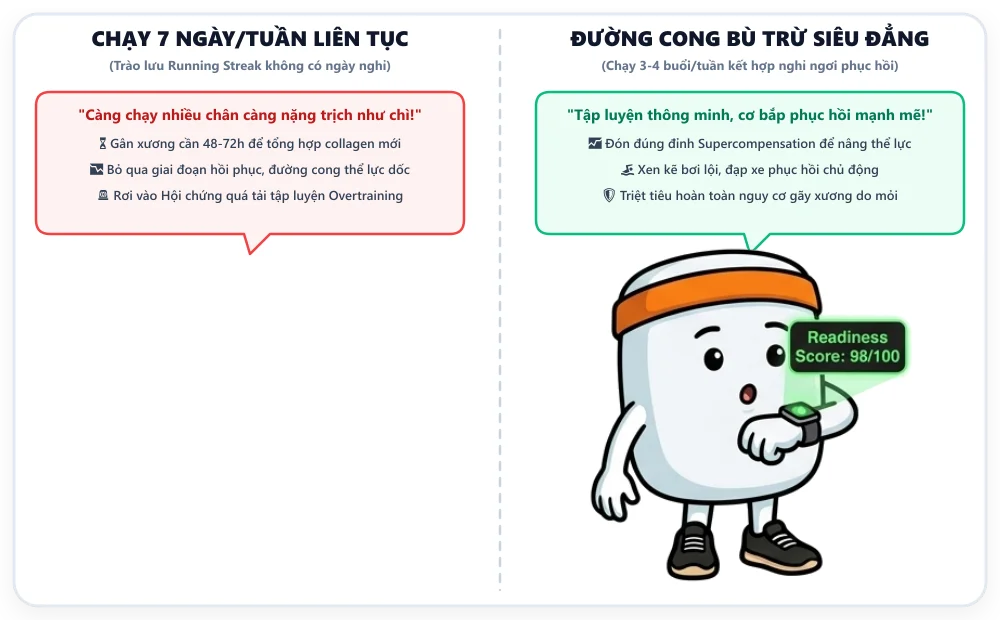
The “running streak” trend—committing to run every single day for 30, 100, or even 365 days—has exploded on platforms like Strava and Facebook. Many runners view daily mileage as the ultimate badge of discipline, believing that more miles inevitably lead to faster times.
However, from the perspective of exercise physiology and sports medicine, your body does not grow while running; it grows while recovering from the run.
Without necessary rest periods for cellular remodeling, running 7 days a week can quickly turn from a health-boosting habit into a double-edged sword, leading straight to Overtraining Syndrome (OTS).
       THE REAL GROWTH CYCLE OF THE BODY
  ┌─────────────────────────────────────────────────────────────┐
  │ 1. Run = STIMULUS & CELLULAR DESTRUCTION (Micro-trauma)    │
  │ 2. Rest & Nutrition = REPAIR & REBUILDING PHASE             │
  │ 3. Supercompensation = STRONGER THAN BEFORE                 │
  │ ──> Running non-stop = ACCUMULATED DAMAGE & COLLAPSE        │
  └─────────────────────────────────────────────────────────────┘
The Science of Supercompensation
Every training gain follows Hans Selye’s classic model of adaptation:
           THE SUPERCOMPENSATION MODEL
 Fitness ▲
         │                  [Supercompensation Peak]
         │                          ╭───────╮  <── The GOLDEN window
         │                         ╱         ╲     for your next workout!
 Baseline├── ─ ─ ─ ─ ─ ─ ─ ─ ─ ─ ─ ╱─ ─ ─ ─ ─ ─╲─ ─ ─ ─ ─ ─ ─ ─ ─ ─ ─
         │       ╲               ╱
         │        ╲             ╱ [Recovery & Synthesis]
         │         ╲           ╱
         │          ╰─────────╯ [Fatigue at the end of a run]
└──────────────────────────────────────────────────────────► Time- Stimulus Phase: A run disrupts homeostasis, causing micro-tears in muscle fibers and depleting glycogen stores.
- Recovery Phase: The body mobilizes protein, enzymes, and energy to repair the damage.
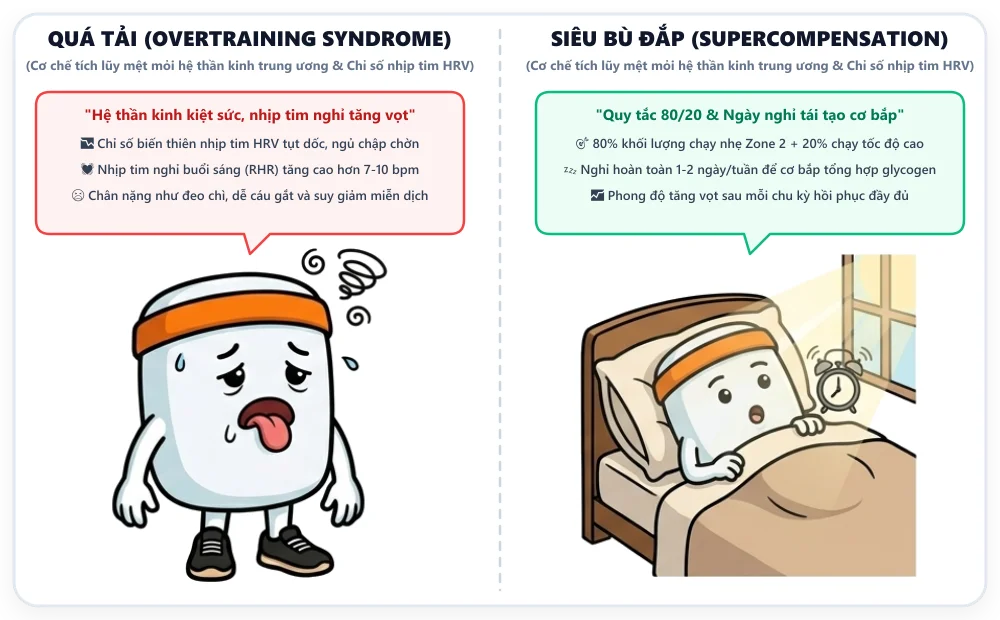
- Supercompensation Phase: The body doesn’t just return to baseline—it over-compensates, building thicker muscle fibers and expanding capillary networks to handle future stress.
- The Daily Running Trap: If you hit a hard workout while still in the fatigue trough, your fitness curve will trend downward, leading to non-functional overreaching.
3 Tiers of Biological Recovery: Why Bones and Tendons Lag Behind
Different systems in your body have vastly different metabolic and remodeling speeds:
            RECOVERY TIME BY TISSUE TYPE
 ┌─────────────────────────────────────────────────────────────────┐
 │ [1] Glycogen Stores (Muscle & Liver)  ──> 24 to 36 hours         │
 ├─────────────────────────────────────────────────────────────────┤
 │ [2] Skeletal Muscle Fibers            ──> 24 to 48 hours         │
 ├─────────────────────────────────────────────────────────────────┤
 │ [3] TENDONS, LIGAMENTS & BONE DENSITY ──> 48 TO 72 HOURS+        │
└─────────────────────────────────────────────────────────────────┘- The Dangerous Disconnect: After one day of rest, your muscles might feel fresh, but your Achilles tendons, IT bands, and shin bones—which have lower blood flow and slower collagen synthesis—are still vulnerable.
- Continuous daily loading turns these micro-injuries into chronic issues: chronic Achilles tendinopathy, plantar fasciitis, and stress fractures.
5 Signs of Overtraining Syndrome (OTS)
Are you training effectively or hitting a wall? Watch for these five medical warning signs:
            5 WARNING SIGNS OF OVERTRAINING
 ┌─────────────────────────────────────────────────────────────┐
 │ [1] Resting Heart Rate (RHR) spikes 5-10 bpm for days       │
 │ [2] HRV (RMSSD) consistently trending downward              │
 │ [3] Insomnia, middle-of-the-night waking, or anxiety        │
 │ [4] Weakened immunity (colds, mouth sores, inflammation)    │
 │ [5] Performance plateau or regression despite effort        │
└─────────────────────────────────────────────────────────────┘- Autonomic Heart Rate Dysfunction:
- Sympathetic OTS: Your morning resting heart rate (RHR) spikes by 5–10 bpm above your baseline.
- Parasympathetic OTS: Your heart rate won’t spike high enough during workouts, leaving your legs feeling like lead.
- Decreased Heart Rate Variability (HRV): If your Garmin/Coros/Apple Watch shows HRV in the red zone for 3–5 days, your nervous system is struggling.
- The “Open Window” Theory: Chronic elevated cortisol suppresses your immune system, making you prone to respiratory infections and sluggish recovery.
- Burnout: A total lack of motivation, feeling dread at the thought of lacing up, and irritability.
Recommended Training Frequency
                  OPTIMAL WEEKLY TRAINING FREQUENCY
 ┌──────────────────────────────────┬──────────────────────────────────┐
 │ BEGINNER                         │ INTERMEDIATE                     │
 │ - 3 runs / week (Every other day)│ - 3 to 4 runs / week             │
 │ - 4 rest/walking days            │ - 1-2 days Cross-train           │
 │ - Focus: Tendon adaptation       │ - 1-2 days complete rest         │
 ├──────────────────────────────────┴──────────────────────────────────┤
 │ SERIOUS MARATHONER: 4 - 5 RUNS + 1 FULL REST DAY                    │
└─────────────────────────────────────────────────────────────────────┘| Experience Level | Optimal Frequency | Rest / Cross-Training | Core Goal |
|---|---|---|---|
| Beginner (< 6 months) | 3 runs / week | 4 days (Rest/Walking) | Bone/tendon durability |
| Intermediate (5K - 21K) | 3 – 4 runs / week | 2 days X-train, 1 rest | Zone 2 aerobic base |
| Marathoner (Sub-3:30) | 4 – 5 runs / week | 1 day Gym, 1 full rest | Mileage & tissue repair |
| Elite Athlete | 6 – 7 runs / week | Massage, 10hr sleep | Performance peaking |
The Art of Active Recovery & Cross-Training
On your “rest days,” you don’t have to be a couch potato. Practice Active Recovery:
- Swimming: Water buoyancy eliminates 100% of impact forces on joints while promoting blood flow.
- Easy Cycling: Flushes oxygenated blood through the legs to clear metabolic waste without mechanical impact.
- Yoga & Foam Rolling: Releases trigger points and maintains joint mobility.
See related articles:
- Sleep and recovery: Running and Sleep
- Intensity control: Heart Rate Zones
- Recovery nutrition: Post-Run Nutrition
Frequently Asked Questions (FAQ)
1. Is a short 2km recovery run every day safe?
If you keep it truly easy on soft surfaces, the mechanical load is low. However, 95% of recreational runners still benefit more from 1–2 days of complete physical and neurological rest.
2. How long to recover from Overtraining Syndrome?
- Functional Overreaching: Needs 3 to 7 days of active rest and quality sleep.
- Chronic OTS: Requires 4 to 12 weeks of medical rest to reset endocrine and nervous system function.
3. Should I take painkillers to stick to my daily running schedule?
ABSOLUTELY NOT! Pain is the only biological signal your body has to warn you of tissue damage. Masking pain with medication to keep running will likely turn a minor micro-tear into a full-blown tendon rupture or stress fracture.
