
Fasted running—waking up at 5 a.m., downing a glass of water, and heading out on an empty stomach—is one of the most debated topics in endurance sports.
Some swear by it as the “golden ticket” for fat adaptation and accelerated fat loss. Conversely, sports nutritionists and medical experts often warn about muscle catabolism, hormonal disruption, and immune system fatigue.
What is the underlying biochemistry, and how can you use it effectively without turning a training session into a health-wrecking shock?
The Biochemistry of the Overnight Fast
To understand why the body reacts differently on an empty stomach, we must look at the biological homeostasis after an 8–10 hour fast:
[8–10 Hour Overnight Fast]
                │
                ▼
┌───────────────┴───────────────┐
│                               │
▼                               ▼
[Liver Glycogen Stores]        [Muscle Glycogen Stores]
├── Depleted 50%–60%           └── Remain almost 100% INTACT
│   (Maintaining blood glucose     (Muscles lack the glucose-6-phosphatase
│    for the brain)                 enzyme to release sugar into blood)
└── Ready to trigger
Lipolysis- Serum Insulin Levels Bottom Out: Without carbohydrate intake, insulin levels drop to their nadir. This triggers the enzyme Hormone-Sensitive Lipase (HSL), allowing adipocytes (fat cells) to break down triglycerides into free fatty acids (FFAs) that enter the bloodstream.
- AMPK and PGC-1α Signaling: The drop in liver glycogen stimulates AMPK (AMP-activated protein kinase), a key cellular energy sensor. This pathway activates PGC-1α, which drives mitochondrial biogenesis and increases the production of transport proteins (CD36, CPT-1) that shuttle fat into the muscles.
Metabolic Benefits: When Does Fasted Running Work?
In modern endurance sports science, the concept of “Train Low, Compete High” (Training with low glycogen, competing with full stores) is widely used by marathoners and ultra-runners:
[Zone 2 fasted run]
                 │
                 ▼
[Forcing muscle cells to use Free Fatty Acids as fuel]
                 │
                 ▼
[Boosting fat oxidation rates by 20% – 30%]
                 │
                 ▼
[Preserving precious glycogen for the final miles of race day]- Developing Metabolic Flexibility: The body learns to switch efficiently between burning sugar and fat, helping avoid “Hitting the Wall” during the latter stages of a marathon.
- Morning Efficiency: For busy runners, it allows for a workout without waiting 2–3 hours for a meal to digest.
The Dark Side: The Cost of Improper Execution
Abusing fasted runs for every session or performing them at high intensity can trigger harmful protective mechanisms:
┌────────────────────────────────────────────────────────────────────────┐
│             3 PHYSIOLOGICAL RISKS OF IMPROPER FASTED RUNNING           │
├────────────────────────────────────────────────────────────────────────┤
│ 1. Protein Catabolism & Muscle Loss                                    │
│    └── During high-intensity efforts (Zone 4–5) without glucose,       │
│        the body breaks down muscle fibers (especially Leucine)         │
│        via gluconeogenesis.                                            │
│                                                                        │
│ 2. Cortisol Spikes & Adrenal Overload                                  │
│    └── Fasting combined with heavy exercise triggers the HPA axis,     │
│        elevating Cortisol, which can disrupt sleep and cause long-term │
│        muscle atrophy.                                                 │
│                                                                        │
│ 3. Acute Hypoglycemia & Injury Risk                                    │
│    └── A sudden drop in brain glucose causes lightheadedness, shakiness,│
│        and loss of focus, leading to falls and fatigue-related injury. │
└────────────────────────────────────────────────────────────────────────┘
Comparison: Safe vs. Dangerous Fasted Running
| Criteria | SAFE & EFFECTIVE Protocol | DANGEROUS Scenario to Avoid |
|---|---|---|
| Heart Rate Zone | Zone 1 to Zone 2 (60% – 70% HRmax) | Zone 4 to Zone 5 (Anaerobic, sprints) |
| Workout Type | Recovery Run or Easy Run | Intervals, Tempo, Hill repeats |
| Max Duration | Under 45–60 minutes | Over 75–90 minutes |
| Pre-run Intake | 200–300ml water + pinch of electrolytes | Completely empty stomach, zero fluids |
| Post-run Nutrition | Protein + Carb meal within 45 minutes | Prolonged fasting (e.g., 20/4 IF) |
You can determine your safe heart rate ranges via our Heart Rate Zone Tool.
Gender Differences: Why Women Should Be Cautious
Sports physiology research (notably by Dr. Stacy Sims) indicates that women are more sensitive to fasted training than men:
[Women running on an empty stomach]
               │
               ▼
[Female brains are hyper-sensitive to energy availability]
               │
               ▼
[Triggering 'Low Energy Availability' (LEA) signals]
               │
               ▼
[GnRH suppression in the hypothalamus ➔ Lower Estrogen/Progesterone]
               │
               ▼
[Result: Menstrual irregularities, bone density loss, and thyroid disruption (RED-S)]
Recommendation for female runners: Before morning runs, consume at least a small amount of easy-to-absorb carbohydrates (half a banana, a spoonful of honey, or 150ml of coconut water) to signal to the brain that the body is not in a survival state.
Optimal Fasted Running Protocol
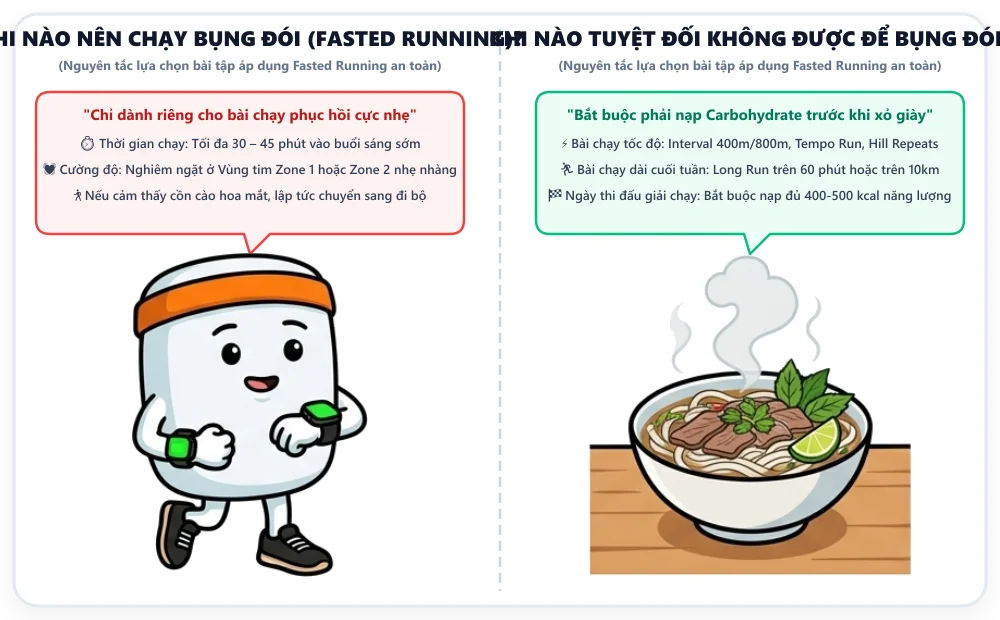
If you are a healthy male runner or wish to use fasted runs 1–2 times a week for metabolic adaptation, follow these 4 steps:
1. Warm Water & Black Coffee 20 Minutes Prior
Drink 250ml of warm water with a pinch of electrolytes. You can add a cup of plain black coffee (100–150mg of caffeine). Caffeine inhibits adenosine receptors, boosting FFA mobilization without spiking insulin.
2. Maintain Zone 2 Intensity
Monitor your heart rate strictly. If it drifts into Zone 3 or you feel breathless, slow down or walk to keep the body in the fat-oxidation zone.
3. The 45-Minute “Catabolic Window” Rule
Immediately after finishing, your muscles are in a highly receptive state (Anabolic Window). Replenish with:
- 20g – 30g High-quality Protein: (3 boiled eggs, 1 scoop of Whey, or 100g of chicken breast) to halt muscle protein breakdown.
- 40g – 60g Complex Carbohydrates: (Oats, whole-grain bread, sweet potato) to restore depleted liver glycogen.
Fasted Running FAQ
1. Do BCAA or EAA supplements break the “fast”?
Branched-chain amino acids (BCAA) may cause a minor insulin response, but they provide essential amino acids to protect muscle fibers. For a 50–60 minute session, 5g of BCAA/EAA is an excellent middle-ground to encourage fat burning while preserving lean muscle.
2. Does fasted running speed up lower belly fat loss?
Stubborn fat has more alpha-2 adrenergic receptors, making it harder to mobilize. While fasted runs increase blood flow to adipose tissue, fat loss is still governed by your Total Daily Energy Expenditure (TDEE). You cannot “spot reduce” fat.
3. Can I do a long weekend run (25km+) on an empty stomach?
ABSOLUTELY NOT. Long runs over 90 minutes require significant energy to protect the central nervous system and maintain gait mechanics. Fasting during long runs leads to glycogen depletion, poor performance, and long-term immune suppression.
Medical Disclaimer: Those with diabetes using insulin/medication, or those with a history of severe peptic ulcers, should not practice fasted running without professional medical guidance.
