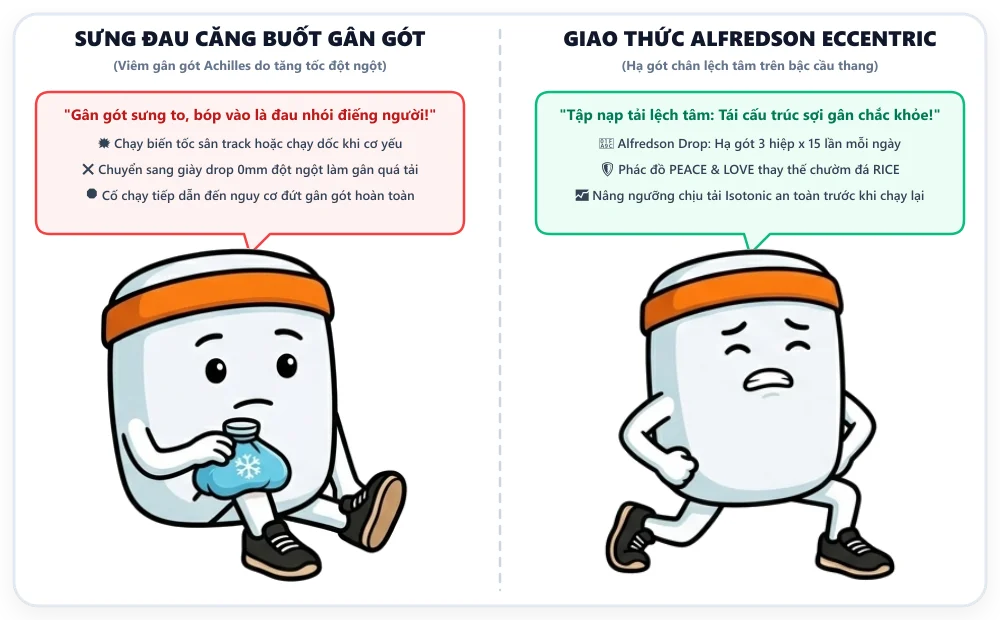
The Achilles tendon is the largest, thickest, and most powerful tendon in the human body. In every stride, it acts as a high-performance biological spring: it stretches to absorb impact forces upon landing and releases elastic energy equivalent to 6 to 8 times your body weight to propel you forward during the toe-off phase.
However, that superior elasticity comes with an anatomical weakness: the capillary network supplying blood to the Achilles is relatively sparse, particularly in the avascular zone located 2 to 6 cm above the heel bone. When training intensity or volume exceeds the tissue’s biological repair capacity, Achilles Tendinopathy develops.
Anatomy & The Tendinopathy Continuum
In modern sports medicine, the term “tendinitis” has largely been replaced by Tendinopathy, as biopsies of chronic tendons rarely show classical inflammatory cells (neutrophils), but rather a disordered structural degeneration of connective tissue.
[Load exceeding recovery capacity]
         │
         ▼
[Stage 1: Reactive Tendinopathy]
├── Tendon cells increase proteoglycan matrix to retain water for protection
└── Localized thickening, pain during sudden loading (fully reversible with deloading)
         │ (continuing to run through pain)
         ▼
[Stage 2: Tendon Dysrepair]
├── Type I collagen matrix breaks down and becomes disorganized
└── Abnormal neovascularization & associated nerve fiber growth
         │ (no intervention)
         ▼
[Stage 3: Degenerative Tendinopathy]
├── Areas of fiber necrosis and programmed cell death (apoptosis)
└── High risk of partial or complete tendon rupture during explosive movement
Classification: Mid-portion vs. Insertional
Identifying the exact location of the injury is crucial for selecting the right exercises, as using the wrong variation can aggravate the condition.
| Classification Criteria | Mid-portion Tendinopathy | Insertional Tendinopathy |
|---|---|---|
| Exact Location | 2 to 6 cm above the heel bone | Directly at the back of the heel bone, where the tendon attaches |
| Prevalence | Approximately 70%–75% of cases | Approximately 25%–30% of cases |
| Structural Factors | Excessive spring loading, over-pronation | Often associated with heel spurs or Haglund’s Deformity |
| Primary Pain Mechanism | Excessive tensile load | Compressive load as the tendon presses against the bone during dorsiflexion |
| Exercise Contraindications | None (deep heel drops are excellent) | NO deep heel drops (compresses the tendon against the bone) |
Early Warning Signs & Loading Assessment
Achilles tendinopathy has a unique clinical feature known as the “Warm-up Phenomenon.”
- Typical Symptoms: Runners feel stiff and sharp pain when taking the first steps out of bed or during the first 1–2 kilometers of a run. After the body warms up, the pain decreases or vanishes, leading runners to falsely believe the injury has healed. However, hours after stopping—or the next morning—the heel will feel significantly more swollen and painful.
- Palpation Test: Use your thumb and index finger to gently squeeze both sides of the Achilles. If you feel sharp pain or notice a thickened, lumpy tendon, it has entered the reactive or dysrepair stage.
If you are unsure whether your heel pain is caused by the Achilles or Plantar Fasciitis, use our Injury Diagnostic Tool to compare clinical symptoms.
Sports Medicine Recovery Protocol (4 Phases)
Tendons cannot heal through passive rest; they require precise Mechanical Loading to stimulate tenocytes to synthesize new Type I collagen and realign the fiber matrix.
┌─────────────────────────────────────────────────────────────┐
│               4-PHASE ACHILLES REHAB PROTOCOL               │
├─────────────────────────────────────────────────────────────┤
│  PHASE 1: Isometric Loading (Pain relief)                   │
│  ▼                                                          │
│  PHASE 2: Heavy Slow Resistance (HSR)                       │
│  ▼                                                          │
│  PHASE 3: Plyometrics & Spring Load                         │
│  ▼                                                          │
│  PHASE 4: Return to Run                                     │
└─────────────────────────────────────────────────────────────┘
Phase 1: Isometric Loading – Immediate Pain Relief
Isometrics do not change tendon length but trigger cortical inhibition, providing immediate pain relief lasting up to 45 minutes without stimulating an inflammatory response.
- Isometric Heel Raise Hold:
- Stand on flat ground, lift your heels to mid-range (60–70% of max height).
- Hold the position on the affected leg for 45 seconds.
- Rest 2 minutes between sets. Perform 5 sets daily.
- If bodyweight isn’t enough to load the tendon, use a 5–10kg dumbbell.
Phase 2: Heavy Slow Resistance (HSR)
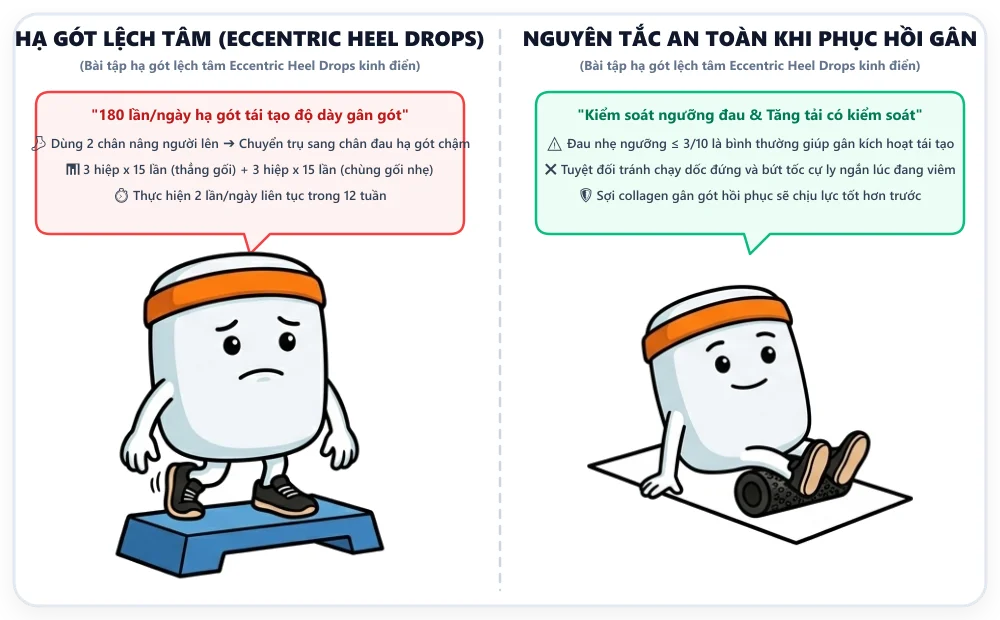
Research by Beyer et al. (2015, Am J Sports Med) proves that the HSR protocol yields collagen regeneration equivalent or superior to eccentric stretching (Alfredson Protocol), while being more time-efficient (3 sessions/week instead of 2x/day).
[HSR EXECUTION RULES FOR ACHILLES]
- Tempo: 3 seconds concentric ➔ 3 seconds eccentric. No bouncing.
- Frequency: 3 sessions/week (every other day).

1. Straight-Leg Calf Raise (Gastrocnemius focus):
   - Stand on a block (for mid-portion) or floor (for insertional).
   - Use dumbbells or a weighted vest (60–80% 1RM).
   - 3 sec up, 3 sec down.
   - Weeks 1-2: 3 sets x 15 reps (moderate load)
   - Weeks 3-5: 4 sets x 10-12 reps (heavy load)
   - Weeks 6-12: 4 sets x 6-8 reps (very heavy load)

2. Bent-Knee Calf Raise / Seated Calf Raise (Soleus focus):
   - Sit with knees at 90 degrees, place heavy weight on thighs near knees.
   - 3 sec up, 3 sec down.
   - The Soleus bears 6.5–8x body weight during running; this is the key to protecting your Achilles!
Phase 3: Plyometrics & Elastic Energy Storage
Once calf strength reaches at least 1.5x body weight and you have no pain during brisk walking:
- Pogo Hops: Land on the forefoot with stiff knees, using the natural spring of the ankle. Start with 3 sets x 30 reps.
- Single-Leg Box Hops: Hop onto a 10cm box and step down. 3 sets x 10 reps per leg.
Equipment & Running Form Adjustments
Alongside mechanical loading, adjusting your running gear can relieve pressure on the heel during recovery:
[STRIKE PATTERN & ANKLE]
- Over-striding with a Forefoot Strike: Increases Achilles load by 25–30%!
  ➔ Temporarily shift to a midfoot or rearfoot strike during recovery.

[HEEL-TO-TOE DROP]
- Zero-drop (0mm) or Low-drop (4mm) shoes: Maximizes Achilles stretch at toe-off.
  ➔ Use high-drop shoes (8mm–12mm) or insert a Heel Wedge (4–6mm) to reduce ankle dorsiflexion.
You can check the heel drop and foam characteristics of your shoes using our Running Shoe Comparison Tool.
Differential Diagnosis
| Condition | Core Pain Location | Distinguishing Features |
|---|---|---|
| Achilles Tendinopathy | 2–6 cm above heel or at insertion | Morning stiffness, sharp pain on palpation, pain increases with hopping |
| Retrocalcaneal Bursitis | Deep between the Achilles and heel bone | Swelling on both sides of the tendon; painful when squeezed from the sides |
| FHL Tendinopathy | Behind the inner ankle, down to the arch | Pain when curling the big toe against resistance |
| Complete Achilles Rupture | Loud “pop” like being kicked in the heel | Total loss of ability to rise on toes; positive Thompson test |
Return-to-Run Criteria
Before your first run, you must meet these 4 safety criteria:
- Single-leg Calf Raise: Minimum 25 reps with full range of motion on the injured side without pain.
- Single-leg Hop: 30 continuous hops on the injured leg with pain levels not exceeding 2/10.
- 24-Hour Rule: After any exercise or test run, pain the next morning must not be higher than the previous morning.
Frequently Asked Questions (FAQ)
1. Should I stretch my Achilles while it’s painful?
For Insertional Tendinopathy, deep stretching (dorsiflexion) is strictly contraindicated as it causes compression against the bone, worsening the injury. For mid-portion, heavy loading (HSR) is far more effective for collagen regeneration than passive stretching.
2. Does a Corticosteroid injection help me recover faster?
ABSOLUTELY NOT. Medical evidence confirms that steroid injections cause tendon cell necrosis, weaken collagen structure, and significantly increase the risk of a spontaneous tendon rupture.
3. How long does a full recovery take?
Tendon tissue has a metabolic rate 7 to 10 times slower than skeletal muscle due to limited blood supply. A collagen regeneration and adaptation cycle typically takes 12 to 24 weeks. Consistency with HSR is the only key to sustainable recovery.
Medical Note: This article is for educational purposes. If you hear a loud “pop” behind the heel accompanied by a total loss of force during a sprint, seek immediate medical attention to rule out an acute Achilles rupture.
