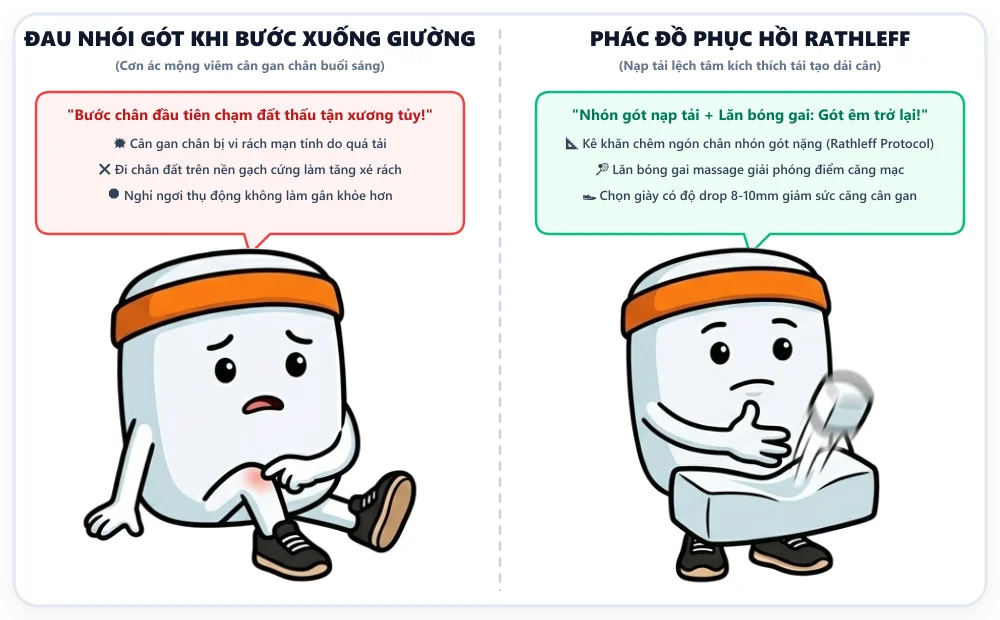
The sensation of that first step out of bed feeling like stepping on a nail—it’s a classic experience for thousands of runners dealing with Plantar Fasciitis.
Many mistake this for a simple bruise from stepping on a pebble or wearing stiff shoes. In reality, the plantar fascia is a thick, fan-shaped band of connective tissue running from your heel bone to the base of your toes. It acts like a bowstring, supporting your arch, absorbing shock, and transferring energy during every stride.
According to data from the American Academy of Sports Physical Therapy (AASPT), plantar fasciitis accounts for about 10% of all running-related injuries and is the leading cause of heel pain in distance runners.
Why Are Mornings a “Nightmare” for Your Feet?
During your 7–8 hours of sleep, your feet typically relax in a downward-pointing position (plantarflexion). In this state, the plantar fascia shortens, and your body begins repairing the micro-tears caused by the previous day’s training.
When your alarm goes off and you step out of bed:
- Your full body weight suddenly flattens the arch, violently stretching the shortened, stiffened tissue.
- Those freshly healed collagen fibers are torn again, stimulating pain receptors around the heel bone and triggering that sharp, stabbing sensation.
- After walking for 10–15 minutes, the tissue warms up and loosens, leading many runners to mistakenly think, “It’s better now; I can run again this afternoon.”
The Windlass Mechanism & Root Causes of Overload
To understand why the fascia gets damaged, look at the Windlass Mechanism: When you push off, your toes dorsiflex, tightening the plantar fascia around the metatarsal heads, which automatically raises the arch and turns your foot into a rigid lever for propulsion.
This structure becomes severely overloaded due to these factors:
1. Tight Calves (Gastrocnemius & Soleus)
When calves are tight, ankle dorsiflexion is limited. To complete your stride, the foot is forced to collapse the arch prematurely, doubling the stress on the heel attachment point.
2. Sudden Changes in Volume or Intensity
Increasing weekly mileage by over 15%, shifting to speed work on your forefoot too quickly, or tackling long hills before your foot muscles are adapted.
3. Foot Anatomy
- Overpronation: A flat arch puts the fascia under constant, extreme tension.
- High Arches: A rigid, high-arched foot lacks natural cushioning, dumping all impact forces into the heel and forefoot.

4. Worn-Out Shoes or Sudden Transition to Zero-Drop
Running in shoes with over 800km (500 miles) wears down the foam, or switching abruptly from a 10mm drop to zero-drop footwear without a 6–8 week transition period.
If you are unsure about your heel pain, use our quick self-assessment tool: Injury Diagnosis Tool.
Differentiating: Plantar Fasciitis vs. Heel Spurs vs. Stress Fractures
Many runners panic when an X-ray shows a “heel spur,” thinking it’s stabbing them. Research shows many people have heel spurs with zero pain; the spur is often just a result of chronic tension causing calcium deposits at the attachment point.
| Criteria | Plantar Fasciitis (PF) | Heel Spur | Stress Fracture |
|---|---|---|---|
| Pain Location | Bottom of heel, towards the arch | Directly at the heel bone base | Sides of heel (pain when squeezed) |
| Peak Pain | First step in the morning, improves with movement | Dull ache after standing long | Worse with activity, hurts at rest |
| Testing | Tenderness at the medial heel; toe extension hurts | Visible on X-ray | Positive Calcaneal Squeeze Test |
| Recovery | 6 – 12 weeks | Surgery rarely needed | 8 – 16 weeks immobilization |
The Rathleff Protocol: The New Standard in Sports Medicine
Research by Dr. Michael Skovdal Rathleff, published in the Scandinavian Journal of Medicine & Science in Sports, proves that high-load strength training speeds up collagen repair and reduces pain significantly better than simple static stretching.
The Rathleff Protocol Routine
- Setup: Stand on the edge of a stair with the front half of your foot. Place a rolled-up towel under your toes to keep them in maximum dorsiflexion (activating the Windlass mechanism).
- Concentric Phase: Use your injured foot to raise your heel as high as possible over 3 seconds.
- Isometric Phase: Hold the peak position for 2 seconds.
- Eccentric Phase: Lower the heel below the stair level in a controlled 3 seconds.
- Load Progression:
- Weeks 1–2: 3 sets of 12 reps (body weight), every other day.
- Weeks 3–4: 4 sets of 10 reps (add a backpack with 2–5kg).
- Weeks 5–8: 4 sets of 8 reps (add more weight as pain subsides).
4 Home Therapy Exercises
1. Frozen Bottle Roll
- Roll a frozen water bottle under your arch for 5–7 minutes to combine myofascial release with cold therapy for inflammation.
2. Dual Calf Stretch
- Gastrocnemius: Stand facing a wall, injured leg back, knee straight. Hold for 30s x 3 sets.
- Soleus: Same as above, but slightly bend the rear knee 20 degrees. Hold for 30s x 3 sets.
3. Manual Fascia Stretch
- Sit with your injured foot on the opposite knee. Pull your toes back manually to expose the fascia and massage along the band for 2–3 minutes before getting out of bed.
4. Short Foot & Towel Scrunches
- Use your toes to scrunch a towel toward your heel. This strengthens intrinsic foot muscles, offloading the fascia.
Footwear & Orthotics During Recovery
- Avoid barefoot walking on hard surfaces: Use cushioned, arch-supporting recovery slides (like OOFOS or Hoka Ora) even inside your home.
- Choose 8mm–10mm drop shoes: Avoid zero-drop or overly flexible shoes during the acute phase.
- Orthotic Insoles: If you have severe flat feet, semi-rigid arch supports can reduce stress on the heel insertion point by 25%–30%.
Return to Running: The Pain Scale Rule
You don’t have to wait for 100% pain-free status, but follow the VAS Pain Scale (0–10):
- Pain during the run must not exceed 3/10.
- Morning pain the next day must not be worse than the previous day.
- Use a Run-Walk strategy: 1 min run, 1 min walk, for 10 cycles on flat surfaces. Avoid deep sand or steep inclines.
FAQ
Should I get a Cortisone injection?
It helps with immediate pain for 2–4 weeks, but long-term studies show it can cause atrophy of the heel’s fat pad and increases the risk of a full plantar fascia rupture by 3x. Use as a last resort.
Are night splints effective?
Yes. They keep the foot at 90 degrees all night, preventing the fascia from shortening while you sleep. Many runners report a 70% reduction in morning pain.
How long until I’m fully recovered?
With the Rathleff Protocol and proper training management, about 80% of runners recover within 8 to 12 weeks. If pain persists beyond 6 months, see a doctor for an MRI to check for chronic Plantar Fasciosis or consider Shockwave Therapy.
🏥 Related Diagnosis & Injury Links:
- Evaluate your heel pain: Injury Diagnosis Tool.
- Achilles Tendonitis: Treatment Guide.
- Shin Splints: Identification & Recovery.
- Runner’s Knee: Managing Knee Pain.
- Warm-up & Flexibility: 10-Minute Science-Based Stretching.
Medical Disclaimer: This content is based on recommendations from the AASPT, the Scandinavian Journal of Medicine & Science in Sports, and the Mayo Clinic. It does not replace professional medical diagnosis or treatment.
