When you first step into the world of running, it can feel like wandering through a maze of acronyms and jargon: “What’s your Pace today?”, “Hit an 180 Cadence yet?”, “Did you bag a new PR at the HM?”…
To help you seamlessly integrate into the running community and fully understand the metrics on your sports watch, Thích Chạy Bộ has put together this essential, easy-to-understand running glossary.
1. Performance & Metrics Terminology
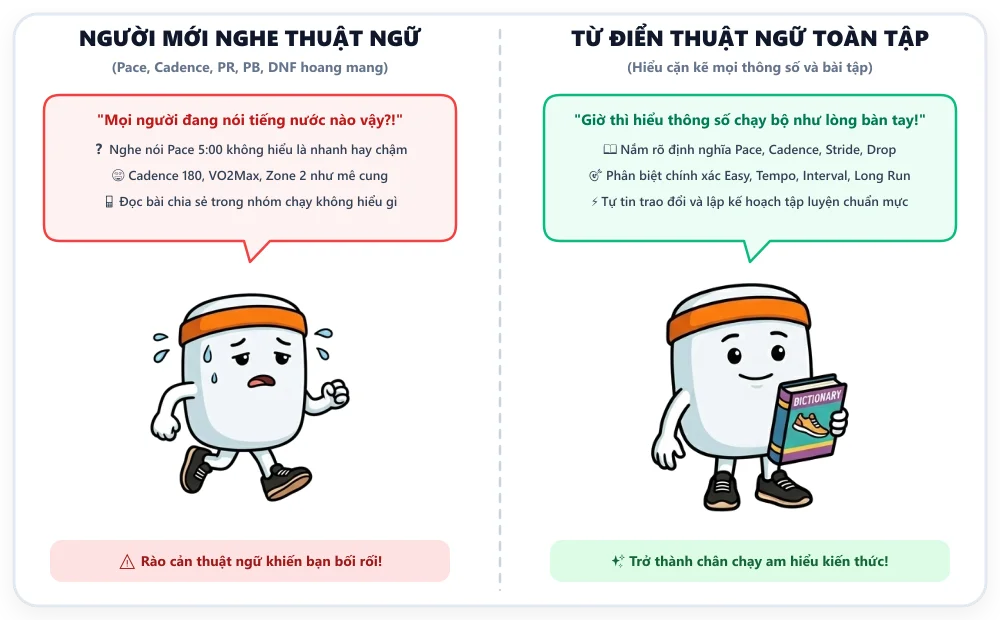
- Pace: The time it takes you to complete 1 kilometer (or 1 mile). Example: Pace 5:30 means it takes you 5 minutes and 30 seconds to run a single kilometer.
- Cadence: The total number of steps you take per minute (SPM - Steps Per Minute). The gold standard recommendation is 170 – 180 steps per minute, which helps reduce the impact shock on your knee joints.
- Stride Length: The distance between two consecutive footstrikes. For runners of average height (like myself at 1.65m and 57kg), increasing your Cadence is much more efficient and safer than trying to overreach with an excessively long stride (Overstriding).
- Heart Rate Zones: Cardio intensity divided into 5 zones—from Zone 1 (Recovery), Zone 2 (Aerobic base building), Zone 3 (Endurance focus), and Zone 4 (Lactic Threshold) to Zone 5 (Max VO2Max).
- VO2Max: The peak measurement of your cardiorespiratory fitness. The higher your VO2Max score, the more sustainably you can maintain faster speeds.
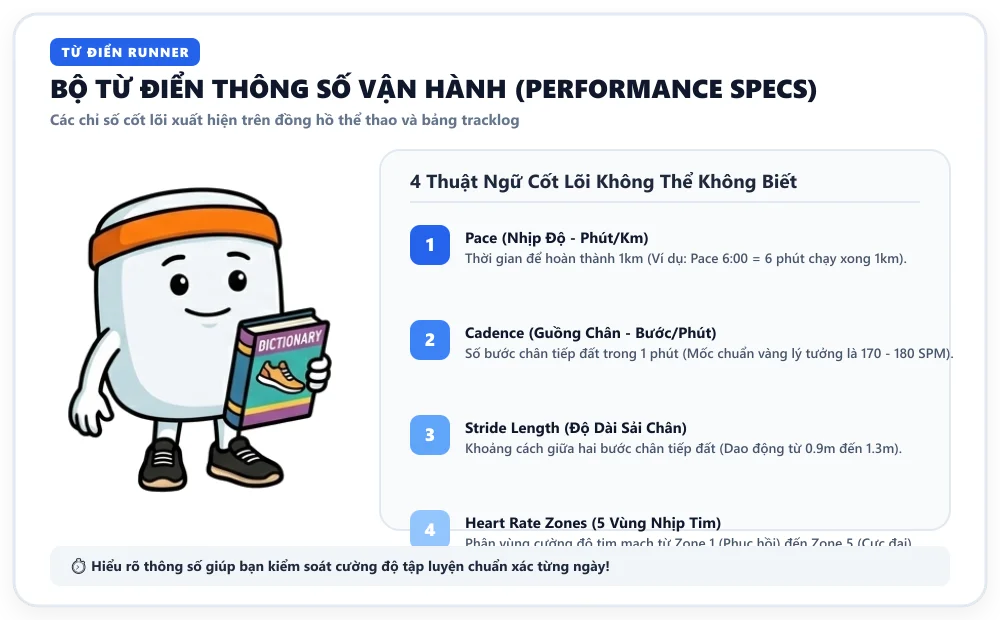
- PR / PB (Personal Record / Personal Best): Your fastest recorded finishing time for a specific distance (5K, 10K, 21K, 42K).
💡 Pace Calculation Tip: You can quickly convert times and pace ranges for any distance using the Thích Chạy Bộ Pace Calculator.
2. Training & Workout Terminology
- Easy Run: Makes up 70–80% of your total weekly training volume. You run at a Zone 2 heart rate while maintaining a conversational pace.
- Long Run: A weekend staple designed to build aerobic endurance and mental toughness for Half Marathons and Full Marathons.
- Tempo Run: Running at a comfortably hard, relatively fast pace (sustainable for 20–40 minutes) designed to raise your muscles’ tolerance for lactic acid accumulation.
- Interval Training: High-intensity speed repeats interspersed with walking or slow jogging recoveries (Example: 6 x 800m).
- Fartlek: Swedish for “speed play,” this is unstructured speedwork based on feel and terrain without being locked into fixed intervals.
- Recovery Run: A very slow, short run (3–5km) the day after a hard session that promotes blood flow, helps clear lactic acid, and repairs muscle fibers.
3. Race & Event Terminology
- HM (Half Marathon): The international standard half marathon distance of 21.0975 km.
- FM (Full Marathon): The international standard marathon distance of 42.195 km.
- Ultra Marathon: Any long-distance running event that exceeds 42.195km (50km, 70km, 100km, 160km).
- BIB: The runner’s identification number printed on a hard card worn on the chest during races.
- Chip Time (Net Time): The actual elapsed time from the exact moment your foot crosses the starting mat to when you cross the finish line mat.
- Gun Time: The official race time measured from the starter’s gun until you cross the finish line.
- DNF (Did Not Finish): Failing to complete the race due to injury or missing a Cut-Off Time (COT).
- DNS (Did Not Start): Registering for a race but failing to show up at the starting line.
- Pacer: A runner wearing balloons or a flag who guides a group of runners to the finish line in a target time (Sub-2, Sub-4, etc.).
4. Shoes & Gear Terminology
- Stack Height: The thickness of the midsole foam from the ground up to the heel and forefoot.
- Heel-to-Toe Drop: The height difference between the heel and the forefoot of a running shoe (ranging from 0mm to 10-12mm).
- Midsole: The heart of the running shoe, packed with foam technology (EVA, TPU, PEBA, Supercritical Foam) that provides impact absorption and energy return.
- Carbon Plate: A curved carbon fiber plate embedded within the midsole foam to act as a springboard, maximizing propulsion during fast-paced races and workouts.
- Overpronation: The excessive inward rolling of the ankle upon landing, which typically requires Stability Shoes featuring a supportive medial post.
💡 Explore Gear Specs: Compare construction details, stack heights, and foam technologies of top shoe models at the Thích Chạy Bộ Shoe Compare Tool.
5. Conclusion
Mastering these basic running terms not only helps you follow your training plan more effectively but also deepens your understanding of what your body is telling you with every single kilometer. Go ahead and apply these insights to your daily runs with confidence!
🔗 Related Articles & Useful Tools:
- Master your heart rate zones: What Is Zone 2 Running? The Guide to Slow Down to Speed Up.
- Combined training methods: Jeff Galloway’s Run-Walk Method.
- Calculate paces and target finish times with the Pace & Running Metrics Calculator.
