In the running community, we often see a familiar yet paradoxical image: Runners spend $200–$300 on top-tier carbon-plated super shoes like the Nike Vaporfly 3, Alphafly 3, or Adidas Adios Pro 4, only to pair them with cheap, flimsy cotton socks bought at a local market.
This oversight often comes at a high price. By the 15km mark of a Half Marathon or the 28km mark of a Full Marathon, the temperature inside your shoe spikes, sweat pools, and every footstrike turns into a burning friction nightmare. Blisters bloom across your arches, toe gaps, and heels, shattering your cadence and turning a 4-month PR quest into a painful survival crawl to the finish line.
While your shoes are the engine that drives you forward, your socks are your primary armor, providing a 1:1 interface with your skin. A pair of technical anti-blister socks ($10–$30) offers the highest ROI of any gear on the road. Let’s break down the biomechanics and why you need to toss those cotton socks before your next race.
1. The Anatomy of a Blister: The “Triangle of Destruction”
Physiologically, a friction blister isn’t just a surface abrasion. It is the direct result of Repetitive Shear Stress.
During a run, every kilometer involves 1,200–1,500 footstrikes. The constant sliding force between your foot bones, soft tissue, socks, and insoles causes the epidermis to separate from the dermis. This gap fills with serum, creating a painful, fluid-filled blister.
Blisters strike when three conditions align in the “Triangle of Destruction”:
┌─────────────────────────────────────────────────────────────┐
│               THE BLISTER "TRIANGLE OF DESTRUCTION"         │
├─────────────────────────────────────────────────────────────┤
│                                                             │
│                         FRICTION                            │
│                             ▲                               │
│                            / \                              │
│                           /   \                             │
│                          /     \                            │
│                         /       \                           │
│                        / BLISTER \                          │
│                       /           \                         │
│                      ▼             ▼                        │
│            MOISTURE ◄─────────────► HEAT                    │
│                                                             │
│ • Friction: Micro-sliding between skin, sock, and insole.   │
│ • Moisture: Sweat softens skin (maceration), increasing     │
│   shear vulnerability by 300%.                              │
│ • Heat: Friction-generated heat dilates blood vessels.      │
└─────────────────────────────────────────────────────────────┘- Friction: The surface slippage between layers during the transition from initial contact to toe-off.
- Moisture: A runner’s foot can produce 150ml–250ml of sweat per hour. This moisture causes maceration, weakening the outer layer of skin and making it highly susceptible to tearing.
- Heat: Increased friction coupled with ambient foot temperature triggers inflammation and heightens pain sensitivity.
Why 100% Cotton socks are a runner’s “Public Enemy #1”
Cotton is great for lounging, but it’s a disaster for endurance sports:
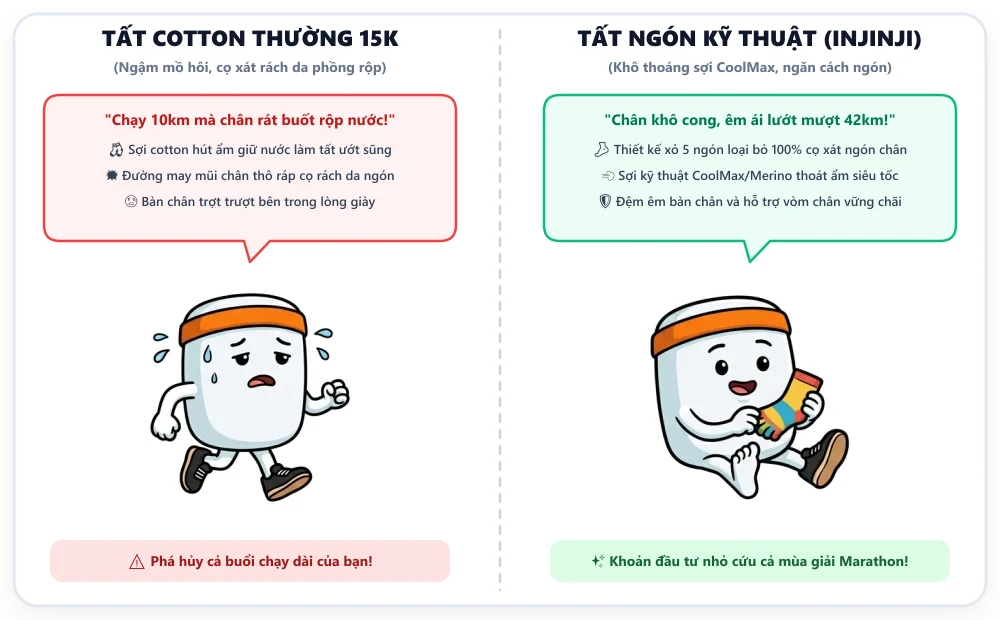
- Hydrophilic Trap: Cotton absorbs 20–27 times its weight in water. It acts like a wet sponge against your skin.
- Hardens and Bunches: When saturated, cotton loses its elasticity, becoming a stiff, abrasive fabric that creates “hot spots” through constant rubbing.
- Loses Shape: Cotton socks quickly stretch out, sliding down the heel or bunching up in the toe box, cutting off circulation and causing pressure points.
2. Anatomy of a Technical Running Sock
To neutralize the “Friction Triangle,” brands design socks as a Microclimate Engine using four key pillars:
1. Advanced Hydrophobic Yarns
- CoolMax (Multi-channel Polyester): Tetrachannel fibers use capillary action to pull sweat away from the skin for rapid evaporation.
- Dryarn & Polypropylene: The lightest fibers in the industry (density 0.91 g/cm³), which are naturally hydrophobic. They repel moisture rather than absorbing it, keeping your feet dry.
- Merino Wool (Smartwool/Darn Tough): Nature’s performance fiber. It is thermoregulating (cool in summer, warm in winter), antimicrobial, and keeps you comfortable even when soaked during an Ultra Trail run.
- Nylon & Elastane: Adds durability to high-wear areas and provides a 360-degree compression fit.
2. Arch Compression & Anatomical Fit
- High-density elastic bands lock the sock in place, preventing shifting or bunching during aggressive cornering or acceleration.
- Anatomical Left (L) and Right (R) fits match the natural contours of your toes.
3. Targeted Cushioning
- Strategic padding in high-impact zones (Heel and Ball of the Foot) without adding bulk, while using breathable mesh on the instep to dump excess heat.
4. Seamless Toe Box
- Technical socks use hand-linked or seamless closures to eliminate the bulky seam that typically sits across the toes, preventing “black toenails.”
3. The Great Debate: Toe Socks (Injinji) vs. Traditional Performance Socks

┌─────────────────────────────────────────────────────────────────────────┐
│                     TOE SOCKS VS. TRADITIONAL PERFORMANCE               │
├──────────────────────────────────┬──────────────────────────────────────┤
│ 🖐️ TOE SOCKS (Injinji, Aonijie)  │ 🧦 PERFORMANCE TAB (Feetures, Balega)│
├──────────────────────────────────┼──────────────────────────────────────┤
│ • Individual toe sleeves.        │ • Unified toe box design.            │
│ • Eliminates skin-on-skin rub.   │ • High-performance heel/arch lock.   │
│ • Encourages natural toe splay.  │ • Faster to put on/take off.         │
│ • King of Trail & Ultra events.  │ • Optimized for speed/road racing.   │
└──────────────────────────────────┴──────────────────────────────────────┘- Toe Socks: By wrapping each toe, they eliminate friction between digits entirely. Ideal for those with wide feet, overlapping toes, or ultra-distance trail runners.
- Traditional Performance: These rely on targeted compression and advanced weave structures. They are perfect for road runners who prefer a streamlined, secure “locked-in” feel.
4. Real-World Comparison Table
| Feature | Technical Running Socks | Standard Cotton Socks |
|---|---|---|
| Material | Hydrophobic (CoolMax, Merino) | 80–100% Cotton |
| Moisture Management | Rapid wicking / evaporation | Traps water (heavy) |
| Blister Risk | Low (<5%) | High (>85%) |
| Fit/Stability | Arch compression (L/R specific) | Loose / prone to slipping |
| Toe Seams | Seamless | Bulky, abrasive seams |
| Durability | High (maintains shape) | Low (shrinks/stretches) |
5. The 5-Step “Blister-Proof” Protocol for Race Day

- Trim your nails: Do this 2–3 days before the race. Avoid rounded corners; cut straight across.
- Apply Anti-Chafe: Use balms (Body Glide/Vaseline) on hotspots (heels, toe gaps, edges of feet).
- Use Kinesiology Tape: If you have known friction areas, apply tape as a preventative layer.
- Heel Lock Lacing: Use the extra eyelet on your running shoes to secure your heel and prevent sliding.
- Never New on Race Day: Train in your race-day socks at least 2–3 times during long runs (15km+).
6. Medical Care for Blisters
- Small, non-painful blisters: DO NOT pop. They are a natural, sterile barrier. Clean, cover, and protect.
- Painful, tense blisters: Clean the area with antiseptic. Use a sterile needle to pierce the edge of the blister. Drain gently, keep the skin flap intact, and apply an antibiotic ointment followed by a Hydrocolloid dressing (e.g., Compeed) for 3–5 days.
8. Closing Thoughts
Running is a sport of consistency. Don’t let hundreds of hours of training and expensive race entry fees go to waste because you didn’t invest in quality socks. Give your feet—the engine of your progress—the protection they deserve with a pair of proper technical socks today!
🔗 Related Resources:
- Faster Recovery: Compression Socks & Recovery Gear
- Foot Protection: Beginner’s Guide to Choosing Running Shoes
- Sizing Tools: Running Shoe Size Conversion Chart
