Music has long been recognized by sports scientists as a “legal ergogenic aid.” A playlist with a tempo of 160–180 BPM not only helps synchronize your cadence and stabilize your Zone 2 heart rate, but it also tricks the brain, helping you push through the fatigue of long runs (20km–30km) in brutal weather.
However, if you’ve ever worn noise-canceling in-ear headphones (like AirPods Pro or Sony WF-1000XM5) on the streets at 5 AM or 6 PM, you know the feeling: The music lifts you up, but danger is lurking right behind you.
Unexpected scooters swerving without signals, trucks honking, silent electric vehicles, or loose dogs darting out—blocking your ear canals effectively makes you a “voluntary deaf person” in complex traffic.
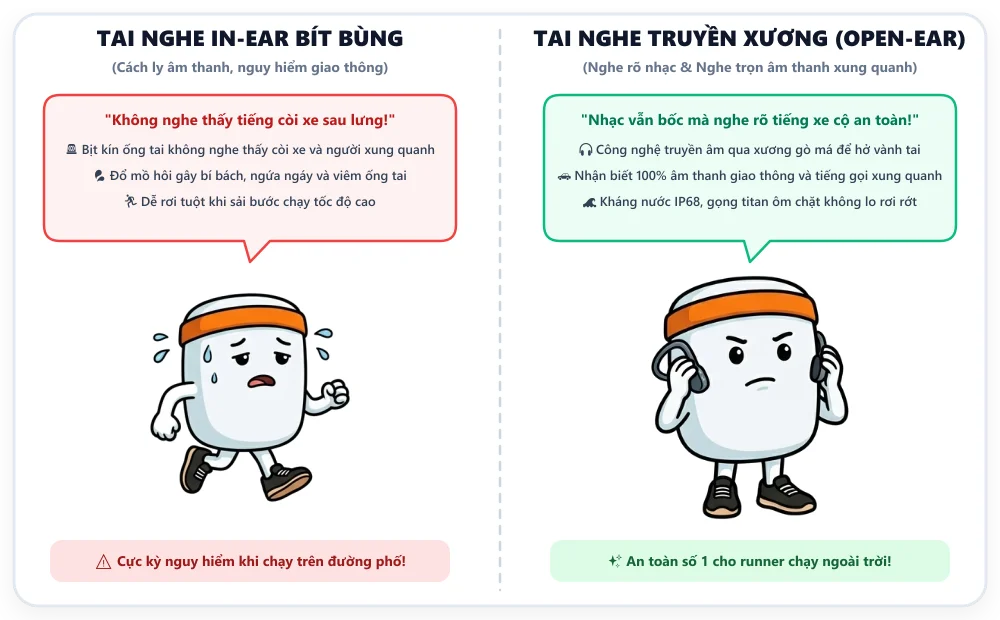
[!WARNING] Road Safety Alert: UK Athletics and many major marathons have implemented rules banning or restricting sealed in-ear headphones on open courses. “Open-ear” (Open-Ear / Bone Conduction) headphones are the only allowed exceptions to ensure athlete safety.
That’s why the sports audio market has exploded with two open-design categories: Bone Conduction and Open-Ear (Air Conduction). Both free up your ear canals, but their operating mechanisms, sound quality, and real-world feel are worlds apart. This article breaks down the physics, compares them across 5 critical criteria, and suggests the Top 5 sports headphones worth owning in 2026 for every type of runner.
1. Technical Principles: How Does Sound Reach Your Brain?
 Graphic: Mechanical vibrations travel through the cheekbone to the cochlea, leaving the ear canal open.
To understand why modern sports headphones can play music without entering the ear, we must look at human auditory anatomy.
                    ┌─────────────────────────────────────────────────────────┐
                    │               3 SOUND TRANSMISSION MECHANISMS          │
                    └─────────────────────────────────────────────────────────┘

1. TRADITIONAL (Sealed In-Ear / Earbuds):
   [ Driver ] ──(Air Pressure)──► [ Closed Canal ] ──► [ Eardrum ] ──► [ Ossicles ] ──► [ Cochlea ] ──► BRAIN
   *(Downsides: Blocks environmental sound, traps sweat, ear fatigue)*

2. BONE CONDUCTION:
   [ Transducer ] ──(Mechanical Vibration)──► [ Cheekbone / Skull ] ──(Bypass Eardrum)──► [ Cochlea ] ──► BRAIN
   *(Upsides: 100% open canal, total safety for traffic awareness)*

3. AIR CONDUCTION (Open-Ear):
   [ Large Driver ] ──(Directional Sound Beam)──► [ Open Canal ] ──► [ Eardrum ] ──► [ Cochlea ] ──► BRAIN
   *(Upsides: Richer bass, no cheek vibration, keeps canal naturally open)*
1.1. Bone Conduction
- Mechanism: Instead of a traditional diaphragm pushing air, bone conduction uses electromagnetic transducers pressed against the cheekbones. These create micro-vibrations that travel through the skull directly to the cochlea, bypassing the eardrum.
- Characteristics: Your ear canal is literally 100% open, allowing you to hear wind, traffic, and your own breathing clearly.
1.2. Open-Ear / Air Conduction
- Mechanism: Relies on traditional air transmission but uses enlarged drivers (14.2mm–18mm) positioned just outside the ear. Directional acoustics and anti-phase cancellation direct sound into the canal while minimizing leakage.
- Characteristics: No silicone plugs; you get a dynamic speaker experience while keeping the ear naturally ventilated.
2. Real-World Comparison: 5 Critical Runner Criteria
 Graphic: Titanium frame withstands rain and sprinting vibrations.
As a runner who has logged thousands of kilometers from road marathons to 70km trail ultras, I evaluate these based on 5 benchmarks:
┌─────────────────────────────────────────────────────────────────────────────────────────────┐
│                           5-CRITERIA HEAD-TO-HEAD COMPARISON                                │
├───────────────────────────────┬──────────────────────────────┬──────────────────────────────┤
│ CRITERIA                      │ BONE CONDUCTION              │ OPEN-EAR (AIR CONDUCTION)    │
├───────────────────────────────┼──────────────────────────────┼──────────────────────────────┤
│ 1. Situational Awareness      │ ⭐⭐⭐⭐⭐ (Perfect 10/10)      │ ⭐⭐⭐⭐☆ (Excellent 8.5/10)   │
│ 2. Bass Quality               │ ⭐⭐⭐☆☆ (Average 6.5/10)       │ ⭐⭐⭐⭐⭐ (Exceptional 9/10)   │
│ 3. Cheek Vibration Sensation  │ Present (>80% Volume)        │ None (Completely smooth)     │
│ 4. Fit Stability              │ ⭐⭐⭐⭐⭐ (Titanium Band 10/10) │ ⭐⭐⭐⭐☆ (Ear-hook 8.5/10)    │
│ 5. Waterproofing              │ IP67 - IP68 (Swim/Heavy rain)│ IPX4 - IPX5 (Splash proof)   │
└───────────────────────────────┴──────────────────────────────┴──────────────────────────────┘
Criterion 1: Situational Awareness
- Bone Conduction (Winner): Since sound travels through bone, your ears are truly free. You can listen to a podcast and still pinpoint a scooter overtaking you 15 meters away.
- Open-Ear (Very good): At moderate volumes (<70%), it’s great. However, at 85%–100% during interval sprints, the powerful output from the large dynamic drivers can partially mask ambient noise.
Criterion 2: Bass & Cheek Tickle
- Bass Response:
- Bone Conduction: Physics limits its sub-bass performance (20Hz – 60Hz). It excels in Mids and Highs—great for Podcasts and Acoustic tracks.
- Open-Ear: Large 16.2mm drivers plus bass-enhancement algorithms produce deep, punchy bass, making it superior for EDM and Hip-hop.
- Vibration: Bone conduction can cause a tickling sensation on the cheeks at high volumes. Open-ear avoids this entirely.
Criterion 3: Stability & Sweat
- Titanium Neckband (Bone): The clamping force is perfect. Whether you’re sprinting at a 3:30 pace or hopping over mud on a trail, it stays locked in place.
- Ear-hook TWS (Open-Ear): Very comfortable, with no pressure on the back of the head. However, some heavier models might feel slightly less secure in torrential rain or during extreme lateral head movements.
Criterion 4: IP Rating & Salt Sweat
- Bone Conduction: Often IP67/IP68. Sealed designs prevent sweat corrosion and some models are even fully submersible.
- Open-Ear: Usually IPX4/IPX5. Great for sweat and drizzle, but should not be submerged.
Criterion 5: The “Runner’s Combo”: Sunglasses + Hat + Headphones
- Open-Ear: The slim silicone hooks play nicely with sunglass arms.
- Bone Conduction: The neckband and sunglass arms can occasionally conflict.
[!TIP] Pro Tip: Put on the headphones first, then rest your sunglasses on top of the headphone frame for a secure, comfortable fit.
3. Top 5 Sports Headphones to Buy in 2026
1. Shokz OpenRun Pro 2 – The Hybrid King
- Tech: DualPitch™ Hybrid (Bone for Mids/Highs + Air for Bass)
- Battery: 12 hours playback
- Pros: Best-in-class sound; USB-C charging; lighter vibration.
- Cons: IP55 rating (don’t swim with it).
2. Shokz OpenFit – The Comfort Standard
- Tech: DirectPitch™ Air Conduction
- Pros: Ultra-light (8.3g); DolphinArc hooks are incredibly comfortable for 42km runs.
3. Oladance OWS Pro – The Audiophile Choice
- Tech: Dual 23x10mm drivers
- Pros: Massive 16-hour battery; 360-degree stereo soundstage.
4. Soundcore AeroFit Pro – Versatile Design
- Tech: 16.2mm Titanium driver
- Pros: Detachable neckband for gym-to-trail transition; punchy “BassUp” sound.
5. Mojawa HaptiFit Terra – The AI Trainer
- Tech: Bone conduction + PPG heart rate sensor + 32GB storage
- Pros: All-in-one; tracks HR and cadence without a phone; IP68.
5. Which One Fits Your “Running DNA”?
- Urban Road Runner: Prioritize safety. Go with Shokz OpenRun Pro 2.
- Ultra/Trail Runner: Need long battery and durability. Oladance OWS Pro or Mojawa HaptiFit Terra.
- Music Lover: Want big bass. Soundcore AeroFit Pro or Shokz OpenFit.
6. Final Thoughts: The 3 Golden Rules of Running Music
- 60/60 Rule: Don’t exceed 60% volume if running in traffic.
- Visual Scanning: Even with open ears, your eyes are your primary safety tool at intersections.
- Post-Run Maintenance: Wipe down sweat and salt after every run to extend device life.
Happy running, and enjoy the rhythm!
