You’ve decided to lace up your running shoes to drop some weight, shed fat, boost your heart health, and get in shape. You’re pumped, feeling invincible on that first day at the park. But just two or three runs later, the nightmare begins:
- Your knees start aching—a dull, throbbing pain that flares up every time you take the stairs.
- Your shins feel like they’re burning, with a piercing ache deep in the bone the moment your feet strike the pavement.
- Your ankles and arches feel stiff, making you walk with a limp the morning after a run.
Over 80% of heavier runners (75kg, 85kg to 90kg+) end up tossing their shoes into the back of the closet, quitting within the first two weeks due to injuries. Most blame themselves: “I’m too heavy for this, my body isn’t built for running, it’s just going to wreck my knees!”
[!NOTE] The Sports Science Truth: Running does not destroy your knees! The real culprit is the mismatch between the adaptation speed of your musculoskeletal system and your body weight, paired with poor landing technique that amplifies impact forces to a destructive level.
Let Thích Chạy Bộ help you decode biomechanical shock, master the “force-dissipation” landing technique, and follow an 8-week Run-Walk plan designed to get heavier runners through those first few miles safely and comfortably.
1. Biomechanics & Body Mass: The 400kg Knee Impact Problem
To protect your legs, you first need to understand the mechanical stress your body endures when you carry 75kg–85kg+ through every stride.
┌────────────────────────────────────────────────────────────────────────┐
│            GROUND REACTION FORCE (GRF) TABLE UPON LANDING              │
├────────────────────────────────────────────────────────────────────────┤
│  Walking             ➔ GRF = 1.0 – 1.5x Body Weight (BW)               │
│  Running (Flight Phase) ➔ GRF = 3.0 – 5.0x Body Weight (BW)            │
├────────────────────────────────────────────────────────────────────────┤
│  EXAMPLE FOR AN 80KG RUNNER:                                           │
│  • Impact per landing: 80kg x 3 - 5 = 240kg to 400kg of force!         │
│  • A 3km run (≈ 3,500 steps) ➔ Cumulative load: OVER 1,000 TONS        │
└────────────────────────────────────────────────────────────────────────┘
When you walk, at least one foot is always on the ground to distribute your weight. But when you switch to running, your body undergoes an aerial flight phase—both feet leave the ground. Upon landing, the Ground Reaction Force (GRF) spikes to 3 to 5 times your body weight.
[!WARNING] If you weigh 80kg, every time your foot strikes, your knees and cartilage absorb between 240kg and 400kg of compression. In a short 3km run (roughly 3,500 steps), your knees endure a cumulative load of over 1,000 tons of impact force!
The Adaptation Paradox: Heart & Lungs vs. Bones & Joints
Why do new runners usually get injured after 2–3 weeks rather than on day one?
- Cardiovascular system: Adapts quickly. After two weeks, your heart rate settles, breathing becomes easier, and you feel fitter—tempting you to run faster and longer.
- Musculoskeletal system (Tendons, ligaments, cartilage, periosteum): These are avascular tissues (with limited blood supply) that require 8 to 16 weeks for micro-adaptation and density increases.
When you let your “heart lead the way” while ignoring joint capacity, classic injuries like Runner’s Knee and Shin Splints (MTSS) will strike immediately.
💡 Coach’s Tip: Check your BMI, BMR, and target weight via our Health Calculator before starting your training program.
2. Landing Technique for Heavy Runners: “Breaking” the Braking Vector
Unlike lighter runners (50kg–60kg) who can get away with minor form errors, heavier runners must nail their biomechanics from day one to turn their muscles into a natural hydraulic shock-absorption system.
                  LANDING BIOMECHANICS COMPARISON

   [WRONG: OVERSTRIDING + LOCKED KNEE]        [RIGHT: MIDFOOT + SOFT KNEE]

              ( Knee LOCKED STRAIGHT )                  ( Knee BENT 15°-20° )
                   │                                         │
                 ┌─┴─┐                                     ┌─┴─┐
                 │ KNEE│ ◄── [ 400kg Impact Force ]        │ KNEE│ ◄── [ Quads act as shock ]
                 └─┬─┘                                     └─┬─┘
                 ┌─┴─┐                                     ┌─┴─┐
                 │HEEL │ ◄── [ Landing ahead of center ]   │MID│ ◄── [ Landing UNDER center ]
                 └───┘                                     └───┘
        ═══════════════════════                   ═══════════════════════
        HIGH Braking Force                        SMOOTH Transition
        Risk: Cartilage damage, Shin splints      Protects knees & tibia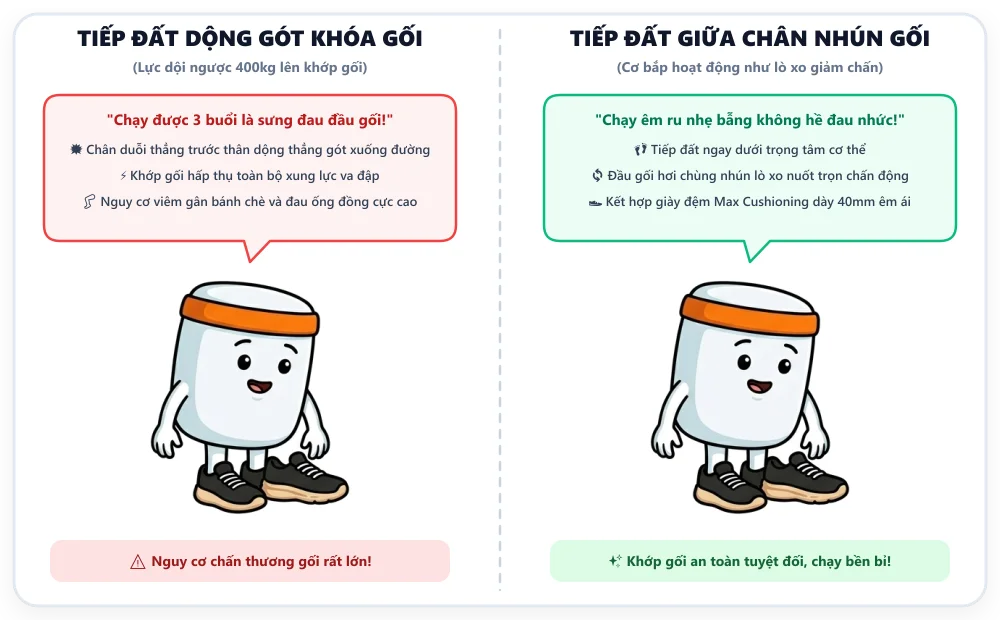
The Fatal Mistake: Overstriding & Locking the Knee
Many beginners make the mistake of reaching out with their lower legs to gain a “long stride.”
- When your foot lands far in front of your Center of Mass (COM), your heel slams into the ground while your knee is locked straight.
- This transforms the ground reaction force into a massive Braking Force. The entire 400kg impact isn’t absorbed by muscles but travels straight from heel ➔ tibia ➔ knee cartilage ➔ hip ➔ spine.
3 Golden Rules for Heavier Runners
1. Shorten Stride & Increase Cadence (165 – 175 spm)
- Low Cadence (145 – 155 spm): You bounce high (high Vertical Oscillation). Landing from a greater height spikes the impact on your knees, and your foot stays on the ground longer (Ground Contact Time - GCT).
- Ideal Cadence (165 – 175 spm): Quick, short steps that “glide” close to the ground (Vertical Oscillation < 6–7cm). Lifting your foot the moment it touches the ground reduces peak pressure on your knees by 25% – 30%.
2. Midfoot Landing Directly UNDER Your Center of Gravity
- Imagine running in place or on thin ice. Your landing point should be right under your hips.
- Landing on your midfoot or flat-foot distributes force across the entire arch rather than a single sharp point on the heel.
3. Maintain “Soft Knees”
- Never land with a straight leg. Keep a slight, natural bend (15°–20°).
- This flexion allows your quadriceps, calves, and Achilles tendon to work like pneumatic shock absorbers, soaking up to 80% of the impact before it reaches your joints.
[!TIP] Coach’s Tip: Lean slightly forward from your ankles (not your back). Focus on “picking your heels up” rather than reaching forward. Aim for silent footsteps.
3. Choosing the Right Shoes for Heavier Runners
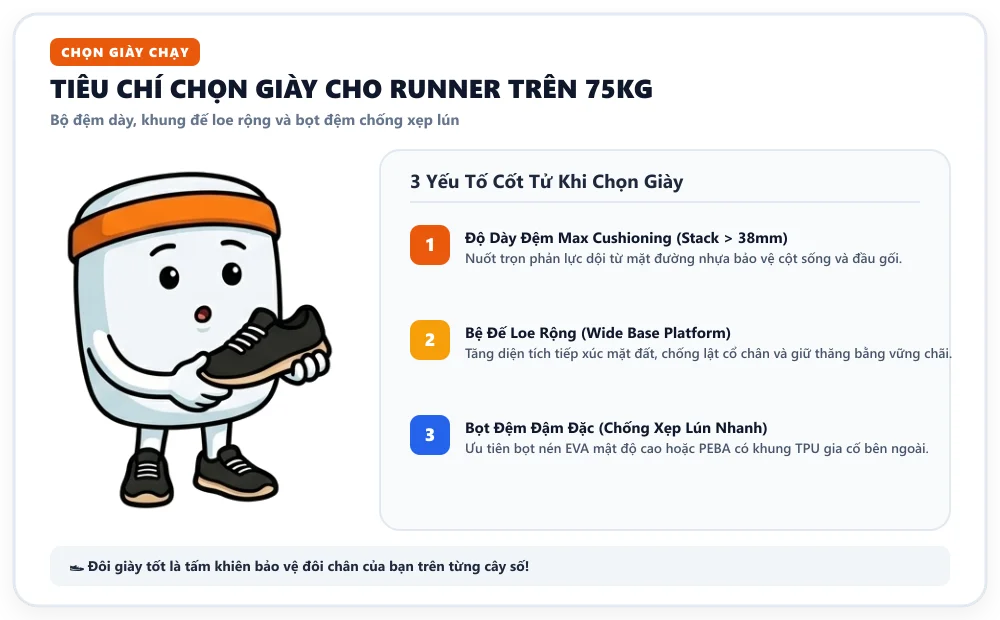
Choosing the wrong shoes is a one-way ticket to the orthopedic clinic. For heavier runners, never wear thin-soled racing flats, flat lifestyle sneakers, or overly soft, unstable foam.
┌────────────────────────────────────────────────────────────────────────┐
│           4 PILLARS OF SHOE SELECTION FOR HEAVY RUNNERS                │
├────────────────────────────────────────────────────────────────────────┤
│ 1. Max Cushioning      ➔ 36mm – 42mm heel stack for impact reduction   │
│ 2. Firm/Dense Foam      ➔ Avoid foams that bottom out                   │
│ 3. Wide Base           ➔ Stability to prevent ankle rolling            │
│ 4. Structured Heel Cup  ➔ Locks the heel, supports the arch             │
└────────────────────────────────────────────────────────────────────────┘
Why You Need Max Cushioning & Stability
- Bottoming-out: Under 80kg+, ultra-soft foam compresses completely after a few miles, leaving your feet to strike the pavement unprotected.
- Overpronation: Excess weight collapses the arch, causing your ankles to roll inward, twisting your shins and leading to IT Band pain.
Top 5 “Knee-Saving” Shoes
| Model | Type | Features | Ideal Weight | Protection |
|---|---|---|---|---|
| ASICS Gel-Nimbus 26/27 | Max Cushion | FF BLAST+ ECO + PureGEL | 75kg–95kg+ | ⭐⭐⭐⭐⭐ |
| ASICS Gel-Kayano 31/32 | Max Stability | 4D Guidance System | 75kg–100kg | ⭐⭐⭐⭐⭐ |
| Nike Vomero 17/18 | Daily Trainer | Dual foam: ZoomX + ReactX | 70kg–85kg | ⭐⭐⭐⭐☆ |
| Brooks Ghost Max 1/2 | Max Cushion Rocker | DNA LOFT v3 + GlideRoll | 75kg–90kg+ | ⭐⭐⭐⭐⭐ |
| Puma ForeverRun Nitro | Dynamic Stability | RunGuide System + Nitro | 75kg–88kg | ⭐⭐⭐⭐☆ |
👟 Find your perfect shoe: Use our Running Shoe Lab for personalized recommendations.
4. 8-Week Run-Walk Plan: Adapting Tendons & Bones

The Run-Walk-Run method is the gold standard for beginners. Interspersing walking intervals helps:
- Keep heart rate in the safe aerobic zone (Zone 2 / MAF).
- Relieve load on shins and joints to prevent micro-trauma accumulation.
- Recover ATP and clear lactic acid for better endurance.
8-Week Progression Plan
| Week | Structure (Set) | Total Time | Running Goal |
|---|---|---|---|
| 1 | 5’ Warmup ➔ 7x [Run 1’ + Walk 2’] ➔ 5’ Cooldown | 31’ | Wake up joints |
| 2 | 5’ Warmup ➔ 7x [Run 1.5’ + Walk 1.5’] ➔ 5’ Cooldown | 31’ | Increase load |
| 3 | 5’ Warmup ➔ 7x [Run 2’ + Walk 1’] ➔ 5’ Cooldown | 31’ | Build quad strength |
| 4 | 5’ Warmup ➔ 6x [Run 3’ + Walk 1’] ➔ 5’ Cooldown | 34’ | Consolidate 165+ cadence |
| 5 | 5’ Warmup ➔ 4x [Run 5’ + Walk 1’] ➔ 5’ Cooldown | 34’ | Aerobic challenge |
| 6 | 5’ Warmup ➔ 3x [Run 8’ + Walk 1’] ➔ 5’ Cooldown | 37’ | Fat burning |
| 7 | 5’ Warmup ➔ [Run 12’ + Walk 2’ + Run 12’] ➔ 5’ Cooldown | 36’ | Endurance prep |
| 8 | 5’ Warmup ➔ RUN 25–30 MIN CONTINUOUSLY ➔ 5’ Cooldown | 35-40’ | Graduation! |
[!IMPORTANT] If you feel persistent soreness, rest for 2 days and repeat the previous week’s plan. Never rush.
5. Nutrition, Hydration & Recovery
Training is only half the equation. Smart recovery is how you sustain weight loss and protect your joints.
1. Moderate Caloric Deficit (300 – 500 kcal/day)
Don’t starve yourself. Aim for 0.5kg–0.7kg weight loss per week. Every 1kg of weight you lose removes 4kg of impact force from your knees per step.
2. Nutrition for Repair
- Protein: 1.4g–1.8g/kg of body weight. Essential for repairing muscle damage.
- Joint Support: Collagen Peptide (Type II) + Vitamin C, Glucosamine/Chondroitin, and Omega-3 (fish oil) for inflammation.
3. Hydration
Heavier runners sweat more. Drink 100ml–150ml of electrolytes every 15–20 minutes to prevent cramps.
4. Zero-Impact Cross-Training
On rest days, cycle or swim for 30-45 minutes to strengthen your legs without impact.
6. 5 Absolute Forbidden Rules
┌────────────────────────────────────────────────────────────────────────┐
│                   5 DON'TS FOR HEAVY RUNNERS                           │
├────────────────────────────────────────────────────────────────────────┤
│  [X] DON'T 1: Run fast downhill                                        │
│  [X] DON'T 2: Compare pace/distance with lighter runners               │
│  [X] DON'T 3: Skip strength training                                   │
│  [X] DON'T 4: Use worn-out, non-running sneakers                       │
│  [X] DON'T 5: Push through sharp, localized pain                       │
└────────────────────────────────────────────────────────────────────────┘
Final Word from Your Coach
Running at 75kg, 85kg, or 90kg+ requires more courage and discipline than anyone else. Your body is doing heavy work. Remember: Your current weight does not define your future limits.
Every run, every correct landing, and every healthy meal builds a stronger version of you. Lace up, keep it light, and enjoy the journey with Thích Chạy Bộ!
