In today’s running shoe landscape, where brands are in a fierce arms race of “super-thick” midsoles and expensive carbon plates, the Nike Quest 7 emerges as a testament to the value of minimalism and practicality. Rather than attempting to be a record-breaking race shoe, the Quest 7 positions itself as a durable “workhorse,” catering to the first steps of beginners or cross-training sessions in the gym. This is a model that goes against the bulky trend to maintain a flexible road feel—a characteristic that is gradually disappearing from mainstream daily trainers.
Lab Specs & Real-World Weight (Standard US Men’s Size 8)
Below are the actual measurements and standardized figures for the men’s version, providing the most objective look at the shoe’s construction:
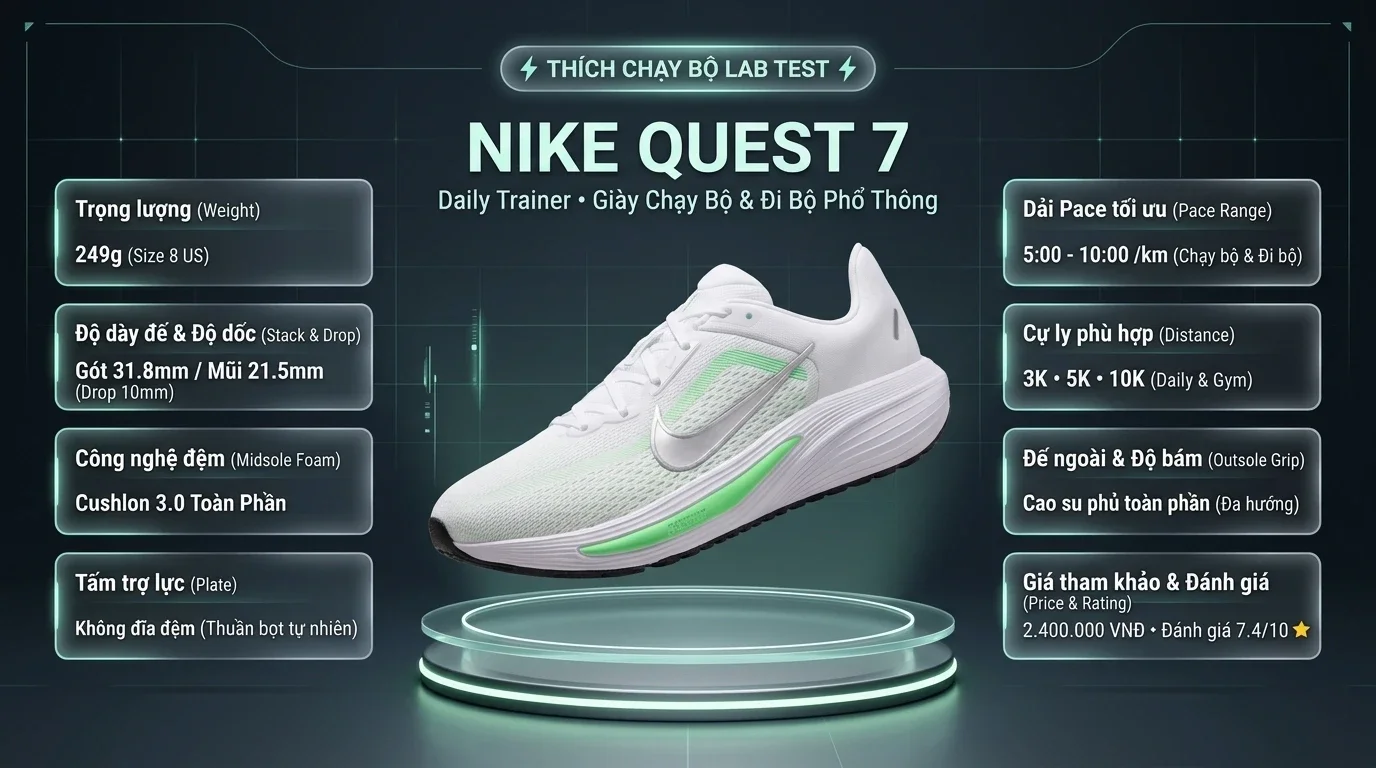
- Actual Weight: 249g (Men’s US Size 8). This is a significant improvement, approximately 36g lighter than its predecessor, making the underfoot feel noticeably more agile.
- Stack Height: 31.8mm (Heel) / 21.5mm (Forefoot).
- Heel-to-Toe Drop: 10mm (Actual lab measurements fluctuate around 10.3mm).
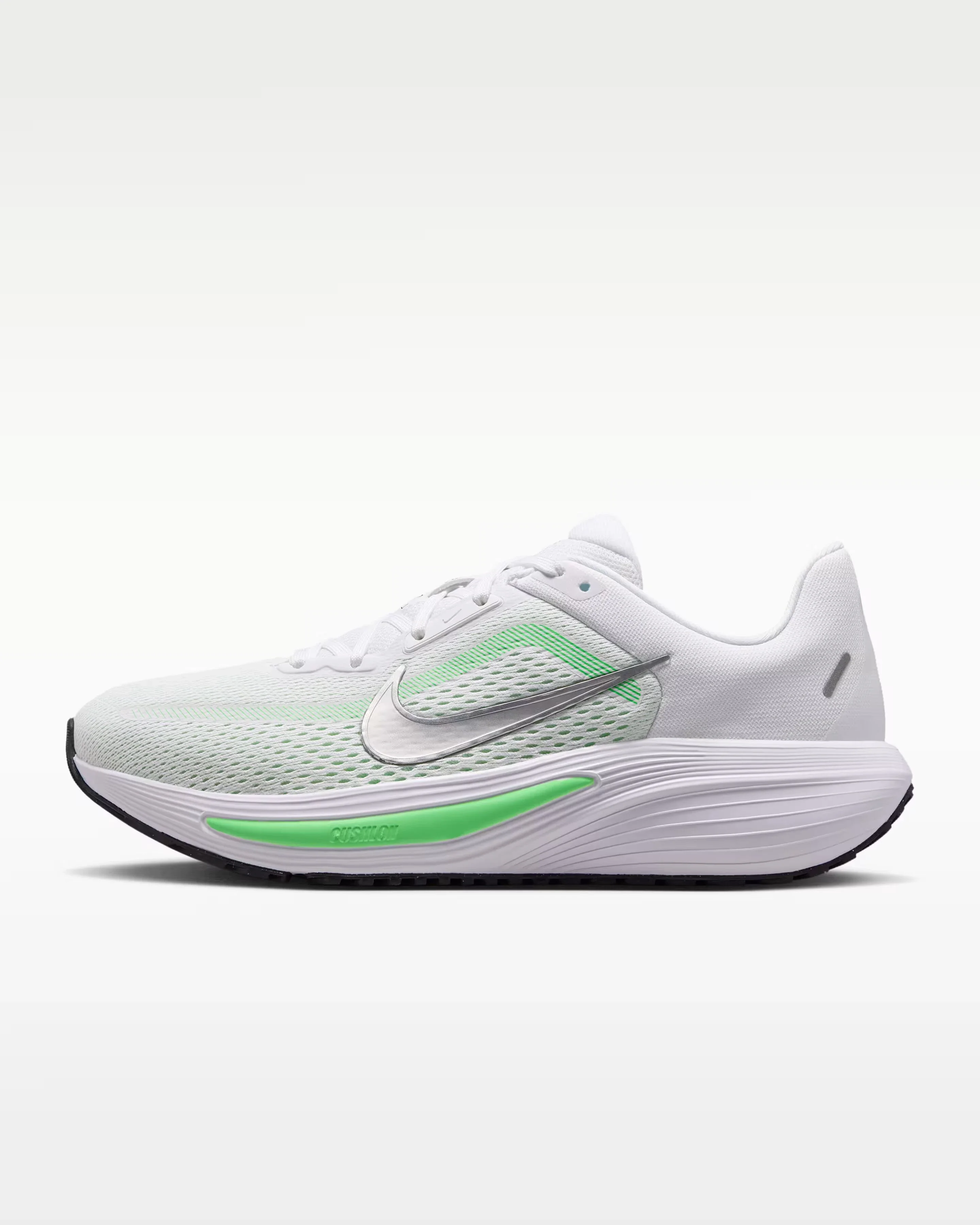
- Midsole Foam: Full-length Cushlon 3.0.
- Plate: None (The plateless design allows for a natural foot flex).
- Outsole: Full-coverage rubber with a multi-directional traction pattern.
- Upper: Two-tone Engineered Mesh.
- Optimal Pace Range: 5:00 - 10:00 /km (8:00 - 16:00 min/mile).
- Recommended Distance: 3km - 15km.
Cushioning Technology & Energy Return
The heart of the Nike Quest 7 lies in the Cushlon 3.0 foam layer spanning the entire length of the sole. Compared to previous generations that used older, somewhat stiff foam compounds, Cushlon 3.0 represents a major step forward in comfort. To the touch, this foam offers moderate compression—not overly soft or “sinky” like ZoomX, but not harsh either.
The Quest 7’s impact absorption is primarily concentrated in the heel. With a heel stack of nearly 32mm, the shoe handles impact well for heel strikers. However, it is worth noting that the forefoot cushioning is quite thin (only 21.5mm). For a runner with an average build, this foam responds quite honestly and remains stable through the first few kilometers. But if you are a midfoot or forefoot striker, you will definitely experience a distinct “road feel.” This means that protection for the forefoot diminishes as the mileage increases. The energy return of Cushlon 3.0 is decent; it leans more toward supporting stability and durability rather than generating powerful propulsion for speedwork.
Real-World Road Experience: Optimal Pace and Stability
When taking the Nike Quest 7 out for a test on hard asphalt, the first sensation is stability. Thanks to the lower stack height and the absence of a plate, the runner’s center of gravity remains at a safe level, with very little instability when cornering or making sudden directional changes.
- Pace 8:00 - 10:00 /km (Walking and Recovery Runs): This is the ideal operating zone. The shoe provides absolute comfort for low-intensity activities. The 10mm drop aids in smooth transitions, reducing pressure on the Achilles tendon.
- Pace 5:30 - 7:30 /km (Easy Runs): The Quest 7 fulfills its role as a standard daily trainer. The 249g weight prevents early leg fatigue. The flexibility of the outsole allows the foot to move naturally according to its inherent biomechanics.
- Pace 5:00 - 5:30 /km (Steady Runs): At this speed, the shoe begins to show its limits in terms of bounce. You will have to use more leg power to maintain speed because the Cushlon 3.0 foam does not offer much mechanical assistance.
The stability of the Quest 7 also makes it an excellent choice for supplemental gym workouts. During light weightlifting or treadmill sessions, the sturdy base helps keep the foot stable, avoiding the tilting or sinking sensation found in ultra-soft midsoles.
Direct Comparison with the Nike Quest 6
The biggest differences lie in the weight and the foam feel. The Nike Quest 7 has undergone a dramatic “weight loss” program, cutting down by 36g. In running, reducing weight on the feet is significant for oxygen economy and reducing the load on the hip joints. Furthermore, the switch to Cushlon 3.0 helps the Quest 7 shed the “stiff shoe” reputation of the v6. The underfoot feel is now friendlier, bouncier, and much more lively. The toe box of the Quest 7 has also been slightly widened, addressing the toe-pinching issue that was a persistent weakness in previous Quest models.
Upper Construction & Lockdown
Nike utilized a two-tone engineered mesh for the Quest 7, giving it a more premium appearance than its price tag suggests. However, real-world use shows that this mesh is relatively thick and densely woven, resulting in only average breathability. During summer afternoon runs or long efforts over 10km, the feet can feel a bit warm and stuffy.
The biggest highlights of the upper are the tongue and heel lockdown. The tongue features a gusseted design, ensuring it stays centered over the midfoot without sliding during intense movement. The padding at the collar and tongue is quite plush, providing a pleasant, snug sensation from the very first wear.
The lockdown on the Quest 7 is extremely impressive. The heel counter is reinforced and stiff, which, combined with the standard lacing system, keeps the heel locked into the footbed, completely eliminating heel slippage. Although the toe box is wider than the previous version, the overall silhouette still carries Nike’s signature narrow taper toward the front. Runners with wide feet should consider going up half a size to ensure the toes have enough room to splay during long runs.
Technical Limitations and Long-Distance Considerations
Despite significant improvements in weight and foam quality, the Nike Quest 7 still reveals clear physical limitations when pushed into high-intensity workouts or long distances. The critical weakness lies in the uneven distribution of cushioning. While the heel is generously padded with a 31.8mm stack height, the forefoot remains relatively thin (approximately 21.5mm). When running beyond the 10km threshold, the Cushlon 3.0 foam in the forefoot area begins to show signs of “bottoming out,” causing the runner to feel the harshness of the asphalt.
Heat management is another drawback to note. While the two-tone engineered mesh provides a secure and premium feel, the weave density is quite thick, restricting airflow. In hot and humid climates, running continuously for over 60 minutes can lead to a stuffy sensation, increasing the risk of friction blisters. Additionally, the toe box retains Nike’s signature tapered shape, which inadvertently puts pressure on the toes for those with wide feet or natural toe splay. Finally, Cushlon 3.0 is tuned for stability and soft comfort rather than energy return. Consequently, if you attempt to push the pace below 4:45/km, the shoe feels “sluggish,” lacking the necessary pop to support a high-speed cadence.
Optimal User Profile and Contraindications
Nike Quest 7 is accurately positioned as a versatile “entry-level” shoe. It is an ideal choice for beginners running for health maintenance, performing light 3km to 5km runs, or doing treadmill sessions at the gym. Thanks to its low-profile platform and high stability, this shoe also serves exceptionally well for daily walking, light weightlifting, or as a stylish lifestyle sneaker due to its modern design.
However, there are specific “contraindications” that runners should carefully consider:
- Runners over 75kg: The thin forefoot cushioning will quickly compress under heavy pressure, failing to absorb impact effectively, which can lead to knee and plantar fatigue.
- People standing for work all day: While comfortable initially, the running-oriented geometry means it doesn’t provide the best support for standing still or walking 10,000+ steps on hard concrete for older adults.
- Athletes for Intervals or Long Runs: The lack of a propulsive plate and low foam responsiveness will cause you to fatigue faster.
Market Positioning, Retail Price & Sale Hunting Tips
Within the Nike ecosystem, the Quest 7 is positioned in the Entry-level (budget) segment, sitting just below the legendary Pegasus line. The current retail price in the Vietnamese market is 2,400,000 VND. At this full retail price, the Quest 7 faces stiff competition from discounted models in higher segments or Chinese competitors that offer more advanced foam technologies.
However, the real strategy for owning the Quest 7 lies in patiently waiting for deep discounts. To achieve the optimal P/P (Price-to-Performance) ratio, you should aim to hunt for sales with discounts ranging from 40% to 60% or more. When the actual price hits the 1,000,000 VND - 1,400,000 VND range, the Quest 7 truly becomes an unrivaled bargain. At this sale price point, the shoe’s P/P score jumps to an 8/10, making it the most economical choice for gym sessions and light daily runs while still guaranteeing durability and a reputable brand name.
Shoe Rotation Matrix
To optimize performance and extend the lifespan of your gear, you should integrate the Nike Quest 7 into a structured training routine:
- Daily Trainer & Walking: Use the Nike Quest 7 for gentle recovery runs at a pace of 7:00 - 9:00 /km or for casual walking around town.
- Speedwork & Endurance: When you need to level up your performance or tackle distances over 15km, consider switching to models with thicker cushioning and better energy return, such as the Nike Pegasus 41 or Nike Vomero 18. You can also check out our Running Shoe Comparison Tool to find heavy hitters for your long run days.
- Optimize your Shoe Rotation: To build a complementary footwear system, use the Shoe Rotation Tool to scientifically allocate the specific purpose for your Quest 7, ensuring you don’t overtax your feet.
Conclusion & Performance Scorecard
Nike Quest 7 isn’t a record-breaking “super shoe,” but it is a dedicated companion for those very first running steps. The weight reduction and full-length Cushlon 3.0 foam in the midsole elevate the experience compared to older generations, making it one of Nike’s best everyday running shoes to own if you time your purchase right.
Performance Scorecard:
- Fit: 7.6 / 10 (Secure upper, comfortable tongue, but slightly warm with a tapered toe box).
- Cushioning: 6.8 / 10 (Good heel cushioning, but thin in the forefoot with a lack of bounce).
- Stability: 8.5 / 10 (The standout feature, extremely solid upon landing and during gym sessions).
- Ride: 7.2 / 10 (Flexible and ground-connected at slower paces).
- Value (P/P): 8.0 / 10 (If you catch it on sale at 40-60% off, this score jumps significantly).
OVERALL SCORE: 7.4 / 10 ⭐
Frequently Asked Questions (FAQ)
Can the Nike Quest 7 be used for a Half Marathon (21.1km)?
Technically yes, but it’s not recommended. Due to the thin forefoot cushioning, you will likely feel significant soreness and fatigue in the arches after the 12-15km mark. This shoe performs best at distances under 10km.
Is the Nike Quest 7 suitable for wide feet?
Although Nike has widened the toe box compared to the Quest 6, the overall fit still leans toward being narrow. If you have wide feet, it is essential to go up 0.5 to 1 full size to avoid toe pinching.
How durable is the rubber outsole on the Quest 7?
Very durable. The full-length rubber coverage provides stable traction on both dry and slightly wet asphalt. This is one of the most durable outsoles in the budget category.
Should I use the Nike Quest 7 for gym workouts and treadmill running?
Absolutely. This is the “sweet spot” for the Quest 7. The 10mm drop and stable platform provide a solid base for light squats or logging miles on the treadmill.