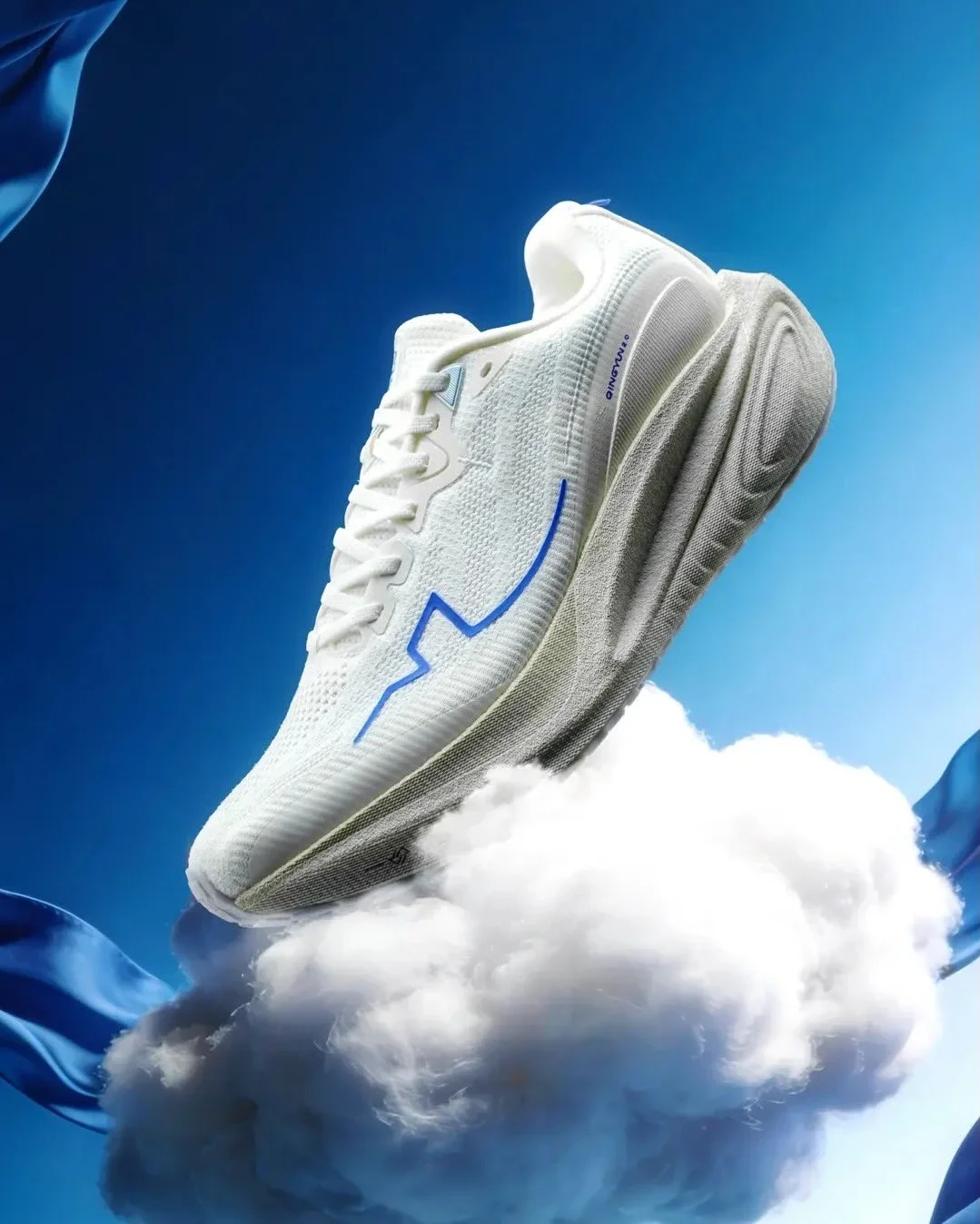
The budget-friendly, high-stack running shoe segment typically falls into two familiar extremes: either too firm, causing the knee joints to absorb direct impact from the asphalt, or too soft, leading to deep sinking and ankle instability. After the original Xtep Qingyun made its mark with a stable platform, Xtep has released the Qingyun 2.0 (特步青云 2.0) with the goal of lowering the foam density for a plusher feel while maintaining the stability required of a daily trainer.
Aggregated data and performance feedback from Chinese domestic running forums show that the Qingyun 2.0 features a distinct shift in underfoot experience. Rather than chasing the weight-reduction race or pushing for top speeds, this model focuses on solving the problem of joint protection for beginners, wide-footed runners, and those needing a versatile shoe for daily wear. This is a budget daily trainer that is exceptionally well-suited for walking and easy runs, thanks to a new foam structure optimized for comfort.
Lab Specs & Actual Weight (Standard US Size 8)
The figures below are compiled from the manufacturer’s official specifications and actual measurements of the Chinese domestic version, standardized according to the Thích Chạy Bộ reference system:
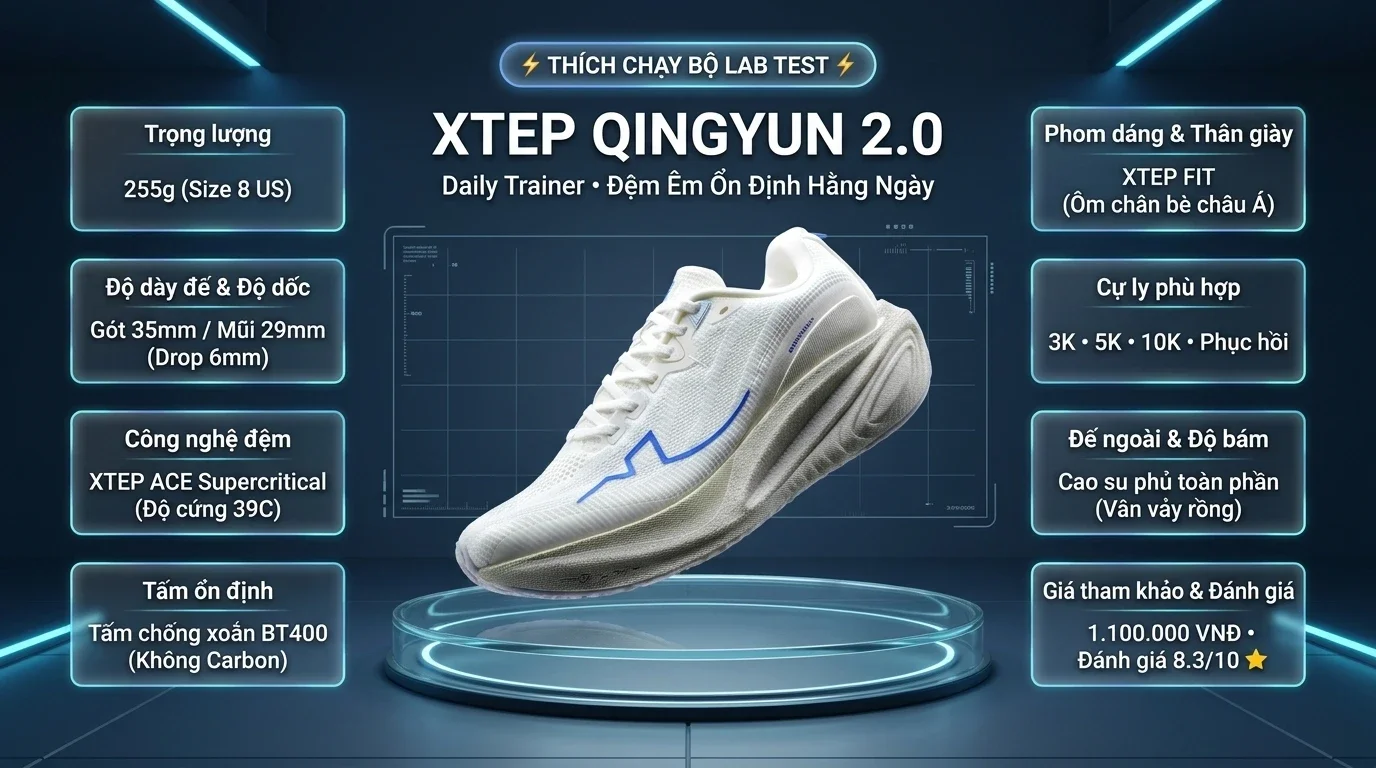
- Weight: Ranges between 250g – 260g per shoe (Standard US Size 8 reference). This is an ideal weight for a daily trainer, significantly lighter than initial estimates, helping to reduce pressure on the ankles during high-mileage grinds.
- Stack Height: 35mm in the heel and 29mm in the forefoot. This structure provides a cushion layer thick enough to absorb impact without being so high that it compromises your center of gravity.
- Heel-to-Toe Drop: 6mm. This mid-range drop supports various footstrike patterns from heel to midfoot, creating a smoother transition compared to shoes with an aggressive high drop.
- Midsole Foam: Fully constructed from XTEP ACE supercritical foam, with the firmness fine-tuned to an ultra-soft 39° (39C - Soft and Elastic).
- Stability Frame: XTEP POWER BT400 composite plate positioned in the midfoot area. Important note: This is a synthetic torsion plate, it does not contain carbon fiber, and is designed purely for stability rather than propulsion.
- Sole Width: The midfoot has been widened by 14mm and the heel by 6mm compared to version 1.0, creating an extremely stable platform.
- Upper: XTEP FIT last optimized for Asian foot shapes, featuring either one-piece knit or Jacquard mesh depending on the colorway.
- Outsole: Full-coverage rubber with a dragon-scale tread pattern to enhance durability and traction.
Midsole Technology & Shock Absorption (Cushion & Energy Return)
The appearance of the BT400 plate, visible through the cutout in the outsole, acts as a structural skeleton, locking down lateral torsion in the midfoot during off-axis landings. Despite the absence of carbon, this rigid plastic structure works exceptionally well with the XTEP ACE 39C foam to disperse compression forces. Upon impact, the foam compresses smoothly to neutralize shock to the knees but stops at the right moment thanks to the support of the BT400 frame underneath.
The 39C softness level (Soft and Elastic) creates a distinct difference compared to the brand’s other training lines. Specifically, when placed alongside its workhorse sibling, the Xtep 2000km 5.0, the ACE foam on the Qingyun 2.0 feels significantly softer and offers a more plush, sink-in sensation. For a runner profile of 1m65 (5’5”) and 57kg (125 lbs), the body weight isn’t quite enough to fully bottom out the XTEP ACE foam, so the sensation leans toward lightweight cushioning and just the right amount of heel support. Conversely, runners over 70kg (154 lbs) will feel a deeper compression from the very first strides, reducing mechanical impact on the ankles and shins. The energy return of approximately 70% is sufficient for easy runs, providing that signature “pampering” feel characteristic of recovery shoes.
Road Performance: Optimal Pace & Stability
With a 35mm/29mm stack and a 6mm drop, the Xtep Qingyun 2.0 caters directly to heel strikers or those with a heel-to-midfoot transition. The moderate center of gravity allows for a natural foot roll. When using a pace calculator to define training zones, the most effective speed range for this shoe is between 6:00 - 7:30 /km for Easy Runs or Recovery Runs ranging from 3km to 10km.
At this pace, stability is the standout feature. Thanks to the platform being 14mm wider at the midfoot, the heel doesn’t wobble or shift laterally, even when cornering on asphalt or navigating uneven tiled sidewalks. The 250g - 260g weight sheds the clunky feel of the previous generation, allowing runners to maintain a steady cadence without early fatigue.
Direct Comparison with the Predecessor (Xtep Qingyun)
- Cushioning: The Qingyun 2.0 uses 39C foam, which is noticeably softer than the 43C foam used in version 1.0, providing immediate step-in comfort.
- Weight: Version 2.0 is better optimized, dropping significant weight from the nearly 300g mark of the original, making the leg lift feel more agile.
- Stability: Both feature the BT400 plate, but version 2.0 has a wider outsole footprint, increasing contact area and better minimizing the risk of ankle rolls.
- Toe Box Space: The XTEP FIT last on version 2.0 has been widened, completely fixing the pinky-toe pinching that was a major drawback of version 1.0.
Upper Construction, Fit & Lockdown
A common complaint regarding its predecessor was the low-profile toe box, which caused toe pinching during long runs. In the Qingyun 2.0, the XTEP FIT last has been adjusted to widen the forefoot and raise the instep arch, effectively solving the issue of pinky toe compression or midfoot numbness for runners with wide feet. Xtep also utilized a separate mold for the women’s version with a narrower heel to prevent heel slippage during the gait cycle.
The upper features a thick knit construction, paired with a plush heel collar and a heavily padded tongue that provides an immediate step-in comfort. The lacing system, combined with reinforced overlays on the lateral and medial sides, locks the foot securely onto the footbed, ensuring zero internal movement during activity. However, this thickness is a double-edged sword when it comes to heat dissipation.
Technical Limitations and Long-Distance Considerations
While it excels at providing comfort over short distances, real-world testing reveals three distinct limitations of the Qingyun 2.0:
- Energy Loss over Long Distances: Due to the ACE foam being tuned to a soft 39C with an energy return of approximately 70% and the lack of a propulsive carbon plate, the cushioning tends to bottom out and lose its bounce after about 12km. Your legs will feel heavier if you try to push the pace below 5:30/km.
- Breathability: In cool weather, the feet stay comfortable, but when running in the summer heat or high humidity typical of Vietnam, heat builds up easily, leading to a stuffy sensation after about 40 minutes of continuous movement due to the dense knit fabric.
- Weight Limits: Heavier runners (over 80kg) running at slow paces may feel the foam sink excessively, hitting the firm threshold of the BT400 plate, which can create a slightly jarring sensation under the arch.
Optimal User Profile and Contraindications
Best Suited For:
- Beginners (Newbies) needing a shoe with excellent knee protection at an affordable price point.
- Runners with the wide-foot shape characteristic of many Asian athletes.
- Runners looking for a dedicated recovery shoe for easy days after heavy workouts.
- Those needing a versatile hybrid: comfortable for walking or standing all day, yet capable of light 5-10km runs.
Not Recommended For:
- Runners looking to break a PR (Personal Record) or perform speed work (Tempo, Intervals).
- Athletes training for a Full Marathon (42km) with high performance goals.
- Those who prioritize absolute breathability for hot summer conditions.
Market Positioning, Pricing & Sale Hunting Tips
The Xtep Qingyun 2.0 sits in the budget Daily Trainer segment but boasts premium supercritical foam technology.
- MSRP: Approximately 400 CNY (~1,400,000 VND).
- Sale Price: In Vietnam, you can easily find it priced between 750,000 VND and 1,100,000 VND on e-commerce platforms.
- P/P (Price/Performance) Ratio: Extremely high. Under the 1 million VND mark, it is hard to find a competitor that offers this combination of plush supercritical foam and a stable, supportive chassis like the Qingyun 2.0.
Shoe Rotation Matrix
To optimize your training performance, you can integrate the Xtep Qingyun 2.0 into your rotation as follows:
- Easy/Recovery Runs (3-10km): Use the Xtep Qingyun 2.0 to take advantage of the cushioning and foot protection.
- Speed/Tempo Runs: Switch to lighter models like the Xtep 160X (if budget allows) or the brand’s dedicated speed series.
- Walking/Gym: The Qingyun 2.0 handles these perfectly thanks to its stylish design and durable outsole rubber.
Conclusion & Performance Scorecard
The Xtep Qingyun 2.0 is a significant step up from its predecessor, specifically with the weight reduction down to the 250g-260g range and the fine-tuning of the ultra-plush ACE 39C foam. Even without a carbon plate, the BT400 plate does an excellent job of keeping the shoe from feeling unstable. This is a “gold standard” choice for beginners looking for a budget-friendly entry into running.
Performance Scorecard (Scale of 10):
- Fit: 9.0 / 10 (Excellent for wide feet)
- Cushion: 9.0 / 10 (Soft and forgiving)
- Stability: 8.0 / 10 (Stable thanks to the wide base and BT400 plate)
- Ride: 7.0 / 10 (Great at slow paces, but loses steam at faster paces)
- P/P (Price/Performance): 10 / 10 (Unbeatable in the sub-1 million VND price range)
⭐ OVERALL SCORE: 8.3 / 10
FAQ
Is the BT400 plate on the Xtep Qingyun 2.0 made of carbon?
No. It is a synthetic anti-torsion plate (reinforced TPU/Nylon), not carbon fiber. It is designed to stabilize the arch rather than provide the propulsive snap found in racing shoes.
Is the shoe durable for regular road running?
Very durable. The outsole rubber covers almost the entire contact area with a dragon-scale pattern that has high abrasion resistance. Expect the foam and outsole to last over 600-800km.
I have very wide feet; do I need to size up?
The XTEP FIT last of the Qingyun 2.0 is already designed with a generous Asian fit. You should go True to Size (TTS). Only size up by 0.5 if you have an extremely high instep or prefer wearing very thick performance socks.
Can the Xtep Qingyun 2.0 be used in the rain?
The dragon-scale traction performs decently on wet asphalt. However, because the upper is a thick knit, it will absorb water quickly and take a long time to dry, making the shoe feel heavy if run in heavy rain.