Detailed Specs Sheet (Quick Specs Sheet)
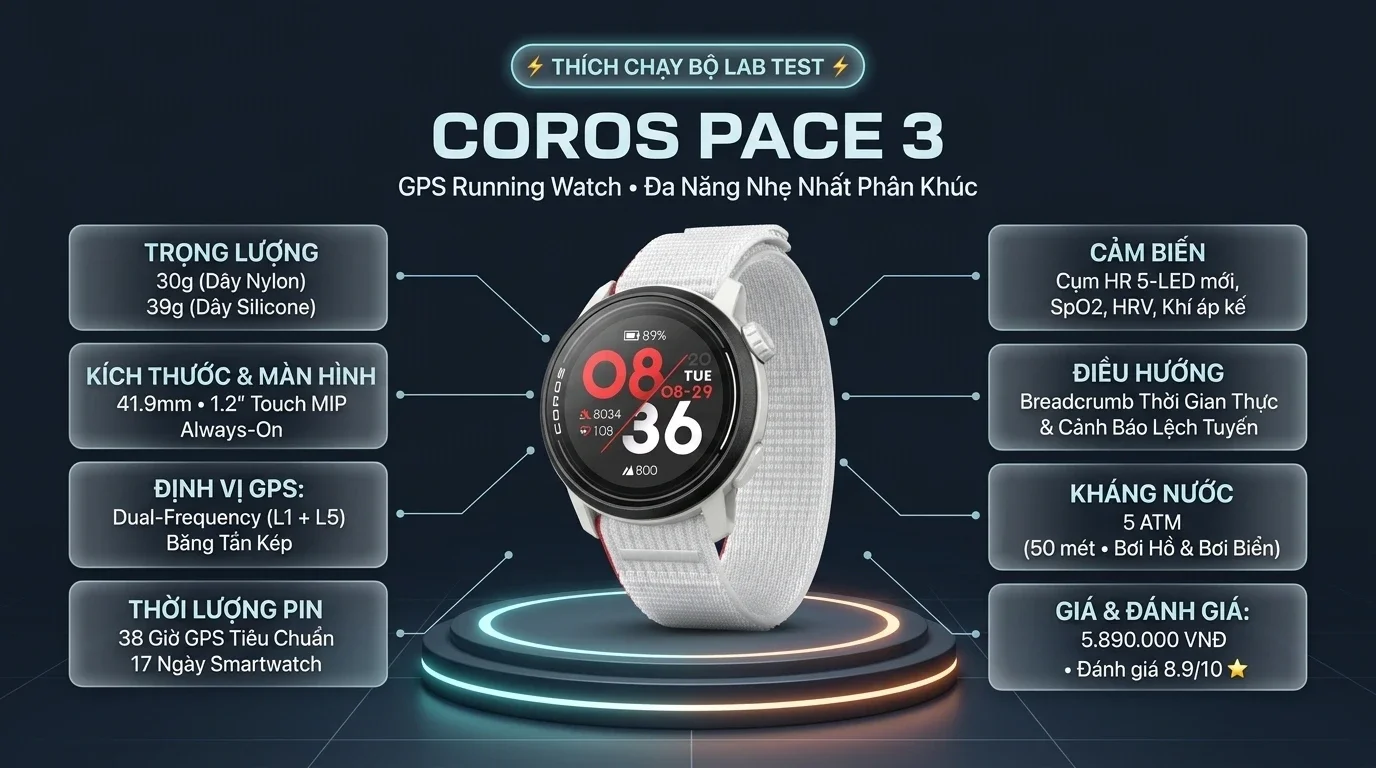
- Case Size: 41.9 x 41.9 x 11.7 mm (compact form factor tailored for wrist circumferences around 15.5 - 16.5 cm).
- Actual Weight: 30g with the breathable nylon band / 39g with the standard silicone strap.
- Display: 1.2-inch Always-On Memory-in-Pixel (MIP), 240 x 240 pixel resolution featuring touch functionality and scratch-resistant Mineral Glass.
- GNSS / Satellite Positioning: Dual-Frequency (L1 + L5) All-Systems GNSS (simultaneous support for GPS, GLONASS, Galileo, Beidou, and QZSS).
- Sensor Suite: Next-generation 5-LED optical heart rate sensor array, pulse oximeter (SpO2), overnight Heart Rate Variability (HRV) tracking, Barometric Altimeter, digital compass, accelerometer, and gyroscope.
- Real-World Battery Life: 38 hours in standard full GPS mode, 15 hours in dual-frequency GPS mode, and up to 17 days of continuous daily smartwatch usage.
- Water Resistance Rating: 5 ATM (water resistant down to 50 meters, fully certified for lap swimming and open-water swimming).
- Navigation & Mapping: Real-time Breadcrumb Navigation + Deviate Alert (off-course warnings) + Back-to-Start routing.
- Memory & Music Storage: 4GB onboard storage (supports offline MP3 playback directly to paired Bluetooth headphones).
- Optimal Pace Range: 3:00 - 8:00 /km (covering everything from high-intensity interval sessions and tempo efforts to long easy recovery runs).
- MSRP Reference: 5,890,000 VND (Street promotional pricing with available vouchers typically ranges from 3,600,000 to 4,000,000 VND).
- Overall Performance Rating: 8.9 / 10 ⭐.
Design Philosophy and the Evolution of the Pace Lineup
The COROS Pace 3 stands out as a masterclass in hardware optimization within a compact, lightweight chassis. Since the inception of the Pace series, COROS has relentlessly adhered to a strategy of delivering top-tier performance metrics at an accessible price point, and this third-generation model cements that legacy. The device transcends the role of a basic fitness tracker; it serves as a dedicated training telemetry unit engineered to meet the demands of explosive track workouts, structured marathon builds, and multi-hour mountain trail runs.
The most significant architectural upgrade resides beneath the hood. By integrating dual-frequency (Multi-Band / L1 + L5) GNSS processing, COROS elevates the Pace 3 into elite territory alongside high-end multisport watches. High-precision satellite mapping is essential for runners who frequently train through urban canyons dominated by skyscrapers, under dense tree canopies, or along steep cliff sides where multipath signal reflections regularly compromise single-band GPS units.
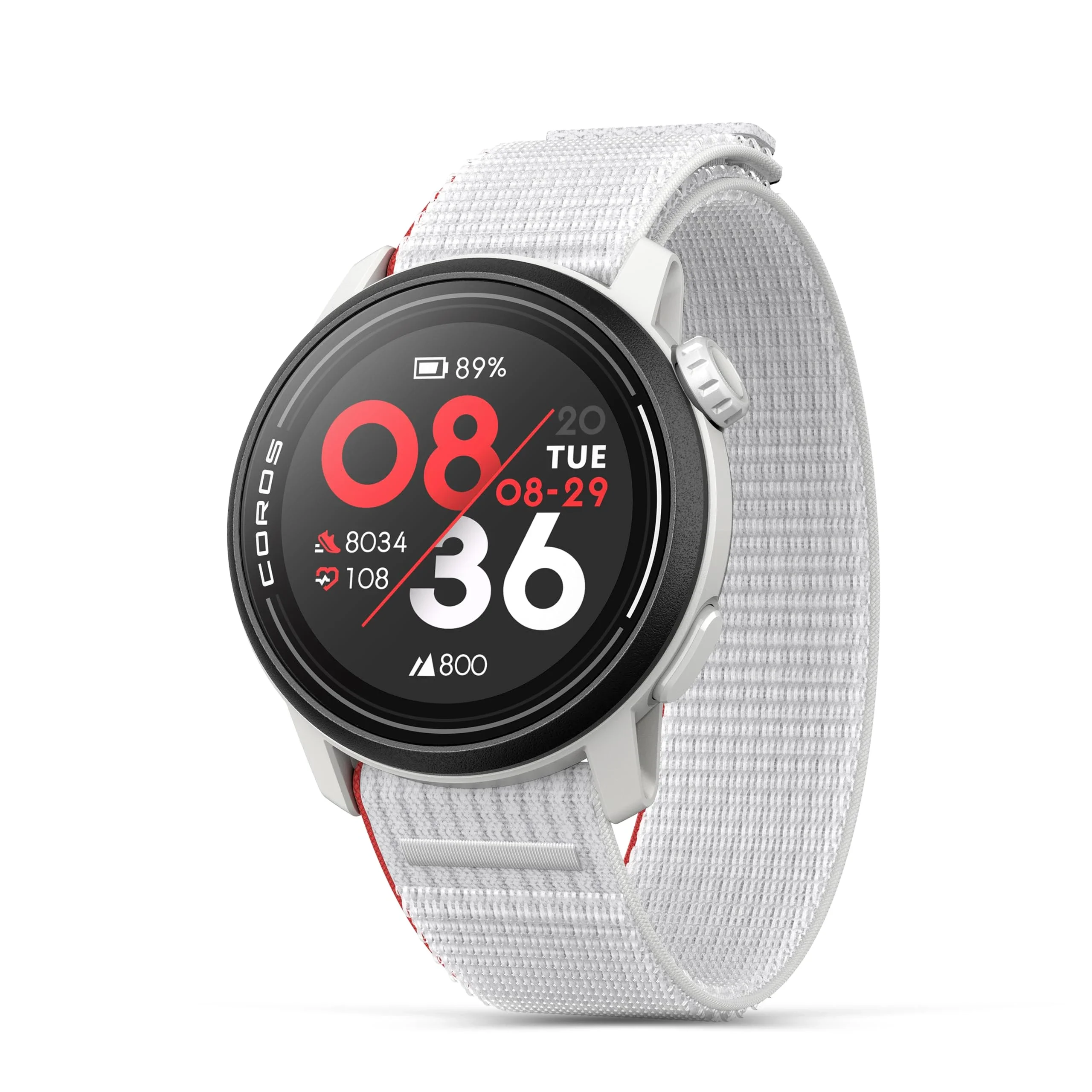
Furthermore, COROS made a subtle yet impact-driven adjustment to the watch’s ergonomics by widening the strap lugs from 20mm up to 22mm. This wider footprint distributes tension far more evenly across the wrist, preventing the casing from tilting or shifting during high-cadence sprints or downhills. Combined with its ultra-light 30g total mass when paired with the nylon band, the watch virtually disappears on your wrist—eliminating the mechanical bounce often experienced with bulkier, metal-bezeled sport watches.
GNSS Navigation and Real-World Battery Performance
The defining highlight of the Pace 3 is its satellite tracking capabilities. During rigorous field testing, the dual-frequency GNSS engine maintained rock-solid signal acquisition with minimal tracklog jitter. Even when navigating complex turns through tight city grids, the plotted GPS lines aligned accurately with actual running lanes rather than drifting across buildings or rivers.
Equal credit must be given to the battery efficiency engineered into this unit. While official specification sheets outline standardized baseline metrics, real-world endurance tests demonstrate that energy management outperforms expectations.
During a 12.5-hour continuous trail hike operating under full dual-frequency GPS mode with real-time breadcrumb navigation continuously rendered on screen, the Pace 3 consumed approximately 66% of its battery capacity. If the optical heart rate sensor is disabled in favor of an external chest strap (such as the COROS Heart Rate Monitor or a Polar H10 paired via Bluetooth/ANT+), power draw drops even further. This performance proves that the central processing unit and power regulator inside the Pace 3 have undergone substantial architectural refinements compared to the Pace 2. If COROS were to include granular battery drain data within exported .fit files in future firmware updates, power-users would gain even greater transparency into energy consumption profiles across varying temperature and satellite environments.
Heart Rate Sensor Array and Health Metrics
To improve optical biometric accuracy, COROS overhauled the sensor platform on the back of the watch. The Pace 3 features a redesigned 5-LED light layout combined with 4 photodetectors arranged in a balanced spatial pattern. This hardware reconfiguration reduces light leakage and improves skin contact, delivering cleaner photoplethysmography (PPG) signals during arm swings and rapid changes in cadence.
Accompanying the heart rate sensor is a medical-grade Pulse Oximeter for measuring blood oxygen saturation (SpO2). Obtaining precise SpO2 readings requires resting your wrist completely still on a flat surface for several seconds, mirroring the protocol of dedicated finger-clip oximeters. This metric provides useful baseline data for runners acclimatizing to higher elevations or assessing baseline oxygen efficiency during high-altitude training camps.
Another significant software addition is nocturnal Heart Rate Variability (HRV) tracking. By measuring the millisecond variations between consecutive heartbeats during sleep, the watch computes your baseline autonomic nervous system balance. This yields valuable insight into your recovery status, helping you determine whether your body is ready to absorb a heavy tempo session or if it requires a low-intensity recovery day. Rather than running the battery-draining green optical LEDs continuously 24 hours a day, the Pace 3 uses adaptive sampling intervals during sedentary periods. This intelligent duty-cycling preserves battery endurance over weeks of use while maintaining continuous health metrics.
User Interface and Auxiliary Features
The addition of a touch-sensitive layer to the 1.2-inch Memory-in-Pixel display marks a major quality-of-life improvement for the Pace series. To prevent accidental inputs caused by running apparel, rain, or sweat droplets, touchscreen functionality is selectively restricted by default to specific contexts, such as navigating breadcrumb maps or scrolling through data pages during a workout session.
For general menu navigation, users still rely on the signature digital crown paired with a dedicated back button. The knurled crown dial provides tactile micro-haptic feedback, enabling effortless menu scrolling even while wearing thick winter gloves or pushing through sweaty summer track sessions. The sunlight-readable MIP display reflects ambient light, making it exceptionally clear under bright afternoon sun without consuming extra battery power, though it lacks the vibrant saturation of modern AMOLED panels.
For runners who prefer to leave their smartphones at home, the Pace 3 includes 4GB of internal storage dedicated to local MP3 audio playback. Audio streams via Bluetooth to wireless earbuds without dropouts. It is worth noting that the watch does not support offline playback synchronization with third-party streaming services like Spotify, Apple Music, or YouTube Music due to digital rights management (DRM) restrictions. While manual MP3 file transfers via a USB cable connection to a computer require a bit of preparation, it delivers a reliable, distraction-free audio experience that remains completely independent of cellular connectivity or subscription plans.
Technical Limitations and Real-World Caveats
Despite its strong overall execution, the COROS Pace 3 has a few areas that could benefit from future refinement:
- Algorithmic Metrics Adaptation: Proprietary performance algorithms—specifically the Race Predictor and 7-Day Training Load metrics—can occasionally display optimistic race estimates or conservative fatigue indicators during the initial weeks of use. Because these predictive models rely on historical heart rate zones and pace data, the system requires several weeks of varied workouts across multiple effort levels to fully calibrate to your physiological profile.
- Nylon Band Maintenance: While the included white nylon strap is remarkably comfortable, soft, and breathable, it accumulates dirt, sweat stains, and road grime quickly. Cleaning the strap requires hand washing with mild soap and air drying. Machine washing can degrade the hook-and-loop fasteners and technical weaves over time.
- Strap Integration & Ergonomics: Upgrading to a 22mm quick-release system offers better stability on the wrist, but users with smaller wrists may find the lug-to-lug proportion slightly wider than its predecessor, though still very manageable.
- Charging Hardware Concerns:
- Cable Length: The included proprietary USB charging cable is short, which can make connecting to elevated wall outlets or recessed power strips awkward.
- Connector Longevity: Over extended months of daily use, the four-pin insertion charging port on the back of the case can collect lint or suffer friction wear. Users must align the connector firmly to ensure reliable charging pins contact.
Target Runner Profile and Market Positioning
The COROS Pace 3 targets entry-level runners through seasoned marathoners who prioritize raw data accuracy, lightweight comfort, and battery life over smartwatch features. Designed for an optimal working pace spectrum ranging from 3:00 to 8:00 /km, the platform adapts equally well to short track intervals, sustained tempo efforts, steady aerobic base building, and long weekend runs.
Weighing just 30 grams on the wrist, it appeals directly to athletes who dislike bulky multisport watches that chafe or bounce during high-cadence strides. Conversely, if your priorities center on smartwatch conveniences—such as contactless mobile payments, vibrant high-refresh AMOLED screens, speakerphone capabilities, or full offline topographic maps with turn-by-turn street routing—the Pace 3 may feel overly spartan. It remains a performance-first training instrument built specifically for endurance athletes.
Market Positioning & Ecosystem Competitor Comparison
Positioned at an MSRP of 5,890,000 VNĐ (with street sales routinely bringing the price down to between 3,600,000 and 4,000,000 VNĐ), the COROS Pace 3 competes directly with middle-tier sports watches such as the Garmin Forerunner 165 and the Suunto Race S. To benchmark technical parameters, sensor arrays, and battery specs side-by-side, visit our dedicated Watch Comparison Station and calculate your target workout splits with our Pace Calculator Tool.
- Versus Garmin Forerunner 165: The Forerunner 165 features a vibrant AMOLED display that delivers richer colors, but its battery life maxes out at 19 hours in standard single-band GPS mode, and it lacks multi-band GNSS support. The Pace 3 delivers twice the battery endurance (38 hours in standard GPS) and superior positional accuracy via dual-frequency tracking in challenging environments.
- Versus Suunto Race S: The Suunto Race S offers high-definition offline topographic maps and a premium stainless-steel bezel, but it comes with a noticeable weight penalty (60g vs. 30g) and carries a higher retail price tag.
- The COROS Training Hub Ecosystem: A standout advantage of choosing COROS is its completely free desktop and mobile software ecosystem. The COROS Training Hub provides web-based workout analysis, Training Load metrics, baseline fitness trends (EvoLab 2.0), and marathon level calculations without locking features behind a monthly subscription paywall.
Conclusion & Real-World Scorecard
The COROS Pace 3 demonstrates that you don’t need to spend top dollar to get high-level athletic data. By packing dual-frequency GNSS tracking, extended battery performance, and an upgraded heart rate sensor into an ultra-lightweight 30g package, COROS delivers a market-leading price-to-performance ratio for endurance runners.
- GPS & Sensor Accuracy: 9.0 / 10 (Dual-Frequency engine delivers smooth tracklogs and stable satellite locking).
- Real-World Battery Life: 9.5 / 10 (38 hours of continuous GPS; average users need to charge only twice a month).
- Display & Wearability: 8.5 / 10 (Featherweight 30g construction; sunlight-readable MIP display excels outdoors).
- Software Ecosystem & Features: 8.5 / 10 (Subscription-free COROS Training Hub provides clean, actionable data analytics).
- Value for Money (P/P): 9.0 / 10 (At its 5,890,000 VNĐ MSRP—and especially at street prices around 3.6M to 4.0M VNĐ—it represents one of the smartest hardware investments for runners of all levels).
- ⭐ OVERALL SCORE: 8.9 / 10
[FAQ] Is the COROS Pace 3 suitable for absolute beginners?
Yes. Despite its deep array of athletic metrics, the mobile application and watch interface remain clean and easy to navigate. Beginners can focus on simple metrics like heart rate zones, distance, and pace, while gradually exploring advanced features like training load and recovery times as their training progresses.
[FAQ] How reliable is the watch’s water resistance rating?
The Pace 3 carries an official 5 ATM water resistance rating, meaning it can withstand water pressures equivalent to a depth of 50 meters. It is fully suited for pool swimming, open-water sessions, and running in heavy downpours. However, users should avoid exposing the device to high-velocity water sports, sauna heat, or harsh cleaning chemicals.
[FAQ] Should current COROS Pace 2 owners upgrade to the Pace 3?
If your running routes take you through high-rise city blocks or dense forest trails where single-band GPS drops signal, the upgrade to dual-frequency GNSS alone justifies the jump. The addition of the optical SpO2 sensor, nocturnal HRV tracking, touchscreen navigation, and local MP3 playback make it a solid upgrade. However, if your Pace 2 meets your core tracking needs on open roads, it remains a reliable device.
[FAQ] Does the battery life match the manufacturer’s claims in real-world testing?
Yes. Under typical real-world conditions, battery endurance meets and often exceeds manufacturer estimates. Using lower-power satellite settings or pairing an external chest strap further extends battery performance, easily covering multi-day ultra-endurance events without requiring mid-race recharging.