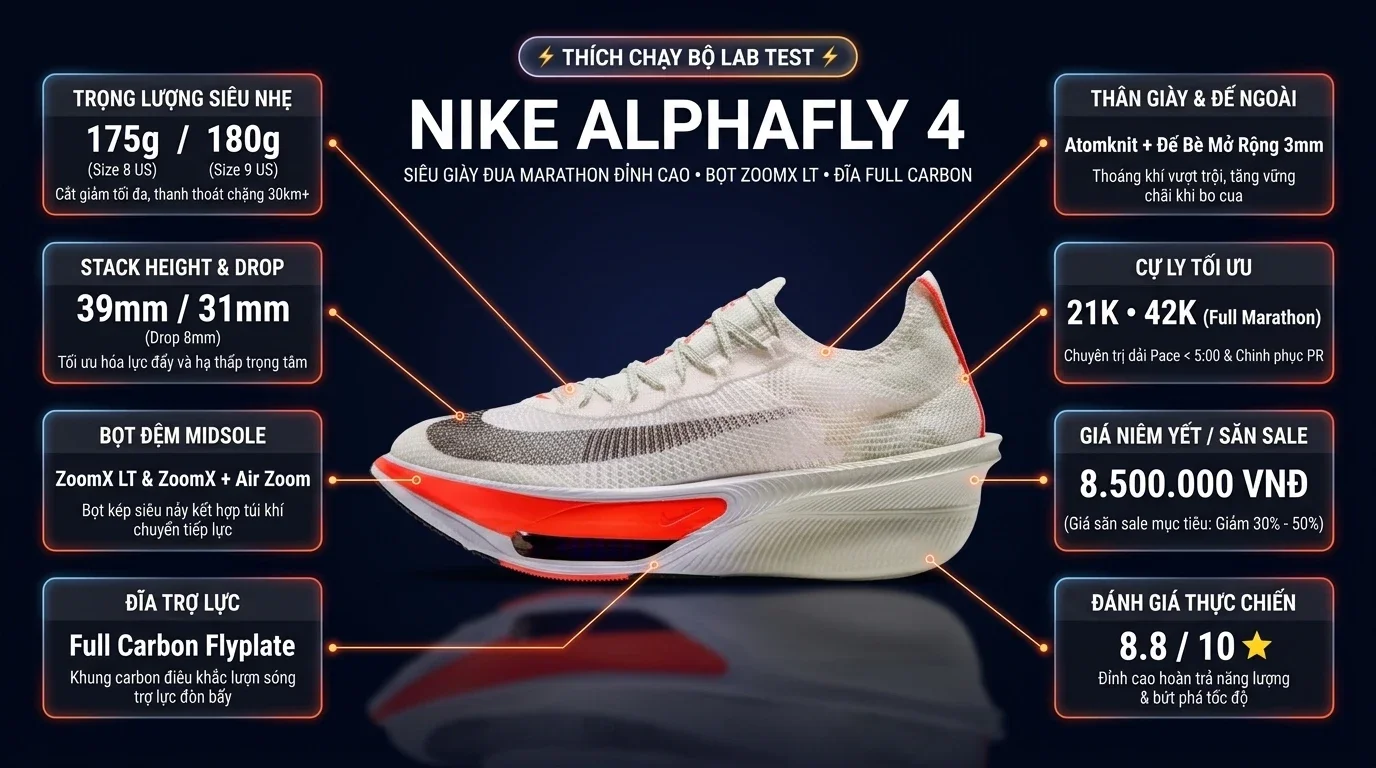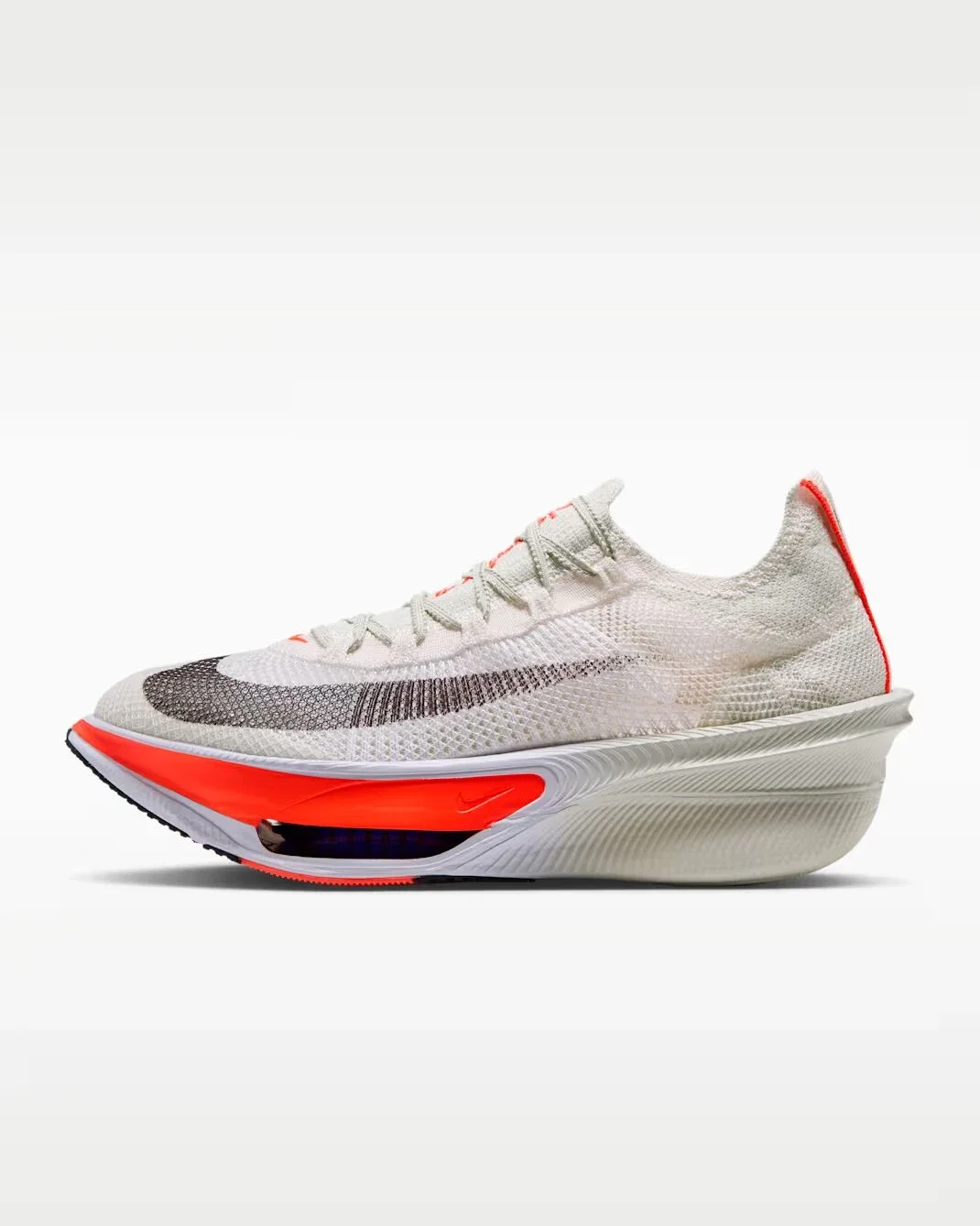
When a flagship supershoe hits the market at a lower MSRP of 8,500,000 VND while simultaneously tweaking its construction for better stability, the question is whether race-day performance was traded off or elevated. This fourth iteration of the shoe that has dominated global marathons brings game-changing updates to weight and mechanical structure, promising to redefine the experience for both recreational and elite runners over the 42.195km distance.
Technical Specifications of the Nike Alphafly 4
Understanding the core specs helps runners visualize this shoe’s performance envelope before putting it to the test:
- Classification: Global release
- Weight: Approx. 175g–180g (Men’s US 8), lighter than predecessors (typically 185g–190g). A significant advancement in material optimization, keeping feet feeling fresh in the final stages of a race.
- Stack Height & Drop: 39mm heel, 31mm forefoot, creating an 8mm drop optimized for midfoot and forefoot strikers.
- Midsole Foam: A dual-layer setup featuring new ZoomX LT (Lightweight Technology) foam on top of standard ZoomX for continuous compression and energy return.
- Plate: Full-length carbon plate, sculpted for improved stiffness and longitudinal transition.
- Outsole: High-performance rubber integrated with Air Zoom pods in the forefoot.
- Upper: Atomknit, offering high-tech breathability and a secure, lockdown fit.
- Optimal Pace & Distance: Built for high-velocity efforts, ideal for Half to Full Marathons (42K).
- Ideal Runner Weight: Best performance for runners under 75kg.
- Rating: 8.8 / 10 ⭐
Direct Comparison: Nike Alphafly 4 vs. Nike Alphafly 3
- Weight: At 175g–180g, the AF4 is noticeably lighter than the Nike Alphafly 3, reducing ankle fatigue during the closing miles of a marathon.
- Stack & Drop: While the Nike Alphafly 3 featured a 40mm/32mm stack, the AF4 drops to 39mm/31mm to maintain the 8mm drop while lowering the center of gravity for better ground feel.
- Foam Setup: The core difference is the layered approach: high-density ZoomX LT for snappy response, paired with standard ZoomX for impact absorption.
- Carbon Plate: The Flyplate is now sculpted with waves matching the metatarsal structure, moving away from the flatter geometry of previous generations.
- Midfoot Stability: The base under the arch has been widened by 3mm, effectively addressing the instability and arch-collapse issues of older models.
- Upper: Atomknit density has been adjusted; looser in the toe box for ventilation and tighter on the sides to lock the foot in during sharp turns.
On-Feet Experience: Fit and Toe Box
Stepping into the Alphafly 4, the feel is snug but not restrictive. The elasticated Atomknit collar is easier to slide into than previous versions, though you’ll still want to utilize the front and rear pull tabs.
The toe box is a pleasant surprise. Unlike the cramped feel of some racing shoes, the AF4 offers enough room for your toes to splay naturally upon impact, reducing the risk of friction-induced blisters or black toenails during long, hot-weather runs.
The midfoot is locked down by the signature serrated lacing system, which prevents the laces from coming undone. A thin pad under the tongue distributes pressure evenly, protecting the top of the foot when cinching the laces for speed work.
ZoomX LT Foam and Air Zoom Pod Energy Return
The technological heart of the AF4 is the interaction between two distinct damping materials. The ZoomX LT foam sits closer to the foot with a higher molecular density, providing a firm, immediate response. The standard ZoomX layer below handles impact absorption.
At goal race Pace (typically sub 5:00 min/km), the system hits its stride:
- Landing: The bottom ZoomX layer compresses to absorb road shock.
- Transition: Energy is transferred through the sculpted Flyplate, activating the forefoot Air Zoom pods.
- Toe-off: Compressed air in the pods combined with the resilience of the ZoomX LT foam provides a powerful forward propulsion.
Ride and Muscle Performance at 30km+
In a marathon, the “wall” usually hits after 30km. This is where quads, calves, and glutes fatigue, and form breaks down. The AF4 shines here.
Thanks to the rocker geometry, the shoe naturally encourages forward momentum even as your legs tire. The stiff carbon plate acts as a lever, stabilizing the ankle and preventing side-to-side wobble. This mechanical support preserves energy in your primary muscle groups, helping prevent cramping and keeping you on target Pace until the finish line.
The ride is snappy and decisive—not mushy or overly soft, but firm in the forefoot with a cushioned heel.
Stability and Cornering
One of the most welcome improvements is the stability upgrade. Previous models often felt wobbly, especially during sharp turns or on uneven surfaces.
Engineers addressed this with two geometric fixes:
- Widened Base: The midfoot area is wider, providing a broader platform for your gait cycle.
- Seamless Outsole: The groove between the heel and forefoot is narrowed, leading to a smoother, more continuous heel-to-toe transition.
When cornering at a 4:00 Pace on wet pavement, the heel remains locked in the rigid heel counter with no lateral sliding or twisting, providing great confidence on technical city courses.
Technical Limitations and Considerations
- Noise: The interaction between the Air Zoom pods and pavement is audible. On smooth or wet roads, it can make a distinct clicking sound. It doesn’t affect performance, but those who prefer a silent run may notice it.
- ZoomX LT Durability: To save weight, the foam density is optimized. You may see minor wear on the midsole surface after 150km. While responsiveness holds up, peak performance typically fades between 300km–400km.
- Wet Traction: The thin rubber on the forefoot is minimalist. On wet asphalt or mossy surfaces, the limited contact area can lead to slight slippage during hard acceleration. Be cautious in corners.
Who Is This For?
Who should buy the Nike Alphafly 4?
- Runners aiming for a new PR in Half or Full Marathons.
- Forefoot or midfoot strikers who can engage the Air Zoom pods.
- Runners under 75kg looking for every marginal gain.
Who should skip it?
- Beginners or those running Pace slower than 6:30 min/km; the shoe won’t perform as designed at slower speeds.
- Runners with weak ankles or severe overpronation; the 39mm stack remains high.
- Those looking for a daily trainer. Using the AF4 for easy runs is a waste of technology and shortens the shoe’s lifespan.
Shoe Rotation Strategy
To preserve your Alphafly 4 for race day, implement a proper shoe rotation:
- Daily Trainer: Use durable, cushioned shoes for base mileage and recovery. This builds natural strength.
- Speed Shoe: Use a shoe with responsive foam and a flexible plate for tempo or interval sessions.
- Race Day: Reserve the Nike Alphafly 4 for race simulation and actual race days.
Economic Value and Sales Strategy
At an MSRP of over 8.5 million VND, this is a significant investment. My advice: be patient. For top-tier supershoes, aiming for a 30%–50% discount after the initial launch period is the best way to optimize your cost-per-kilometer.
FAQ
What is the expected lifespan?
Performance peaks between 300km - 400km. After this, foam resilience drops by 20%-30% and the Air Zoom pods lose their initial pop.
Does it fit wide feet?
The toe box is wider than before, but it remains a performance-fit racing shoe. If you have wide feet, consider going up a half size or trying them on in-store first.
Can I use these for daily training?
Absolutely not. The rigid carbon plate and specialized foam are not designed for easy, recovery runs and will cause foot fatigue while wearing out the foam prematurely.
Is there a specific landing requirement?
Yes, it works best with a midfoot or forefoot strike. Heavy heel strikers may find the shoe unstable and will not benefit from the energy return of the Air Zoom pods.