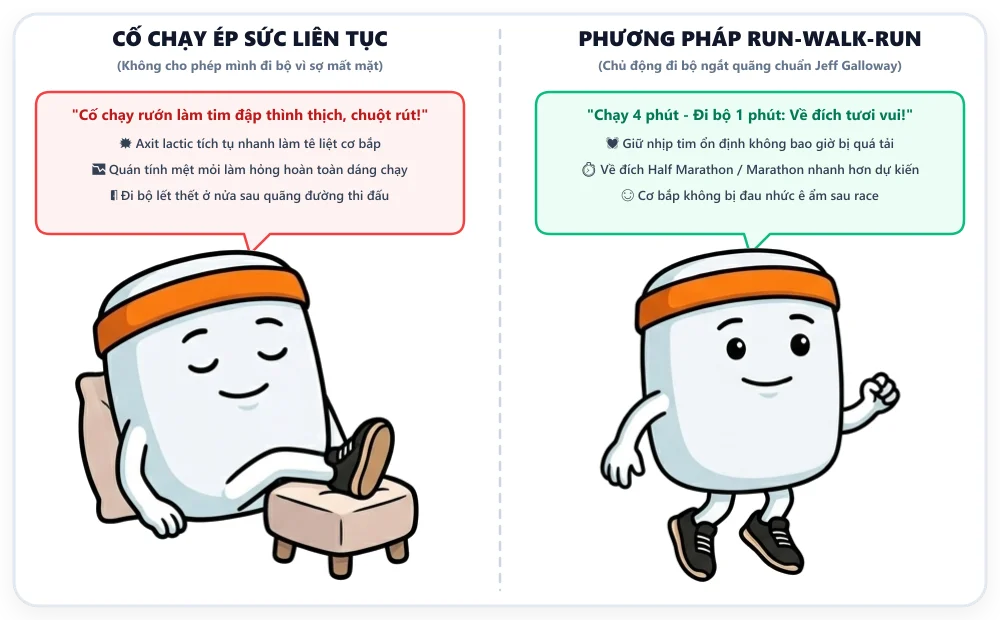
In the world of recreational running, there is an invisible but deeply ingrained bias: If you’ve laced up your shoes, you must run continuously; stopping to walk is a sign of weakness, lack of discipline, or failure.
However, one endurance training method has helped over 500,000 runners worldwide successfully complete distances from 5K to the Marathon (42.195km) completely injury-free. Many have even used it to set new Personal Records (PRs). This is the Run-Walk-Run Method, pioneered by American Olympic athlete Jeff Galloway in 1973.
The core of this method isn’t “walking when you’re exhausted.” It is the strategic use of short walking breaks from the very first kilometer, turning walking into a high-tech physiological tool to manage heart rate, conserve glycogen, and protect your legs.
The Biomechanics & Physiology Behind Tactical Walk Breaks
Why would someone using a run-walk strategy cross the marathon finish line faster and feeling fresher than someone attempting to run continuously for 42km? The answer lies in the body’s mechanical and biochemical adaptive mechanisms:
┌────────────────────────────────────────────────────────────────────────┐
│             PHYSIOLOGICAL MECHANISMS OF RUN-WALK-RUN                   │
├────────────────────────────────────────────────────────────────────────┤
│ 1. Motor Unit Rotation:                                                │
│    Continuous running forces the same Type I slow-twitch muscle fibers │
│    to bear load for thousands of strides. A 30-second walk shifts the   │
│    load, allowing key muscle groups to micro-recover.                  │
│                                                                        │
│ 2. Thermoregulation & Cardiovascular Relief:                           │
│    Walking lowers heart rate by 5–8 bpm, reducing metabolic heat       │
│    production and preventing cardiac drift in hot, humid weather.      │
│                                                                        │
│ 3. Lactic Acid Clearance & Glycogen Sparing:                           │
│    During the 30-second walk, increased oxygen flow helps clear         │
│    fatigue metabolites, optimizing fat oxidation as fuel.              │
│                                                                        │
│ 4. Cognitive Chunking:                                                 │
│    Your brain is no longer overwhelmed by a daunting 42km. The         │
│    challenge is broken down into manageable 2–3 minute segments.       │
└────────────────────────────────────────────────────────────────────────┘
Standard Run-Walk-Run Ratios by Target Pace
Jeff Galloway’s golden rule is: The walk breaks must start FROM THE VERY FIRST MINUTE, while your muscles are still fresh. If you wait until your legs feel like lead, micro-damage has already accumulated, and the recovery benefits are halved.
| Target Pace (min/km) | Run Segment | Walk Segment | Best Application |
|---|---|---|---|
| 8:30 – 10:00 | 30 sec | 30 sec | Beginners, injury recovery |
| 7:30 – 8:30 | 60 sec | 30 sec | Comfortable 5K – 10K finish |
| 6:30 – 7:30 | 90 sec | 30 sec | Sub 2:30 Half Marathon |
| 5:45 – 6:30 | 2 min | 30 sec | Sub 2:00 Half / Sub 4:30 Marathon |
| 5:00 – 5:45 | 3 min | 30 sec | Sub 3:45 – 4:00 Marathon |
| 4:15 – 5:00 | 4 min | 30 sec (or 15s) | BQ (Boston Qualifier) seekers |
You can estimate your finish time and energy distribution using our Race Predictor and Pace Calculator tools.
Smooth Transitions Between Running and Walking
A common mistake beginners make is braking hard when the walk starts, then jerking forward when it’s time to run again:
[SMOOTH TRANSITION TECHNIQUE]
├── 1. The 5-Second Warning: As your timer nears the end of the run,
│      gradually shorten your stride over the last 3 steps.
├── 2. Brisk Power Walk: Do not shuffle! Keep a brisk, purposeful pace,
│      upright posture, and rhythmic arm swing to keep blood flow steady.
└── 3. The Gentle Ramp-Up: After 30 seconds, ease back into your running
       pace over 3–5 steps rather than sprinting back to speed immediately.
Setting Up Your Smartwatch (Garmin / Coros / Apple Watch)
Avoid staring at your watch. Use the Run/Walk Interval Alert feature built into most modern devices:
- Garmin: Go to your
Runactivity ➔Run Settings➔Alerts➔Add New➔Run/Walk. Set your run time (e.g., 2:00) and walk time (e.g., 0:30). Your watch will vibrate/beep at each cycle transition. - Coros: Use the COROS app to create an
Interval Trainingworkout based on time and sync it to your watch.
Race Etiquette
When using Run-Walk in crowded races:
- Stay to the edge: Always stick to the side of the course, avoiding the middle where the main pack is surging.
- Signal your walk: About 3 seconds before you transition, raise one arm to signal to runners behind you so they can pass safely.
- Use aid stations: Time your walk breaks with water stops. It allows you to drink calmly and ingest gels without stomach distress.
See our guide on How to Use Energy Gels Without Stomach Issues.
Frequently Asked Questions (FAQ)
1. Will walking make my legs stiff and stop me from running again?
Stiffness only occurs if you stop completely or walk for too long (over 2–3 minutes), causing blood pooling and a drop in muscle temperature. Galloway’s 15–30 second brisk walk keeps the muscles warm and helps shed mental and physical fatigue.
2. Can I break Sub-4 in a Marathon using Run-Walk?
Absolutely. Thousands of athletes have achieved marathon times between 3:15 and 3:45 using a 4-minute run / 30-second walk ratio. By not exhausting your muscles in the final 10km, you can maintain a more consistent average speed than runners who fade at the end.
3. Is it good for short 5K runs?
Yes. For beginners who cannot run 5km in one go, a [1-min run / 1-min walk] ratio is the safest bridge to completing your first 5K without burnout.
*A message from Jeff Galloway: “Running is meant to improve your quality of life, expand your personal limits, and help you reach the finish line with a smile. Let science guide your stride.”
