
When you commit to lacing up and running for 30–45 minutes consistently every week, a silent but profound “biological revolution” begins within your cells. From your cardiovascular system and mitochondrial energy production to endocrine regulation and neural networks, every organ undergoes a reconstruction process to forge a fitter, more resilient version of you.
Under the lens of Evidence-Based Sports Medicine, these transformations aren’t just vague promises—they are biochemical shifts measurable at the 30, 60, and 90-day marks.
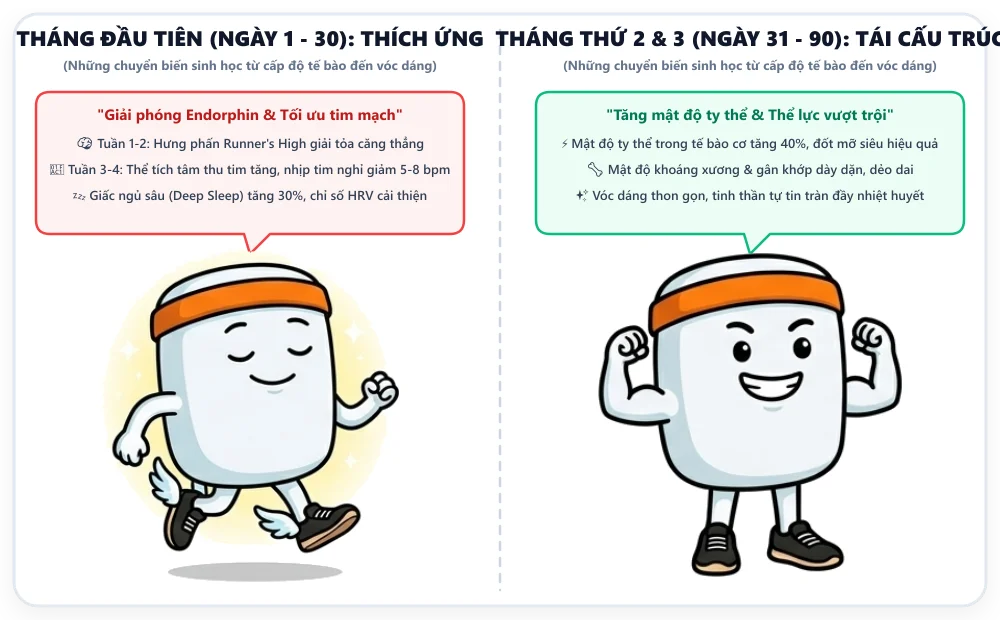
The Biological Adaptation Timeline
┌────────────────────────────────────────────────────────────────────────┐
│               THE RUNNER'S 90-DAY BIOLOGICAL TRANSFORMATION            │
├────────────────────────────────────────────────────────────────────────┤
│ 0 – 14 DAYS: Acute Adaptation & Plasma Volume Expansion                │
│ ▼                                                                      │
│ 15 – 30 DAYS: Mitochondrial Biogenesis & Aerobic System Awakening      │
│ ▼                                                                      │
│ 31 – 60 DAYS: Vascular Remodeling & Visceral Fat Metabolism            │
│ ▼                                                                      │
│ 61 – 90 DAYS: Bone Density Gains, VO2Max Peaks & Neural Rebuilding      │
└────────────────────────────────────────────────────────────────────────┘
Phase 1 (Days 1–30): Awakening Energy Systems
In the first month, your body shifts from sedentary stagnation to an endurance-based movement machine:
[1. PLASMA VOLUME EXPANSION]
- After 7–10 days of consistent running, plasma volume increases by 10%–15%.
- The Benefit: Thinner blood improves heart efficiency and boosts sweat-based cooling.

[2. LOWER RESTING HEART RATE (RHR)]
- RHR typically drops by 3–5 bpm as stroke volume (the amount of blood pumped per beat) increases.

[3. MITOCHONDRIAL BIOGENESIS]
- AMPK and PGC-1α enzymes trigger a 15%–20% increase in mitochondria (cellular power plants).
- Result: Stairs no longer leave you breathless.

[4. DEEP SLEEP IMPROVEMENT]
- Delta wave (deep sleep) and REM sleep duration increase by 15–20%, allowing the body to release Human Growth Hormone (HGH) for tissue repair.

[5. ENDOCANNABINOID RELEASE (THE REAL 'RUNNER'S HIGH')]
- Forget the endorphin myth; modern science confirms the release of Anandamide, an endocannabinoid that crosses the blood-brain barrier to reduce anxiety and stress.
Phase 2 (Days 31–60): Metabolism & Vascular Overhaul
In month two, metabolic markers and blood vessel health see a major breakthrough:
[6. VISCERAL FAT LOSS]
- Zone 2 training stimulates the release of free fatty acids from fat stores around organs.
- Expect a smaller waistline, even if the scale doesn't budge much due to muscle gains.

[7. IMPROVED INSULIN SENSITIVITY (GLUT4 TRANSLOCATION)]
- Muscle contraction triggers GLUT4 proteins to pull glucose from the blood into cells without needing excess insulin.
- This reduces the risk of Type 2 diabetes by up to 40%.

[8. NITRIC OXIDE SURGE & LOWER BLOOD PRESSURE]
- Blood flow friction against vessel walls stimulates Nitric Oxide (NO) production, naturally relaxing arteries and lowering systolic blood pressure by 5–8 mmHg.

[9. CAPILLARIZATION]
- Capillary density around muscle fibers increases by 20–30%, creating a superhighway for oxygen delivery.

[10. TENDON & LIGAMENT REINFORCEMENT]
- Type I collagen fibers in the Achilles and patellar tendons strengthen, improving elastic energy return.
Phase 3 (Days 61–90): Peak Performance & Brain Reconstruction
After 90 days, you officially possess the biological profile of an endurance athlete:
[11. INCREASED BONE MINERAL DENSITY (WOLFF’S LAW)]
- Impact loading stimulates piezoelectric effects, signaling osteoblasts to thicken the femur and tibia.

[12. VO2 MAX GAINS (12%–18%)]
- Your aerobic ceiling rises. A pace that felt like a threshold run on Day 1 now feels like a comfortable Zone 2 recovery effort.

[13. BDNF SURGE (NEUROGENESIS)]
- Elevated Brain-Derived Neurotrophic Factor levels promote new neuron growth in the hippocampus, boosting memory and critical thinking.

[14. ENHANCED IMMUNE FUNCTION]
- Increased activity of Natural Killer (NK) cells and IgA antibodies improves your defense against seasonal colds.

[15. MENTAL TOUGHNESS & DISCIPLINE]
- Overcoming hundreds of runs—regardless of weather or mood—hardens your psychological resilience against life's daily pressures.
Comparison: Sedentary vs. 90-Day Runner
| Biological Marker | Sedentary | 90-Day Runner | Long-Term Health Impact |
|---|---|---|---|
| Resting Heart Rate | 75–85 bpm | 55–65 bpm | Reduces lifetime cardiac load |
| Stroke Volume | 60–70 ml/beat | 90–110 ml/beat | 1.5x more efficient heart pump |
| VO2 Max | 28–35 ml/kg/min | 38–48 ml/kg/min | Correlated with longevity |
| Insulin Sensitivity | Low | Very High | Prevents metabolic disease |
| Mitochondrial Density | Low | Up 25%–35% | Higher daily energy levels |
| Bone Mineral Density | Age-related decline | Up 2%–4% annually | Prevents osteoporosis |
The Sweet Spot: How Much is Enough?
The Copenhagen City Heart Study, tracking 20,000 people over 35 years, identified a U-shaped curve for running benefits:
Mortality Risk
High  │ █ (Sedentary)
      │ █                                               █ (>100km/week)
      │ █                                              ██
      │ █                                            ████
      │  █                                          █████
      │   ██                                       ██████
      │     ████                                 ████████
Low   │         █████████████████████████████████
      └─────────────────────────────────────────────────────
0km/week 15 – 35 km/week (SWEET SPOT) > 90km/week- The Optimal Dose: 15km to 35km per week (3–4 runs, 30–50 minutes at Zone 2). This reduces all-cause mortality by 40% and adds 5–6 years to your life expectancy without overtraining your joints.
Frequently Asked Questions (FAQ)
1. Does running wear down my knees?
The opposite is true. Research in JOSPT involving 125,000 people found that recreational runners have a knee osteoarthritis rate of just 3.5%, compared to 10.2% in sedentary individuals. The cyclical loading of running nourishes the cartilage.
2. If I stop for 2 weeks, do I lose these benefits?
Plasma volume and enzymatic efficiency may dip slightly after 14 days. However, thanks to Muscle Memory and your established capillary network, you can return to 100% capacity in just 7–10 days of consistent training.
3. Can people over 50 see these results?
Absolutely. Neuroplasticity and muscular adaptation are lifelong processes. Seniors who adopt a scientific Run-Walk approach show similar gains in bone density and cardiovascular health as younger runners.
“A journey of a thousand miles begins with a single step. Lace up today—the gift of health is waiting for you 90 days from now!”
