Completing your first 5K without walking is a major milestone. Once you’ve conquered that initial barrier, the natural next question arises: “How do I step up to 10K safely and effectively?”
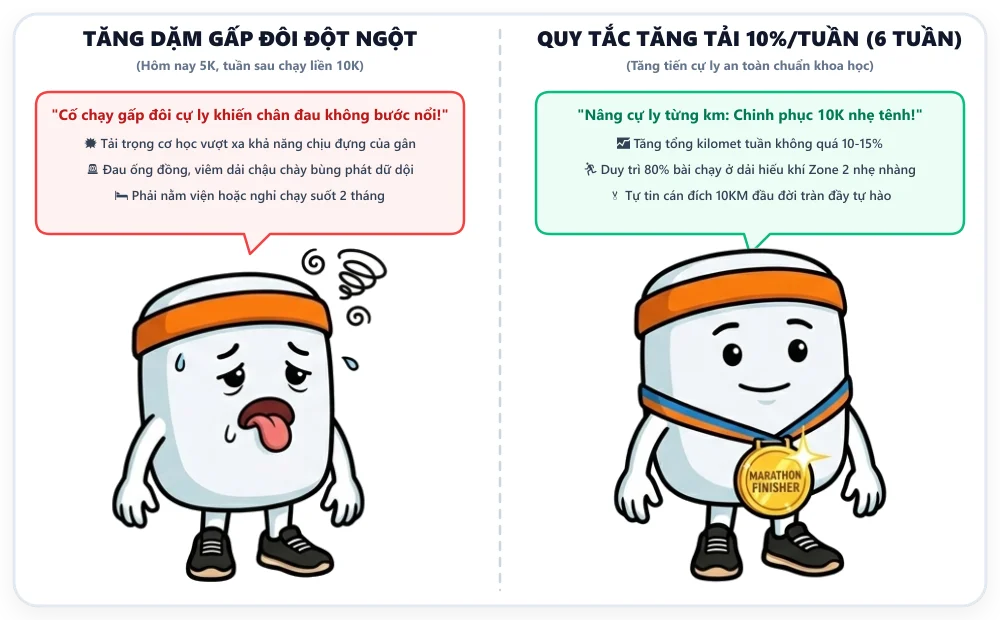
Doubling your distance isn’t just about “running a bit further.” From a sports physiology standpoint, the 10K is a true test of aerobic capacity, requiring your muscles, circulatory system, and connective tissues to handle load continuously for 50 to 75 minutes.
If you rush and double your volume in just a week or two, your musculoskeletal system won’t have time to adapt, leading to inevitable micro-trauma. Below is a structured 6-week roadmap to help you crush your first 10K at peak performance.
Physiological Shifts: The Difference Between 5K and 10K
To build an effective plan, you need to understand how your body fuels itself at these different distances:
┌─────────────────────────────────────────────────────────────┐
│                 5K RUN (HIGH-INTENSITY)                     │
├─────────────────────────────────────────────────────────────┤
│ • Duration: 25 – 35 minutes                                 │
│ • Intensity: 85% – 95% VO2Max                               │
│ • Energy System: ~85% Aerobic + ~15% Anaerobic              │
│ • Primary Challenge: Lactate threshold & acid buildup       │
└─────────────────────────────────────────────────────────────┘

┌─────────────────────────────────────────────────────────────┐
│                 10K RUN (AEROBIC ENDURANCE)                 │
├─────────────────────────────────────────────────────────────┤
│ • Duration: 50 – 75 minutes                                 │
│ • Intensity: 75% – 85% VO2Max                               │
│ • Energy System: ~92% – 95% Aerobic                         │
│ • Primary Challenge: Muscular endurance & pace maintenance  │
└─────────────────────────────────────────────────────────────┘
When running 10K, your body requires:
- Increased Capillarization: More capillaries around Type I (slow-twitch) muscle fibers to maintain oxygen delivery for over an hour.
- Mitochondrial Density: Your cellular energy factories must work efficiently to break down glycogen and fat into ATP.
- Connective Tissue Durability: Your Achilles tendons, IT bands, and shins must absorb the impact of roughly 8,000 to 10,000 footstrikes.
Are You Ready for 10K Training?
Don’t increase your mileage unless you meet these baseline requirements:
| Requirement | Benchmark | Why it matters |
|---|---|---|
| 5K Experience | Completed 5K runs consistently for 4–6 weeks | Cardiovascular system is adapted |
| Frequency | At least 3 runs/week | Consistent neuromuscular stimulus |
| Weekly Volume | 12 to 15 km/week | Structural bone and tendon health |
| Injury Status | No sharp pain in knees, shins, or heels | Avoids aggravating chronic issues |
The 3 Pillars of 10K Training
To finish a 10K strong, every week focuses on these three key workouts:
[1. THE LONG RUN]
- Run at an easy pace (Zone 2) conversational effort.
- Goal: Glycogen storage, mitochondrial development, and mental endurance.
- Distance progresses from 6km to 9km pre-race.

[2. TEMPO / THRESHOLD RUN]
- Run at a "comfortably hard" pace (Zone 3–4).
- Goal: Raise your lactate threshold, allowing you to sustain speed without fatigue.

[3. EASY RUN + STRIDES]
- 4–5km at Zone 2, finishing with 4x20-second strides.
- Goal: Maintain leg turnover and neuromuscular efficiency without added fatigue.
6-Week 10K Training Plan (3 Runs/Week)
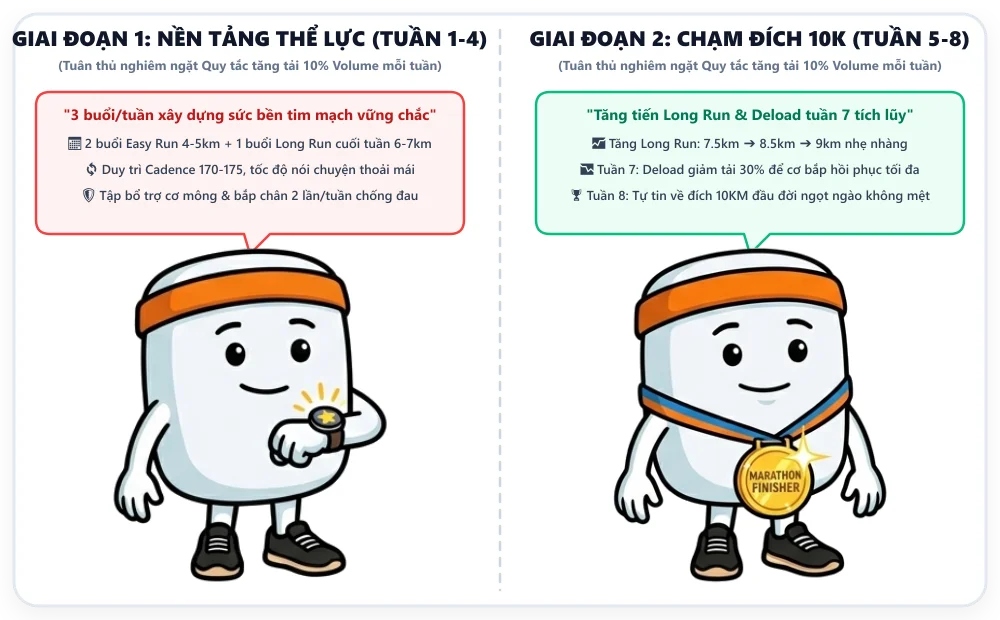
This plan uses a structured progression with a deload week in Week 4 to maximize supercompensation.
| Week | Tuesday (Easy) | Thursday (Quality: Tempo/Interval) | Sunday (Long Run) | Total km |
|---|---|---|---|---|
| 1 | 4 km Easy | 1km Warmup + [4 x 400m @ 5K Pace, 90s rest] + 1km Cooldown | 6.0 km | 14.5 km |
| 2 | 4.5 km Easy | 1km Warmup + 3 km Tempo Run + 1km Cooldown | 7.0 km | 16.5 km |
| 3 | 5.0 km Easy | 1km Warmup + [5 x 400m @ 5K Pace, 90s rest] + 1km Cooldown | 8.0 km | 18.5 km |
| 4 (Deload) | 4.0 km Easy | 4.0 km Easy + 4x 20s Strides | 6.0 km | 14.0 km |
| 5 | 5.0 km Easy | 1km Warmup + 4 km Tempo Run + 1km Cooldown | 9.0 km (Peak) | 20.0 km |
| 6 (Race) | 4.0 km Easy | 3.0 km Easy + 3x 15s Strides | 10K RACE DAY! | 17.0 km |
You can calculate your specific zones via our Pace & Heart Rate Calculator.
The Secret to a Negative Split
The biggest mistake for new 10K runners is going out too hard in the first 2km. By km 5–6, you hit the wall and suffer for the final 4km.
Apply the Negative Split strategy (running the second half faster than the first):
[PHASE 1: 0–3 KM (CONTROL THE EXCITEMENT)]
- Run 10–15 seconds/km SLOWER than your goal pace.
- Let your muscles warm up, stabilize your HR, and find your rhythm.

[PHASE 2: 3–7 KM (CRUISE CONTROL)]
- Settle into your goal pace.
- Focus on a 2:2 breathing pattern and controlled footstrikes under your center of mass.

[PHASE 3: 7–10 KM (THE FINISH KICK)]
- If you feel strong, pick up the pace 5–10 seconds/km faster than goal pace.
- Use the final 500m to sprint through the finish line!
Nutrition & Hydration
- Pre-run meal (2–3 hours before): Complex carbs like a small baked sweet potato, two slices of toast with a banana, or a bowl of oatmeal. Avoid heavy fats or dairy.
- Hydration: Since you’ll be running for 50–75 minutes, your glycogen stores are sufficient; gels are generally not required. Take small sips (60–100ml) of water or electrolyte drink every 2.5–3 km.
10K Training FAQ
1. If my longest run is 9km, can I really finish 10km?
Absolutely! In sports science, you don’t need to run 100% of your race distance in training. Completing a 9km run on tired legs proves you are ready. With a proper taper in the final week and race-day adrenaline, that last kilometer will feel easier than you think.
2. Should I make up for a missed workout?
Don’t double up. If you miss a Tuesday session, let it go and stick to the Thursday schedule. Compressing workouts increases injury risk significantly.
3. How soon can I jump to a Half Marathon (21K) after my 10K?
I recommend maintaining your 10K fitness for 6 to 8 weeks to consolidate your bone density and aerobic foundation before starting a 10–12 week Half Marathon program.
🗺️ Your Progression Path:
- Still building to 5K? Start with the Couch to 5K (C25K) 9-Week Plan.
- Need an 8-week 10K alternative? Check out our 8-Week 10K Plan.
- Ready for the Half? Try the Half Marathon Plan for Busy Runners.
- Race day strategy: The First 5 Minutes of a Race.
- Master the Negative Split Strategy.
From the Thích Chạy Bộ team: 10K is a magical milestone in any runner’s journey. Enjoy every kilometer of training and run with confidence!
