
Walking into a large sports store or scrolling through running groups can be overwhelming. You’re bombarded with technical jargon: supercritical PEBA foam, 40mm stack heights, carbon plates, and 10mm heel drops—with prices ranging from modest to astronomical.
Many newcomers, swayed by flashy marketing, buy high-end, rigid carbon-plated marathon super shoes. A few runs later, they’re left dealing with Achilles tendonitis, ankle instability, and black, bruised toenails.
Your first pair of running shoes is the most critical investment in your long-term success. Choose wrong, and you’re risking injury; choose right, and you’ll fall in love with the sport. Here is a scientific, no-nonsense guide to finding your perfect pair.
The Anatomy of a Running Shoe: 3 Core Components
Before you shop, understand what you’re looking at:
┌─────────────────────────────────────────────────────────────┐
│ 1. UPPER: Engineered Mesh                                   │
│    └── Provides a secure lockdown, heel counter stability,  │
│        and essential breathability.                         │
├─────────────────────────────────────────────────────────────┤
│ 2. MIDSOLE: The Heart & Soul                                │
│    └── Contains the foam for energy return and impact       │
│        absorption; may include a plate/shank for stability. │
├─────────────────────────────────────────────────────────────┤
│ 3. OUTSOLE: Durable Rubber                                  │
│    └── Provides grip and protects the softer midsole foam.  │
└─────────────────────────────────────────────────────────────┘
Understanding Foot Type & Pronation
How your foot strikes the ground is the most important factor in preventing knee and ankle issues. Use the Wet Foot Test: Wet the sole of your foot and step onto a dark piece of cardboard.
┌──────────────────┬──────────────────┬──────────────────┐
│ NORMAL ARCH      │    FLAT FOOT     │  HIGH ARCH       │
│                  │                  │                  │
│      █ █ █       │      █████       │      █   █       │
│      █           │      █████       │                  │
│      █           │      █████       │                  │
│      █ █ █       │      █████       │      █ █ █       │
├──────────────────┼──────────────────┼──────────────────┤
│ Neutral          │ Overpronation    │ Supination       │
└──────────────────┴──────────────────┴──────────────────┘
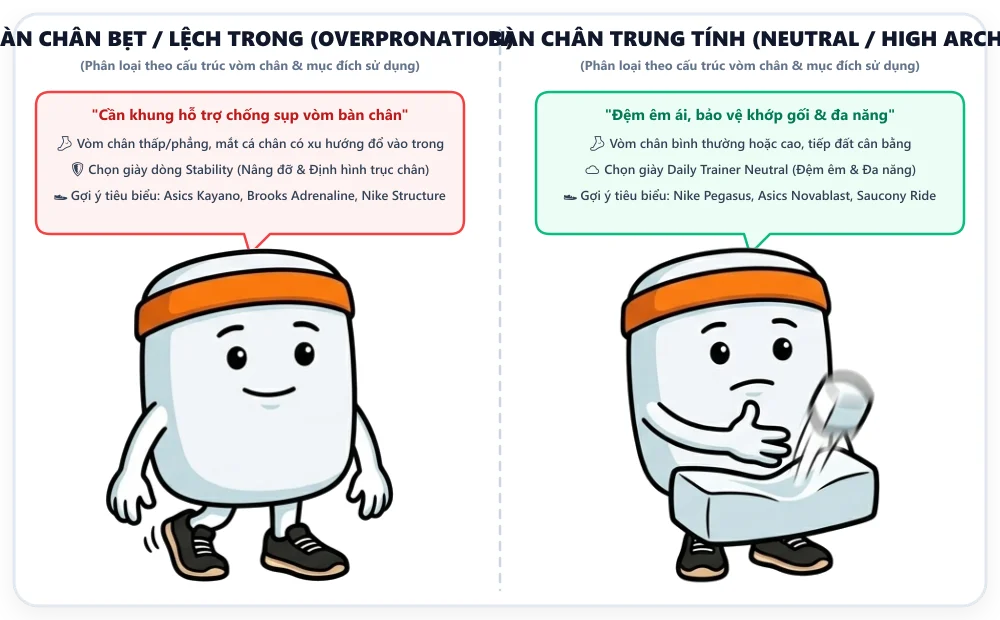
1. Neutral Pronation
- Footprint: The arch shows a distinct curve. Your foot rolls slightly inward (about 15%) to naturally absorb shock.
- Recommended Shoes: Neutral trainers. This is the largest market segment, offering a smooth, natural ride (e.g., Nike Pegasus 41, Puma Velocity Nitro 3, Asics Novablast 4, Saucony Ride 17, Xtep 2000km).
2. Overpronation (Flat Feet)
- Footprint: The entire sole is visible; little to no arch curve. Upon landing, your arch collapses inward, causing your ankle to roll. This often leads to shin splints and knee pain.
- Recommended Shoes: Stability shoes. These feature medial posts, GuideRails, or dual-density foam to prevent the foot from rolling too far inward (e.g., Asics Gel-Kayano 31, Brooks Adrenaline GTS, Puma ForeverRun Nitro).
3. Supination (High Arches)
- Footprint: Only the heel and ball of the foot show clearly, with a very thin or broken outer band. High arches are rigid and poor at natural shock absorption.
- Recommended Shoes: Max-cushioned neutral shoes to compensate for the lack of natural shock absorption (e.g., Asics Gel-Nimbus 26, New Balance Fresh Foam 1080v13, Saucony Triumph 22).
Test your own gait and foot strike using our Running DNA Tool.
Which Heel-to-Toe Drop is Right for Newbies?
Drop is the height difference between the heel and the forefoot (measured in millimeters).
[LOW DROP: 0mm – 4mm]
- Puts significantly more demand on the Achilles tendon and calves.
- NOT RECOMMENDED for beginners due to higher risks of tendonitis and plantar fasciitis.

[STANDARD DROP: 8mm – 10mm]
- Shifts pressure away from the Achilles and calves toward the quads and knees.
- THE SAFEST CHOICE for beginners while your joints and tendons adapt to training.
Should Beginners Buy Carbon-Plated “Super Shoes”?
Sports medicine experts give a definitive answer: ABSOLUTELY NOT.
┌────────────────────────────────────────────────────────────────────────┐
│            WHY NEWBIES SHOULD AVOID CARBON RACERS                      │
├────────────────────────────────────────────────────────────────────────┤
│ 1. Excessive Longitudinal Bending Stiffness:                           │
│    The plate acts as a lever; if your feet/legs aren't conditioned,     │
│    it strains the Achilles and peroneal tendons, causing injury.       │
│                                                                        │
│ 2. Lack of Stability:                                                  │
│    Super-soft PEBA foam and high stack heights (40mm) create a wobbly  │
│    platform, increasing the risk of ankle rolls.                       │
│                                                                        │
│ 3. Short Lifespan & High Cost:                                         │
│    These shoes last only 250–350 km and cost a fortune. Not ideal.     │
└────────────────────────────────────────────────────────────────────────┘
The Sweet Spot: Stick to Daily Trainers. They offer 800–1,000 km of durability, reliable stability, and just enough cushioning to protect your joints.
The Golden Rule of Sizing: Always Size Up!
A common mistake leading to Runner’s Toe (blackened toenails) and blisters is buying the same size you wear in dress shoes or sneakers.
[THE THUMB RULE]
- When you're standing in your laced-up shoes, there should be about 1.0 cm to 1.5 cm
  (roughly a thumb's width) of space between your longest toe and the front of the shoe.
Why you need that extra room:
- Foot Swelling: Your feet naturally expand during long runs as blood flow and temperature increase.
- Toe Impact: When you land, your feet slide forward slightly. Without room, your toes will repeatedly slam into the front of the shoe, causing bruised or lost nails.
Convert sizes across US, UK, EU, and CM standards using our Size Converter.
Top Daily Trainers for Beginners
| Shoe Model | Brand | Best For | Highlights | Price Range |
|---|---|---|---|---|
| Xtep 2000km v2 | Xtep | Durability | 1,500km+ lifespan, supercritical foam | $45 - $60 |
| Puma Velocity Nitro 3 | Puma | Versatility | World-class PumaGrip outsole, plush Nitro foam | $75 - $100 |
| Nike Pegasus 41 | Nike | Consistency | Reliable, comfortable ReactX foam | $100 - $140 |
| Asics Novablast 4 | Asics | Max Cushion | Fun, bouncy FF BLAST+ ECO foam, rocker geometry | $115 - $145 |
| Li-Ning Red Hare 7 Pro | Li-Ning | Lightweight | Airy mesh, lightweight Boom foam | $50 - $65 |
Compare specs and stats using our Running Shoe Comparator.
4 Tips for Trying Shoes In-Store
- Shop in the evening: Your feet naturally swell throughout the day, so this mimics the state of your feet during a run.
- Wear your running socks: Dress socks are too thin; use the actual socks you’ll run in.
- Use the Runner’s Knot: Use the extra eyelet for a heel lock to see if your heel stays secure or slips.
- Check the Toe Box: Ensure your toes have enough room to spread naturally (toe splay).
Beginner FAQs
1. How many kilometers do shoes last?
Most daily trainers last between 600 and 800 kilometers. After that, the midsole foam packs out and loses its rebound, increasing your injury risk.
2. How do I shop for wide feet?
Look for models labeled Wide (2E) for men or (D) for women from brands like Asics, New Balance, or Brooks. Asian brands often naturally cater to wider foot shapes as well.
3. Should I use one pair for everything?
For the first 3–6 months, one high-quality daily trainer is all you need. As your volume exceeds 30km/week, you can consider a shoe rotation to vary the load on your muscles.
Advice from Thích Chạy Bộ: The best shoe isn’t the most expensive or the one with the most hype—it’s the one that fits your foot and feels the most comfortable mile after mile.


