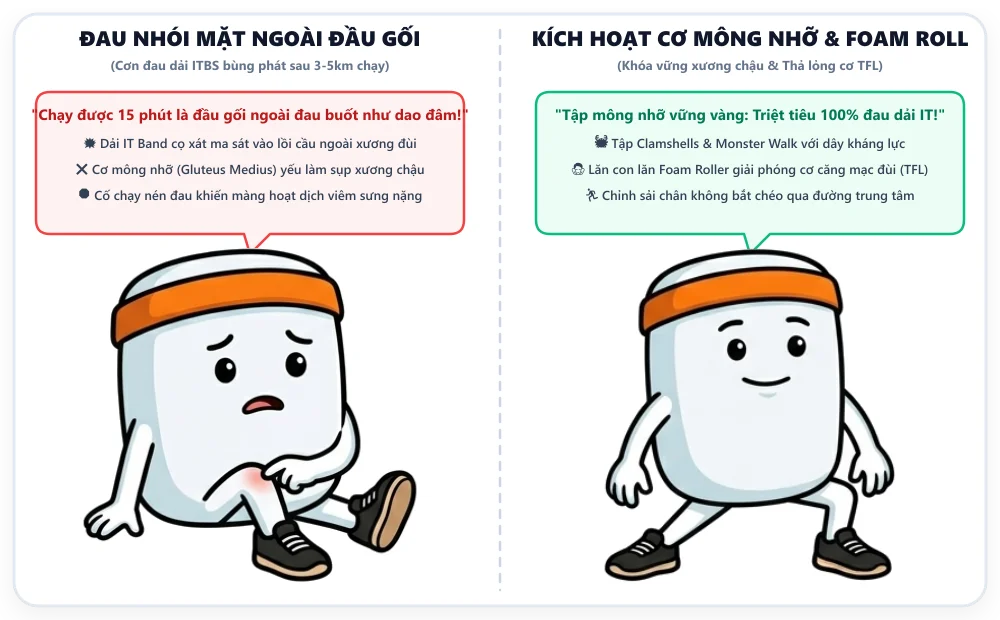
A sharp, stabbing pain on the outside of the knee after hitting the 5km or 8km mark of a long run is a familiar, haunting experience for many runners. It often starts as a dull ache, but intensifies as mileage increases or when tackling downhill terrain. Walking provides temporary relief, but the moment you resume running, that familiar ‘needle-prick’ sensation returns to the lateral femoral epicondyle.
This is the classic clinical presentation of Iliotibial Band Syndrome (ITBS). For decades, ITBS has been misunderstood, leading thousands of runners to follow outdated protocols that turn a few weeks of downtime into months of chronic injury.
Anatomy & The True Nature of ITBS Pain
To resolve ITBS, we must first decode the biological structure of the IT band and the mechanism of pain through the lens of modern sports medicine.
[Iliac Crest & Pelvis]
         │
         ▼
[Tensor Fasciae Latae (TFL) + Gluteus Maximus]
         │
         ▼
[Iliotibial Band - Dense Fibrous Fascia]
         │
         ▼
[Vascularized Fat Pad & Sensory Nerves] ◄── [Compression Site]
         │
         ▼
[Lateral Femoral Epicondyle]
         │
         ▼
[Gerdy's Tubercle on the Tibia]
1. The IT Band is Not a ‘Stretchy’ Tendon
The IT band is a dense fibrous fascia composed primarily of tightly woven Type I collagen fibers. It originates at the iliac crest, blends with the TFL and gluteus maximus, and anchors firmly to Gerdy’s tubercle on the tibia. Because of its rigid structure, the IT band has a biological elasticity of only 1% to 2%. This means you cannot ‘stretch’ the IT band. Any attempt to stretch it only affects the TFL and gluteal muscles above the hip.
2. Friction vs. Compression: The Modern Understanding
- Old Theory (Friction Theory - 1989): Suggested the IT band snapped back and forth over the lateral femoral epicondyle like a cable, irritating a bursa.
- Modern Findings (Fairclough et al. 2006, 2007): There is no independent bursa at this site. Instead, the IT band is anchored to the femur. When the knee is flexed at approximately 30 degrees (the early stance phase of running), the IT band shifts and compresses a highly vascularized, nerve-rich fat pad against the lateral femoral epicondyle.
This repetitive compression over thousands of strides triggers neurovascular inflammation, causing the signature sharp pain of ITBS.
Biomechanical Roots: Why Your Knee Hurts Because of Your Hips
While the pain is felt at the knee, the biomechanical overload originates from kinetic imbalances in the hips and glutes.
| Biomechanical Factor | Mechanism of IT Band Pressure | Real-World Running Symptom |
|---|---|---|
| Weak Gluteus Medius | Opposite pelvis drops (Trendelenburg sign), forcing the femur into internal rotation and adduction | Hip swaying, unstable gait, knee collapsing inward |
| Crossover Gait | Foot lands past the body’s midline (like a runway model) | Increased hip adduction, tightening the IT band against the femur |
| Low Cadence (< 165 spm) | Increased Ground Contact Time and vertical oscillation | 15–20% higher impact forces on the knee |
| Downhill Running | Knee flexion angle stays locked at the ‘danger zone’ of 30 degrees | Sharp pain after just 1–2 km of descending |
[Foot Strike]
         │
         ▼
[Weak Gluteus Medius]
         │
         ▼
[Pelvic Drop (Trendelenburg)]
         │
         ▼
[Femoral Internal Rotation + Adduction]
         │
         ▼
[IT Band Stretched Like a Bowstring]
         │
         ▼
[Compression of Fat Pad at 30° Flexion] ──► [ITBS Pain]
Common Mistakes in ITBS Management
Aggressive Foam Rolling on the Knee
Using a hard roller or massage ball directly on the lateral knee is counterproductive. You are crushing an already inflamed fat pad. Golden Rule: Only foam roll the glutes and TFL at the hip. Never roll the lower third of the outer thigh.
Passive Rest Followed by Immediate Return to Full Volume
Resting reduces inflammation but does not strengthen the glutes or correct gait. Returning to your previous mileage without addressing the underlying mechanics will cause the pain to return by the 3rd kilometer.
Over-reliance on NSAIDs
Using painkillers to ‘push through’ a long run leads to chronic inflammation and potential tissue changes around Gerdy’s tubercle, which can take 6–12 months to heal.
The 4-Phase Functional Recovery Protocol
Recovery is based on increasing Tissue Load Capacity while strengthening the hip chain.
Phase 1: Acute Unloading & Isometric Loading
- Temporary Modification: Stop long runs, downhill running, and speed work. Switch to cycling (with a higher saddle to keep knee flexion < 30°) or swimming with a pull buoy.
- Isometric Side-Lying Hip Abduction: Lie on your side, bottom leg bent, top leg straight and slightly behind. Lift to 30 degrees and hold for 30–45 seconds. This inhibits pain signals and maintains gluteal tone without friction.
Phase 2: Isotonic Strengthening
Once pain-free in daily life, move to full-range resistance:
- Mini-Band Clamshells: 3 sets of 12–15 reps.
- Side Plank with Hip Abduction: 3 sets of 10–12 reps.
- Standing Hip Hitch (Pelvic Drop): 3 sets of 12–15 reps to train pelvic stability.
Phase 3: Dynamic Stability & Load Integration
- Single-Leg Romanian Deadlift (RDL): Focuses on hip stability and preventing internal knee rotation.
- Bulgarian Split Squat: Ensures the knee tracks over the second toe, preventing valgus collapse.
Technical Adjustments to Reduce IT Band Load by 30%
1. Widen Your Step Width
If you have a crossover gait, your IT band is constantly under tension. Aim to land with your feet 3–5 cm apart relative to a center line. Research shows this simple change reduces hip adduction and IT band compression by 20–25%.
2. Increase Cadence by 5–7%
Increasing your cadence (e.g., from 160 to 170 spm) reduces overstriding and keeps the knee out of the ‘danger zone’ of 30-degree flexion.
3. Avoid Cambered Roads
Running on the sloped edge of a road forces one leg into constant hip adduction. Stick to flat surfaces or switch sides frequently.
Return-to-Run Checklist
Before running again, you must pass these tests:
- Single-Leg Squat: 15 reps without pain or knee collapse.
- Single-Leg Hop: 30 consecutive hops without sharp pain.
- Stair Test: Descending 3 flights of stairs pain-free.
Progression: Start with a Run/Walk approach (e.g., 1 min run/2 min walk) for 20 minutes, 3 times a week, gradually increasing the run ratio over 4 weeks.
Medical Disclaimer: This article is for educational purposes. If you experience severe swelling, instability, or pain following a direct trauma, consult a sports medicine specialist or orthopedic doctor to rule out meniscus tears or other structural injuries.
