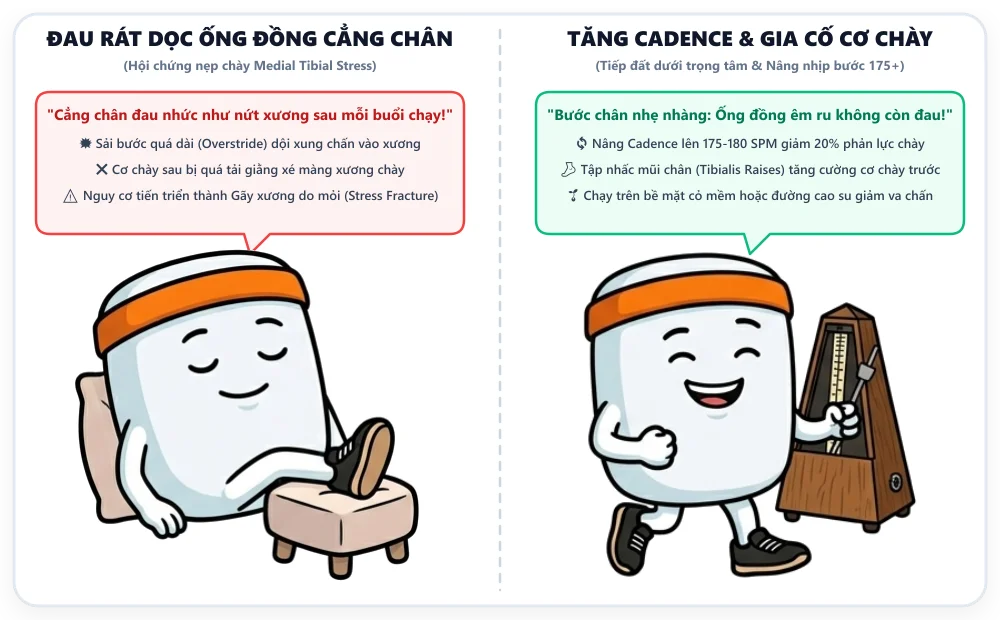
That burning sensation along your shinbone after a run—many runners brush it off, thinking, “It’s normal, I’ll get used to it in a few days.” This is one of the most dangerous myths in running, and it’s time to drop it for good.
Shin splints—medically known as Medial Tibial Stress Syndrome (MTSS)—are not just “muscle soreness from breaking in.” They are a stress reaction of the tibia caused by repetitive loading that outpaces the bone’s ability to remodel. If ignored, MTSS can progress into a stress fracture—and instead of taking 2–4 weeks off, you’ll be sidelined for 3 to 6 months.
This article breaks down what is actually happening inside your body during shin splints, how to differentiate them from worse injuries, and most importantly, how to treat them properly so you can return to running safely.
What Exactly Are Shin Splints?
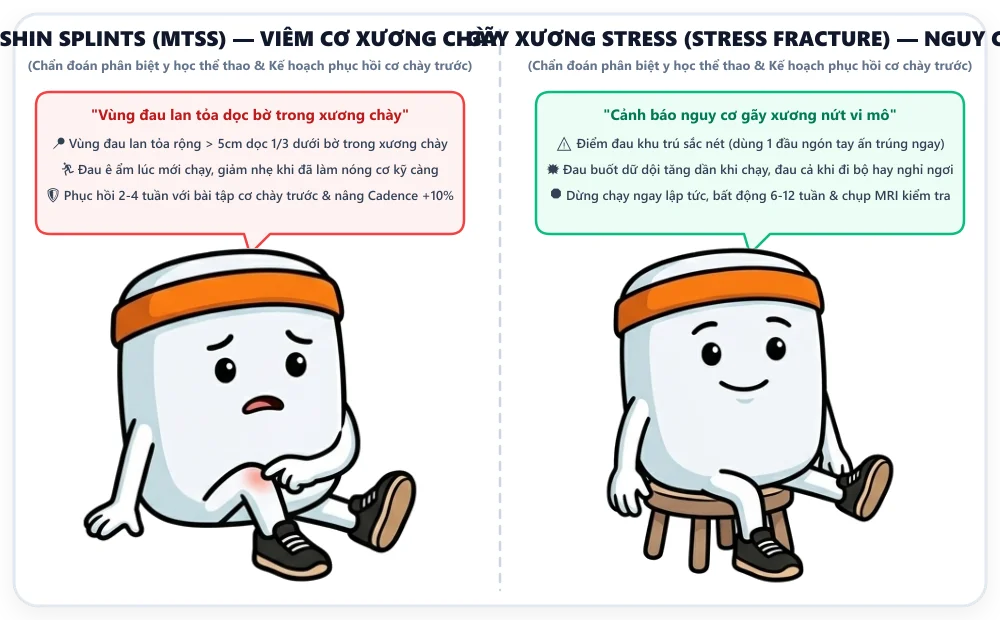
While the term “shin splints” sounds vague, sports medicine has a precise definition: Medial Tibial Stress Syndrome (MTSS). The pain is located along the posteromedial border of the tibia and typically stretches over a span of 5 cm or more.
The core mechanism: every time your foot strikes the ground while running, impact forces travel up your shinbone. Normally, bones undergo bone remodeling to adapt to new loads. But when the workload ramps up too fast—sudden mileage spikes, new running surfaces, or simply dead shoes—the remodeling process falls behind, leading to an accumulation of microdamage in the cortical bone. MRI scans of runners with MTSS often reveal bone marrow edema and periosteal reaction along the inner border of the tibia.
Simply put: shin splints are your shinbone screaming for help because you increased your load faster than it could handle.
Who Is Most At Risk?
Studies on thousands of runners show that 13% to 20% of runners will experience MTSS at some point—a figure that jumps to 35% among military recruits and high-intensity athletes. Females also show a higher prevalence than males (roughly 16.8% vs. 10.7%, according to a study published in the JOSPT).
Key risk factors:
- Ramping up mileage or intensity too fast — the #1 culprit. Especially dangerous when a single long run increases by more than 10% compared to the longest run in the last 30 days (according to a 2025 cohort study of 5,200 runners published in the BJSM).
- Flat feet or excessive pronation — a high navicular drop increases torsional stress on the tibia.
- Weak lower leg muscles — specifically the soleus (deep calf muscle) and tibialis posterior. When these muscles fatigue, the tibia has to shoulder extra impact forces.
- High BMI — impact forces per step scale directly with body weight.
- Hard running surfaces — pounding concrete consistently increases ground reaction forces compared to trails or asphalt.
- Worn-out shoes — midsole cushioning degrades after 500–800 km, significantly dropping shock absorption capacity.
- History of previous MTSS — this is the single strongest predictor of recurrence.
The Three Stages of Shin Splints — Where Do You Stand?
Shin splints don’t happen overnight; they progress along a spectrum. Identifying your current stage helps you make the right call:
Stage 1 — Annoying but runnable: A dull ache along the shin appears at the start of a run, might ease up once you “warm up,” and returns after the run or late in the day. Pressing along the inner border of the tibia feels slightly tender, but the pain zone is broad (over 5 cm). This is the golden window for intervention—with proper load management, recovery takes just 1–2 weeks.
Stage 2 — Gait disruption: Pain becomes more noticeable and no longer disappears during the warm-up. You unconsciously alter your running form (leaning, shortening your stride on the painful leg). Pain lingers for hours after you stop running. You need to pause running and switch to cross-training.
Stage 3 — Pain at rest: Hurts while walking, climbing stairs, or even resting. High risk of progressing into a stress fracture. Stop all impact activities and see a doctor immediately.
Shin Splints vs. Stress Fracture — A Fine But Critical Line
This is the most crucial part of this article. Many runners confuse these two injuries, and that confusion can turn 4 weeks of rest into 4 to 6 months off.
| Shin Splints (MTSS) | Stress Fracture | |
|---|---|---|
| Pain Location | Diffuse along the inner shin, over 5 cm | Localized to a single spot, under 5 cm—you can point to it with one finger |
| Pain Character | Dull, heavy, aching | Sharp, stabbing like a knife |
| While Running | May ease up during the warm-up | Hurts more the longer you run, does not subside |
| At Rest | Pain stops once you finish running | Still hurts at rest, can wake you up at night |
| Hop Test (Single-Leg) | Usually can complete it, though uncomfortable | Sharp pain, unable to perform 10 consecutive hops |
The At-Home “Hop Test”
Stand on your affected leg and try to perform 10 single-leg hops. If you can’t finish due to sharp pain in a very specific spot—that’s a major red flag. Stop running immediately and book an appointment with a sports medicine doctor or get an MRI.
Note: The hop test is just a preliminary screening tool, not a medical diagnosis. If you suspect you’re on the fence, prioritize safety and get checked out.
If you’re unsure which category your injury falls into, try the Preliminary Injury Diagnosis Tool to map out your next steps.
When to Stop Running Immediately — And When You Can Keep Jogging
Stop running right away if:
- You feel sharp pain at a single, pinpoint spot (suspected stress fracture)
- It hurts during normal walking or at rest
- You cannot complete 10 single-leg hops on the injured leg
- Pain hasn’t improved after 2–3 weeks of reduced load
- You have to alter your running gait to compensate for pain
You can continue easy running if:
- Pain stays below 3/10 while running (on the VAS pain scale)
- Pain decreases or disappears during the warm-up
- Pain returns to baseline within 24 hours post-run
- The pain area is broad and diffuse (not pinpoint)
The 3/10 Rule: If pain exceeds 3/10 during your run, or fails to return to baseline within 24 hours, you’ve crossed your current tolerance threshold. Cut your volume further or switch entirely to cross-training (swimming, cycling, elliptical).
Root Causes — And Why “Rest and Return” Usually Isn’t Enough
Many runners get shin splints, take 2 weeks off, return to running the exact same way—and get hurt again. Why? Rest treats the symptom, not the cause. You must address several factors simultaneously:
Training Load Management
A cohort study of 5,200 runners (BJSM 2025) found that single run distance is a much stronger injury predictor than total weekly mileage. In other words, stretching your long run from 15 km to 21 km in a single week is far riskier than bumping total weekly mileage from 40 to 45 km.
Practical rule of thumb: do not let any single run exceed 10% of your longest run from the past 30 days.
Note: The traditional “10% rule” (increasing total weekly mileage by ≤ 10%) is still a useful guide for beginners, but it’s not foolproof—you must pair it with listening to your body and managing intensity.
Lower Leg Strength Training
Weak lower leg muscles = your shinbone bears extra force. You need to break this cycle with systematic strength work (covered in the next section).
Shoe Inspection
Running shoes should be replaced every 500–800 km (depending on runner weight and surface). If you’re running in shoes that have maxed out their mileage, the midsole may have lost a huge chunk of its shock-absorption capacity.
Regarding insoles: a 2023 meta-analysis showed that anti-pronation insoles are effective at preventing MTSS (moderate level of evidence). Conversely, pure shock-absorbing insoles do not prevent shin splints (high level of evidence). So if you have flat feet or significant pronation, orthotic insoles are worth considering—just don’t expect “super plush” insoles to solve the root problem.
Cadence Adjustments
Overstriding (landing with your foot too far out in front of your center of mass) spikes impact forces on the tibia. Increasing your cadence by 5–10% naturally shortens your stride and dampens impact on your shins. No need to chase the magical “180 spm” target—just bump it up slightly from your natural baseline.
At-Home Rehab Exercises
Here are the exercises backed by clinical practice. General rule: only perform them pain-free. If an exercise causes pain, dial back the intensity or drop it temporarily.
Calf Raises — Building the Foundation
Goal: Build calf endurance (gastrocnemius + soleus) to offload the tibia.
- Stand on a flat surface, raise your heels up and lower down slowly.
- Start double-leg, 3 sets of 15 reps. Build up to single-leg × 20–25 pain-free reps before adding load.
- Bent-knee calf raise variation: targets the soleus—the most crucial muscle in the running shock-absorption chain.
Eccentric Calf Raises — The Advanced Phase
Goal: Strengthen the tendon-muscle complex under eccentric load.
- Stand on a step, push up with both feet, and lower down slowly (3–5 seconds) on a single leg below the step level.
- 3 sets of 10–12 reps per leg.
- Note: Only start this once you can comfortably hit 20–25 basic calf raises pain-free. Eccentric work places high stress on the tibia—doing it too soon can backfire.
Toe Raises / Tibialis Raises — The Front of the Shin
Goal: Strengthen the tibialis anterior, which controls foot deceleration during footstrike.
- Stand with your back against a wall, lift your toes up (keeping heels on the floor), hold for 2 seconds, and lower slowly.
- 3 sets of 15–20 reps.
- Progression: stand on a step with your heels hanging off, lower your toes down and pull them back up.
Hip & Glute Strengthening — Don’t Forget the Kinetic Chain
Weak glutes lead to pelvic drop, which increases tibial torsion. Add these:
- Clamshells: 3 sets of 15 reps per side
- Single-leg glute bridges: 3 sets of 12 reps per side
- Side-lying hip abduction: 3 sets of 15 reps per side
Stretching — Easing Tightness
- Gastrocnemius stretch (straight knee, back leg pressing heel to the floor): hold 30 seconds × 3 times
- Soleus stretch (slightly bent knee, heel still touching the ground): hold 30 seconds × 3 times
Perform these exercises daily during your recovery phase. When you return to running, keep them in your routine 3–4 times a week as injury insurance.
Return-to-Running Roadmap
Once you hit these criteria, you can safely start running again:
✅ Walk for 30 continuous minutes pain-free ✅ Pressing along the inner border of the tibia is no longer tender ✅ 10 single-leg hops on the injured leg—pain-free ✅ Single-leg calf raise × 20 reps—pain-free
Weeks 1–2: Alternate walk-run intervals. For example: run 2 minutes – walk 1 minute × 6–8 rounds. Stick to soft surfaces (track, trail, treadmill).
Weeks 3–4: Gradually increase continuous running time and shrink walking breaks. Keep your pace easy (Zone 1–2).
Weeks 5+: Slowly rebuild your old mileage, keeping long run increases under 10% week-over-week. Hold off on tempo runs or intervals for now.
If pain creeps back at any stage—drop back a step. Don’t force it.
Prevention — Because Treating Injuries Always Costs More
A 2023 GRADE-system systematic review highlighted two proven preventive interventions for MTSS:
- Neuromuscular training (lower leg strength + foot stability + glute/core work)—backed by high-quality evidence.
- Anti-pronation insoles (overpronation insoles)—moderate evidence, especially for runners with heavy pronation.
Not recommended: standalone shock-absorbing insoles, isolated stretching programs.
Practical prevention checklist:
- ✅ Train your lower legs (calf raises + tibialis raises) at least 3x/week
- ✅ Keep long run increases under 10% compared to the prior month
- ✅ Replace running shoes every 500–800 km
- ✅ Mix up your running surfaces (asphalt, track, trail)—avoid hammering concrete exclusively
- ✅ Boost your cadence by 5–10% if you tend to overstride
- ✅ Re-evaluate your glutes and hips if you notice a chronic pelvic drop
Frequently Asked Questions
Do shin splints go away on their own?
In mild stages (hurting during a run but fading at rest), shin splints can improve if you cut your volume properly and add strength work. However, if you change nothing—no mileage cut, no strength work, worn-out shoes—the pain will return and likely worsen. “Going away on its own” doesn’t mean the root cause magically fixed itself.
Should I keep running with shin splints?
It depends on the severity. If pain is under 3/10, fades during warm-up, and returns to baseline within 24 hours, you can maintain light running at a lower volume. If pain tops 3/10, messes with your running form, or lingers at rest—stop running, cross-train with swimming or cycling, and focus on rehab.
How do I tell shin splints apart from a stress fracture?
Shin splints produce diffuse pain along the shin (over 5 cm) that often eases up during a warm-up. Stress fractures cause pinpoint pain (you can point to it with one finger) that worsens the longer you run and hurts even at rest. Quick at-home test: try 10 single-leg hops on the sore leg—if sharp pain stops you from finishing, that’s a red flag requiring a doctor’s visit.
Will stability shoes cure shin splints?
Stability shoes are not a magic cure for shin splints. Scientific evidence shows stability shoes don’t significantly lower injury rates compared to neutral shoes. However, if you are a heavy overpronator, anti-pronation orthotic insoles (not shock-absorbing insoles) have moderate evidence supporting their preventive value. Shoe choices should be based on comfort and personal fit, not a “stability” label on the box.
How long does it take to recover from shin splints?
Recovery time depends on severity and how you handle it. Stage 1 (mild): 1–3 weeks with load management and rehab. Stage 2 (moderate): 3–6 weeks. Stage 3 or suspected stress fracture: requires medical imaging and can take 6–12+ weeks. The deciding factor isn’t downtime—it’s whether you fixed the root causes (muscle strength, training load, footwear).
🏥 Related Diagnosis & Injury Guides:
- Analyze your pain symptoms to pinpoint your injury: Running Injury Diagnosis Tool.
- Pain shooting down to the sole of your foot or heel? Check out Plantar Fasciitis: Recognition & Recovery.
- Anterior knee pain from ramping mileage too fast? Read Runner’s Knee Causes & Fixes.
- Sharp, stabbing pain on the outside of your knee? Check IT Band Syndrome Explained.
- Injury-proof your body with a quick 10-minute routine: Science-Backed Warm-Up & Stretching Routine.
This article is for informational purposes only, compiled from scientific research and sports medicine literature (NIH, BJSM, JOSPT, ResearchGate). It does not replace professional medical advice. If your shin pain persists or you suspect a stress fracture, consult a sports medicine physician.
