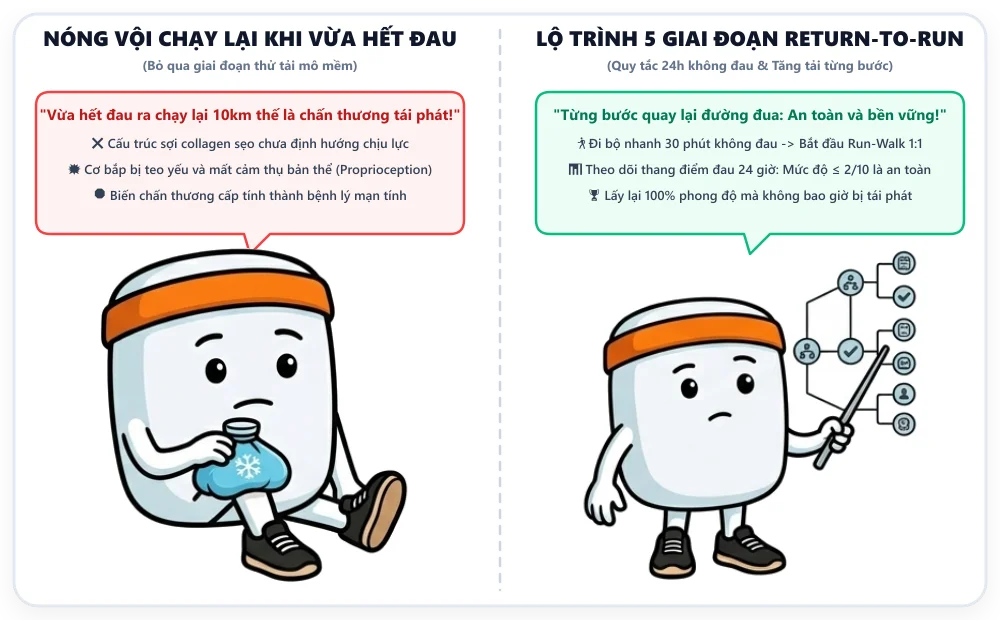
When your orthopedic doctor or physical therapist finally says, “The inflammation has subsided, the tissue has healed, you’re cleared to run,” it’s a massive relief. After weeks or months on the sidelines, it’s easy to get carried away.
However, sports medicine data warns that this is the window with the highest risk of re-injury (up to 40%–60%). The most common mistake? Confusing the absence of pain during daily life with your connective tissues being ready to handle impact forces 3–5 times your body weight over thousands of repetitive steps.
A scientific Return-to-Run (RTR) program requires a controlled transition from passive recovery to adaptive mechanical loading, ensuring your tendons, bones, and cartilage are safely conditioned for the road ahead.
Tissue Adaptation: Why You Can’t Rush Biology
Every structural component in your body has a different cellular turnover rate and collagen remodeling cycle:
┌─────────────────────────────────────────────────────────────┐
│       TISSUE RECOVERY & COLLAGEN REMODELING SPEED           │
├─────────────────────────────────────────────────────────────┤
│ • Skeletal Muscle: 3 – 8 weeks (High blood flow)            │
│ • Bone Remodeling: 3 – 6 months                             │
│ • Tendons & Ligaments: 6 – 12 months                        │
│ • Articular Cartilage: 12 – 24 months                       │
└─────────────────────────────────────────────────────────────┘
When you take 4–6 weeks off for an injury, your muscles might bounce back quickly, but your tendons and bones lose Tissue Load Capacity. If you jump straight back into your old training volume, those structures can’t keep up, leading to micro-trauma and the return of old pain.
Baseline Load Capacity ──────────────────────────┐
                                                 │ (6-week hiatus due to injury)
                                                 ▼
Reduced Tissue Load Capacity ────────────────────┐
                                                 │
       ┌─────────────────────────────────────────┴────────────────────────────────────────┐
       ▼                                                                                  ▼
[JUMPING BACK TOO FAST (WRONG)]                                             [RETURN-TO-RUN PROTOCOL (RIGHT)]
• Immediate 5–10 km runs                                                     • Incremental, stepped loading
• Exceeding current tissue thresholds                                        • Stimulates new collagen synthesis
• RESULT: Re-injury ➔ Back to the sidelines                                  • RESULT: 100% sustainable recovery
6 Functional Tests Before Your First Run
Before you head out for your first interval session, your lower body must pass these single-leg functional screens with zero pain:
| Functional Test | Sports Medicine Standard | Biomechanical Goal |
|---|---|---|
| 1. 30-Min Brisk Walk | 5.5–6.0 km/h on flat ground, no pain or limp | Baseline foot/knee load tolerance |
| 2. Single-Leg Calf Raise | $\ge 25$ reps full range on the injured side | Soleus and Achilles tendon integrity |
| 3. Single-Leg Squat | 15 reps (45–60°), no knee valgus (inward collapse) | Gluteus medius control and knee stability |
| 4. Single-Leg Balance | 30 seconds eyes closed on flat ground | Proprioception and stability |
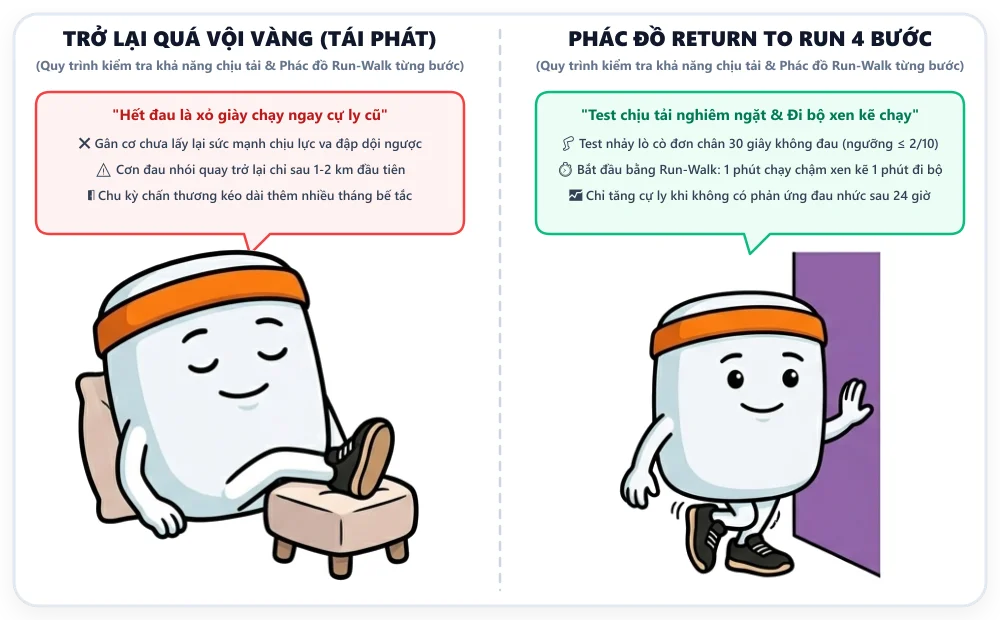
| 5. Single-Leg Hop Test | 30 continuous hops on the spot, no sharp pain | Tendon elasticity and recoil |
| 6. Stair Test | Descending 3 flights at normal speed without pain | Patellofemoral compression tolerance |
You can evaluate your movement patterns and running form using the Running DNA Tool.
The 24-Hour Pain Monitoring Model
During recovery, mild soreness or stiffness is normal. Use the traffic light system (Thomeé et al.) to stay safe:
[PAIN SCALE: 0 TO 10]
├── 0 - 2/10 (GREEN - SAFE): Very mild soreness, disappears within a few hours.
│   └── ➔ PROCEED with your scheduled Return-to-Run plan.
├── 3 - 5/10 (YELLOW - WARNING): Notable pain, slight gait change, but gone by the next day.
│   └── ➔ STOP increasing load. Maintain current intensity until pain drops to Green.
└── 6 - 10/10 (RED - DANGER): Sharp pain, limping, pain worse the next morning.
    └── ➔ STOP running. Drop back 1–2 phases and consult a specialist.
The 24-Hour Golden Rule:
If you run on Tuesday afternoon, the real test isn’t how you feel during the run; it’s your pain level on Wednesday morning. If there is no swelling, no stiffness, and no increased pain 24 hours later, the session was a success.
6-Phase Walk-to-Run Matrix
The most effective way to reload is to alternate short runs with walking intervals, allowing collagen structures time to dissipate compressive forces.
| Week | Session Structure (3x/week, alternating days) | Total Duration | Est. Mileage |
|---|---|---|---|
| 1 | 5’ Walk warm-up + 5 rounds: [1’ Easy Run + 2’ Walk] + 5’ cool-down | 25 mins | ~2.5 km |
| 2 | 5’ Walk warm-up + 5 rounds: [2’ Easy Run + 2’ Walk] + 5’ cool-down | 30 mins | ~3.2 km |
| 3 | 5’ Walk warm-up + 5 rounds: [3’ Easy Run + 1’ Walk] + 5’ cool-down | 30 mins | ~3.8 km |
| 4 | 5’ Walk warm-up + 4 rounds: [5’ Easy Run + 1’ Walk] + 5’ cool-down | 34 mins | ~4.5 km |
| 5 | 5’ Walk warm-up + 2 rounds: [10’ Easy Run + 1’ Walk] + 5’ cool-down | 32 mins | ~4.8 km |
| 6 | 5’ Walk warm-up + 20–25 mins continuous easy Zone 2 run | 30 mins | ~4.5 – 5.0 km |
Once you crush Week 6 without hitting any yellow or red zones, you can move on to base-building plans or try our Couch to 5K (C25K) Roadmap.
3 Technical Tweaks to Protect Your Joints
[1. INCREASE CADENCE BY 5% - 7.5%]
- Higher turnover shortens your stride, landing your foot closer to your center of gravity.
- Reduces impact load on knees, hips, and shins by up to 20%.
- Use a metronome: /tools/cadence-metronome/

[2. CHOOSE LOW-IMPACT SURFACES]
- Priority order for the first 4 weeks:
  1. Treadmill (Flat belt, consistent surface, high shock absorption).
  2. Track (Synthetic rubber surface).
  3. Smooth Asphalt (Flat park paths).
  └── AVOID: Uneven concrete sidewalks, cambered roads, or technical trails.

[3. SAY NO TO SUPER SHOES]
- During the return phase, stick to a cushioned, stable daily trainer.
- Avoid high-stack carbon-plated super shoes, as the rigid plates put significant leverage on the Achilles and periosteum.
The Psychology of Recovery: Overcoming Kinesiophobia
After an injury, your brain often builds a defensive mechanism known as Kinesiophobia (fear of movement). Runners often hyper-focus on every minor sensation, imagining pain is returning, or develop an imbalanced gait to protect the injured side, which creates new issues.
The Solution: Trust your anatomy. Rely on the objective data—the 24-hour pain scale and functional tests. Mechanical confidence will help your form return to its natural, fluid state.
Frequently Asked Questions (FAQ)
1. Should I cross-train (cycling, swimming) during this protocol?
Absolutely. Low-resistance stationary cycling or swimming helps maintain cardiovascular fitness and promotes tissue repair through blood flow without the impact load of running.
2. What if I hit 4/10 pain in Week 3?
Stop immediately, take 48 hours of active rest, and drop back to Week 2. Only move forward to Week 3 again once you complete Week 2 pain-free for 24 hours.
3. When can I start high-intensity interval training (HIIT) again?
Only after you have completed 30–40 minutes of continuous Easy (Zone 2) running for 3–4 weeks without any issues. Only then should you introduce short strides at the end of runs before progressing to full interval workouts.
Medical Disclaimer: This Return-to-Run guide is a general sports medicine framework. For post-operative cases (ACL reconstruction, meniscus repair) or stress fractures, you must follow your surgeon’s specific clearance and protocols.
