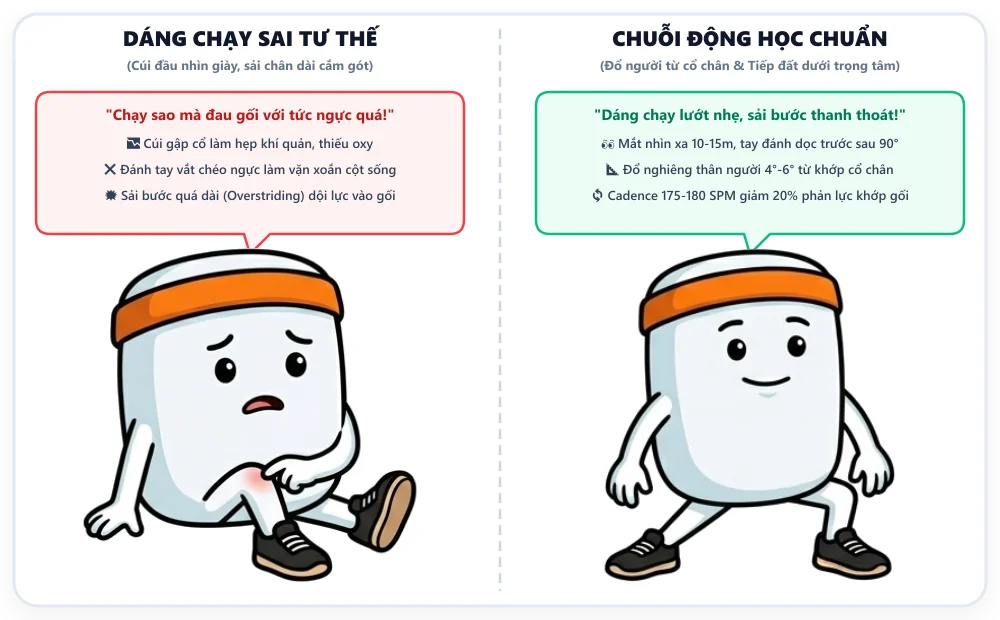
Many people assume running is a natural instinct—just lace up any pair of shoes and dash out the door.
However, after a few sessions, most beginners face the “physical nightmare”: gasping for air after 500 meters, sharp side stitches, aching shins, stiff neck and shoulders, and creaky knees.
In sports science, running is a complex Kinetic Chain of biomechanical movements. Mastering proper form from day one doesn’t just help you run with the grace of a gazelle and optimize oxygen efficiency; it acts as a “biological shield,” preventing over 90% of common running injuries.
       THE RUNNING KINETIC CHAIN
  ┌─────────────────────────────────────────────────────────────┐
  │ [EYES & HEAD]     Neck neutral, gaze 10 - 15m ahead         │
  │ [SHOULDERS & ARMS] Relaxed 90°, swing forward-backward      │
  │ [BODY AXIS]       4° - 6° FORWARD LEAN FROM THE ANKLE       │
  │ [CORE & PELVIS]   Engaged, stable pelvic alignment          │
  │ [FEET & KNEES]    LAND UNDER CENTER OF MASS, SOFT KNEES     │
  └─────────────────────────────────────────────────────────────┘
4 Pillars of Biomechanical Running Posture
Perfect running form is built on a single, continuous vertical axis from the crown of your head to your ankles:
            AERODYNAMIC RUNNING POSTURE
 ┌─────────────────────────────────────────────────────────────────┐
 │ [1] Gaze & Neck: Look 10 - 15 meters ahead                      │
 │     ──> Do NOT look at your feet (collapses airway)             │
 ├─────────────────────────────────────────────────────────────────┤
 │ [2] Arm Carriage: Keep elbows at 90 degrees                     │
 │     ──> Swing forward-backward, DO NOT cross the midline        │
 ├─────────────────────────────────────────────────────────────────┤
 │ [3] Forward Lean: 4° - 6° FROM THE ANKLES                       │
 │     ──> Utilize gravity to propel your body forward             │
 ├─────────────────────────────────────────────────────────────────┤
 │ [4] Core Bracing: Stabilize the pelvis                          │
 │     ──> Eliminate lower back arching, protect spine             │
 └─────────────────────────────────────────────────────────────────┘
1. Head and Gaze
- Keep your eyes fixed 10 to 15 meters ahead, head balanced naturally on the cervical vertebrae.
- Common Mistake: Staring down at your shoes. This kinks your airway, reducing oxygen intake by up to 20% and placing unnecessary stress on the C4-C7 vertebrae.
2. Arm Carriage
- Keep your elbows bent at roughly 90° with shoulders completely relaxed (don’t hunch them up toward your ears).
- Keep your hands soft, as if holding an egg. Arms should act like pendulums, swinging forward and backward alongside your torso.
- Never cross your arms over your chest: This creates unnecessary torso rotation, wasting energy and causing your form to fishtail.
3. The Ankle Lean
- The most efficient way to run is to turn Earth’s gravity into your propulsion: lean your entire body forward at a 4° to 6° angle.
- Vital Rule: The lean must originate from the Ankle Joint, creating a straight line from your ankles through your hips to your ears. Never bend at the waist, as this causes lower back pain and collapses the diaphragm.
The Truth About Foot Strike
The debate between heel striking, forefoot striking, and midfoot striking has lasted decades. However, modern biomechanics confirms: WHERE YOUR FOOT LANDS RELATIVE TO YOUR CENTER OF MASS (COM) IS WHAT MATTERS.
           FOOT STRIKE MECHANICS COMPARISON
 ┌──────────────────────────────────┬──────────────────────────────────┐
 │ [1] OVERSTRIDING                 │ [2] MIDFOOT STRIKE UNDER CoM     │
 │ - Foot lands far ahead of hips   │ - Foot lands directly under CoM  │
 │ - Knee fully extended            │ - Knee slightly flexed (15°-20°) │
 │ - BRAKING FORCE HITS KNEE        │ - KNEE ABSORBS IMPACT SMOOTHLY   │
 │ ──> ROOT CAUSE OF 90% KNEE PAIN  │ ──> EFFICIENT & PROTECTIVE       │
└──────────────────────────────────┴──────────────────────────────────┘- The Goal: A Midfoot strike directly under your pelvis. With the knee slightly flexed (15°–20°), the joint acts as a natural hydraulic shock absorber, distributing impact forces across your thighs and glutes rather than directly into the joint capsule.
Mastering Cadence (170 - 180 SPM)
- Cadence is the number of steps you take per minute (SPM).
- Beginners often have low cadence (150–160 spm), long strides, and excessive vertical oscillation (bouncing).
- By increasing your cadence to the 170–180 SPM range, your stride length naturally shortens, eliminating overstriding, reducing ground contact time, and decreasing knee stress by up to 20%.
Rhythmic Diaphragmatic Breathing
Why do beginners get winded after 1km or suffer from side stitches?
       BELLY BREATHING & THE CAUSE OF SIDE STITCHES
  ┌─────────────────────────────────────────────────────────────┐
  │ [Chest breathing] Shallow, rapid, low oxygen intake          │
  │ [Diaphragmatic] Deep, belly-driven, fills full lung volume  │
  │ [Even 2:2 breathing] Exhale always hits the same side       │
  │  ──> Liver pulls on diaphragm ──> SIDE STITCH               │
  │ [Odd 3:2 breathing] Alternates impact side during exhale    │
  │  ──> ELIMINATES SIDE STITCHES 100%                          │
  └─────────────────────────────────────────────────────────────┘
1. Shift from Chest to Diaphragmatic Breathing
- Inhale: Push your belly out to drop the diaphragm, allowing air to fill the bottom of your lungs.
- Exhale: Gently contract your core to push out stale air.
- Breathe through both nose and mouth: During running, oxygen demand increases tenfold. Nasal-only breathing is insufficient and leads to rapid lactic acid buildup.
2. 3:2 Rhythmic Breathing — The “Side Stitch Killer”
Budd Coates discovered that as you exhale, the diaphragm relaxes upward. If your foot strikes the ground exactly when you exhale, the liver (on your right) pulls on the ligaments connecting it to the diaphragm, causing sharp pain.
- 3:2 Breathing Pattern for Easy/Zone 2 runs:
- Inhale for 3 steps (Left - Right - Left)
- Exhale for 2 steps (Right - Left)
- Next cycle: Inhale for 3 steps (Right - Left - Right) -> Exhale for 2 steps (Left - Right).
- This 5-step cycle ensures the impact of your landing alternates between sides during your exhales, preventing mechanical strain on the liver!
4 Essential Running Drills
Spend 5 minutes before each run performing these drills to “program” your neuromuscular reflexes:
            4 PERFECT RUNNING FORM DRILLS
 ┌─────────────────────────────────────────────────────────────┐
 │ [1] A-Skips: Increases hip flexor power                     │
 │ [2] Butt Kicks: Shortens the swing phase                    │
 │ [3] Straight-Leg Bounds: Activates the Achilles tendon      │
 │ [4] Wall Lean Drill: Internalizes the 5° forward lean       │
└─────────────────────────────────────────────────────────────┘- A-Skips: High-knee skips with a 90° angle, keeping the ankle dorsiflexed (toes pointing up).
- Butt Kicks: Fast heel-to-glute movement while maintaining a stable thigh position.
- Wall Lean Drill: Stand a meter from a wall, lean forward into it to feel the perfect gravitational angle.
Running Parameters Cheat Sheet
| Technical Element | Scientific Standard | Core Biomechanical Benefit |
|---|---|---|
| Cadence | 172 – 180 SPM | Reduces knee impact by 20% |
| Body Lean | 4° - 6° from Ankles | Leverages gravity for propulsion |
| Elbow Angle | 90° (Fwd-Back swing) | Maintains rotational balance |
| Foot Strike | Midfoot under CoM | Eliminates braking force |
| Easy Breathing | 3:2 Pattern (Belly) | Prevents side stitches, optimizes O2 |
| Tempo/Race Breathing | 2:2 or 2:1 | Increases CO2 clearance |
Frequently Asked Questions (FAQ)
1. How do I know if I’m overstriding?
Ask a friend to film you running in slow-motion from the side. Check the moment your foot makes contact: if your foot is far in front of your knee and your leg is fully extended, you are definitely overstriding.
2. Is forefoot striking better than midfoot striking?
Forefoot striking is typically reserved for sprinting (100m – 400m). In distance running (5K to Marathon), constant forefoot striking forces the calves and Achilles tendon to absorb all the impact, often leading to tendonitis or plantar fasciitis. Midfoot striking is the ideal balance.
3. Should beginners force 3:2 breathing from day one?
It might feel awkward initially. Practice the 3:2 pattern while power walking first, then gradually introduce it for 5–10 minutes during your easy runs until your brain automates the rhythm.
