You’ve spent 8 to 10 hours glued to an office chair: eyes locked on a screen, shoulders hunched, hips locked in a rigid 90-degree angle. By 5:30 PM, you’re eager to change into your gear, lace up your trainers, and hit the road to burn off that stress.
Yet, within the first mile, the familiar nightmare returns:
- Your legs feel like lead, with choppy, sluggish strides.
- A dull, nagging ache settles into your lower back.
- Your hips feel locked, forcing your quads to overcompensate, leading to knee pain.
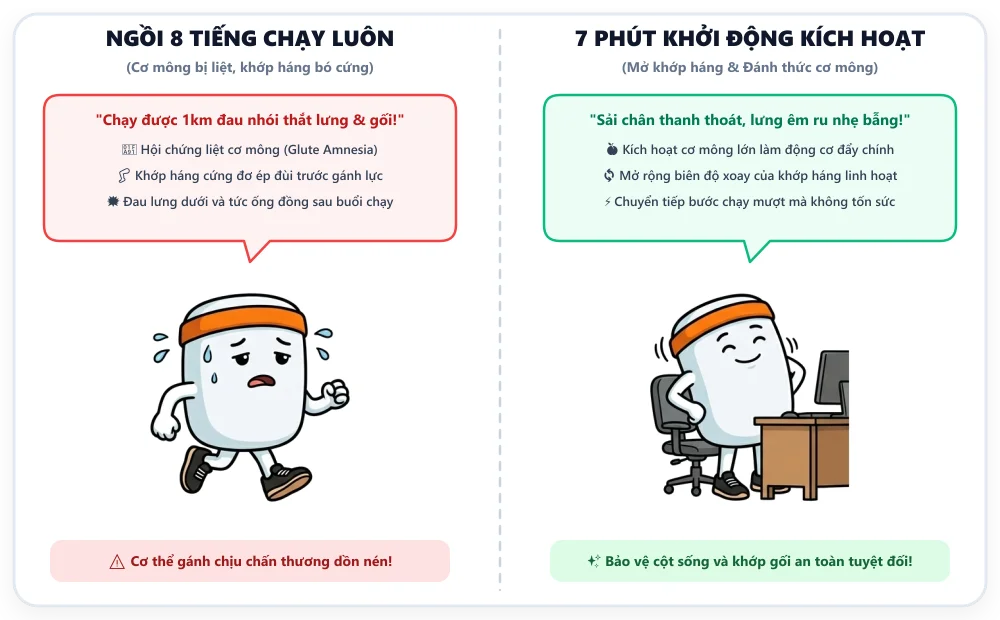
[!WARNING] This is not about poor fitness or your body being “built wrong” for running. You are simply asking a biological machine that has been “locked and powered down” to instantly engage in high-intensity performance.
Let’s dive into the biomechanics of “office chair syndrome” and gear up with a 7-minute, no-equipment routine to unlock your hips and activate your glutes before every run.
1. The Biomechanics: What Happens When You Run Right After Sitting for 8 Hours?
To understand why post-work runs lead to back pain and heavy legs, we need to examine the relationship between your Hips, Glutes, and Lumbar Spine through the lens of sports biomechanics.
┌────────────────────────────────────────────────────────────────────────┐
│             BIOMECHANICAL DYSFUNCTION CHAIN FROM PROLONGED SITTING     │
├────────────────────────────────────────────────────────────────────────┤
│  Sitting 8 hours ➔ Hip Flexors become tight and shortened              │
│                             ▼                                          │
│  Reciprocal Inhibition ➔ Brain "powers down" the Gluteus Maximus       │
│                             ▼                                          │
│  Glute Amnesia + Anterior Pelvic Tilt (APT)                            │
│                             ▼                                          │
│  Running ➔ Hamstrings & Lower back overcompensate ➔ Pain & Poor form   │
└────────────────────────────────────────────────────────────────────────┘
A. Reciprocal Inhibition
According to Sherrington’s Law of neurophysiology, when one muscle group contracts (agonist), the central nervous system automatically sends inhibitory signals to relax the opposing muscle group (antagonist) to facilitate movement.
- When you sit all day, your hip flexors—the psoas major, iliacus, and rectus femoris—are stuck in a shortened, tense state.
- Consequently, their antagonist—the Gluteus Maximus—suffers from prolonged neurological inhibition. Your brain literally “forgets” how to fire your glutes when you stand up.
B. Glute Amnesia (Dead Butt Syndrome)
The gluteus maximus is the body’s most powerful “V8 engine.” In proper running form, the glutes are the primary drivers of the push-off phase, propelling your body weight forward with explosive power.
When your glutes are “asleep”:
- Synergistic Dominance: Smaller auxiliary muscles like the hamstrings and erector spinae must take over the workload.
- The Result: Your hamstrings become overworked (leading to strains or cramps), and your lower back absorbs constant compression, resulting in post-run soreness.
C. Anterior Pelvic Tilt (APT) Locks Your Stride
Shortened hip flexors pull the front of your pelvis downward, causing Anterior Pelvic Tilt (APT) and excessive lumbar lordosis.
With your pelvis locked in this position, hip extension—the ability to drive the leg backward—drops from a healthy 15°–20° to near zero. Unable to push off, runners often compensate by overstriding. This turns foot strike into a “braking force” that sends shockwaves into your shins and knees, often leading to shin splints and runner’s knee.
2. 4 Moves to Unlock Hips & Wake Up Your Glutes in 5-7 Minutes
This 4-move routine follows a scientific progression: Joint Mobility ➔ Antagonist Stretch ➔ Isolated Neural Activation ➔ Integrated Movement. You can do these on the office floor, in the gym, or in a quiet park corner.
🟢 Move 1: 90/90 Hip Mobility
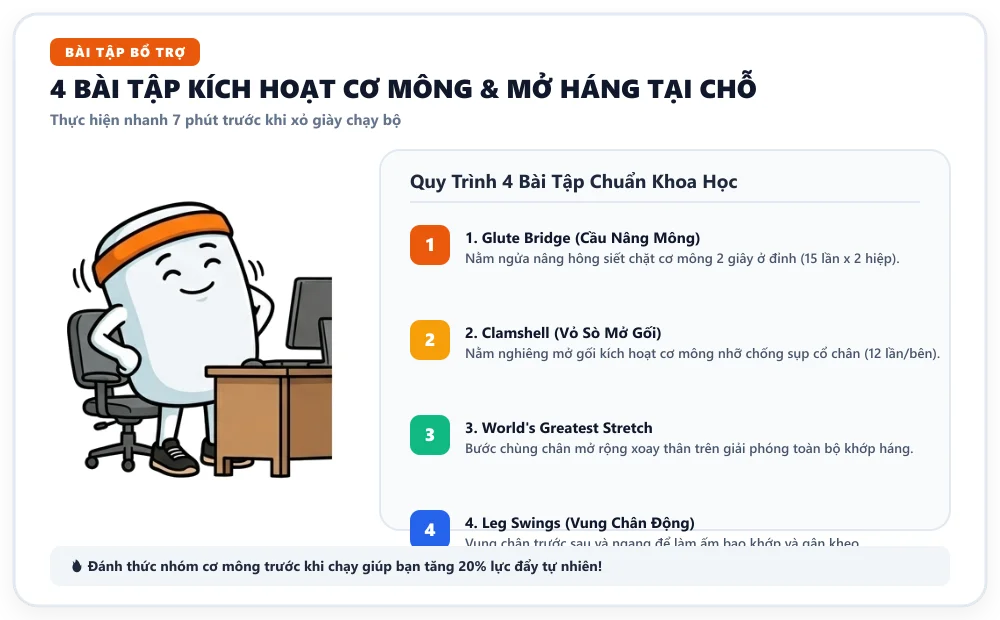
The hip is a ball-and-socket joint that demands multi-directional mobility. Excessive sitting tightens the hip capsule, restricting internal rotation (IR) and external rotation (ER).
- Benefit: Frees the hip capsule, relaxes the piriformis, and increases range of motion for your stride.
- Execution:
- Sit on the floor, both knees at 90-degree angles. Front leg horizontal (90° external rotation), back leg to your side (90° internal rotation).
- Keep your spine neutral and chest up.
- Gently hinge at the hips toward the front shin for 3–5 seconds to feel the stretch.
- Move smoothly to the opposite side by rotating your knees like windshield wipers.
- Repeat 6–8 times per side.
🟢 Move 2: Half-Kneeling Hip Flexor Stretch
Most runners botch this by arching their lower back, which only compresses the spine further.
- Benefit: Deeply stretches the iliopsoas and rectus femoris, effectively “killing” the inhibitory signals blocking your glutes.
- Execution:
- Get into a half-kneeling position.
- The Key: Perform a Posterior Pelvic Tilt by squeezing the glute of the kneeling leg and bracing your core (imagine zipping up tight pants).
- While maintaining that glute squeeze, slowly shift your hips forward 2–3 cm until you feel a deep stretch in the front of the kneeling leg’s hip.
- Reach the arm on the kneeling side overhead, tilting slightly toward the front leg to intensify the stretch.
- Pulse for 2–3 seconds, then release. Do 8–10 reps per side.
🟢 Move 3: Glute Bridge with Core Bracing
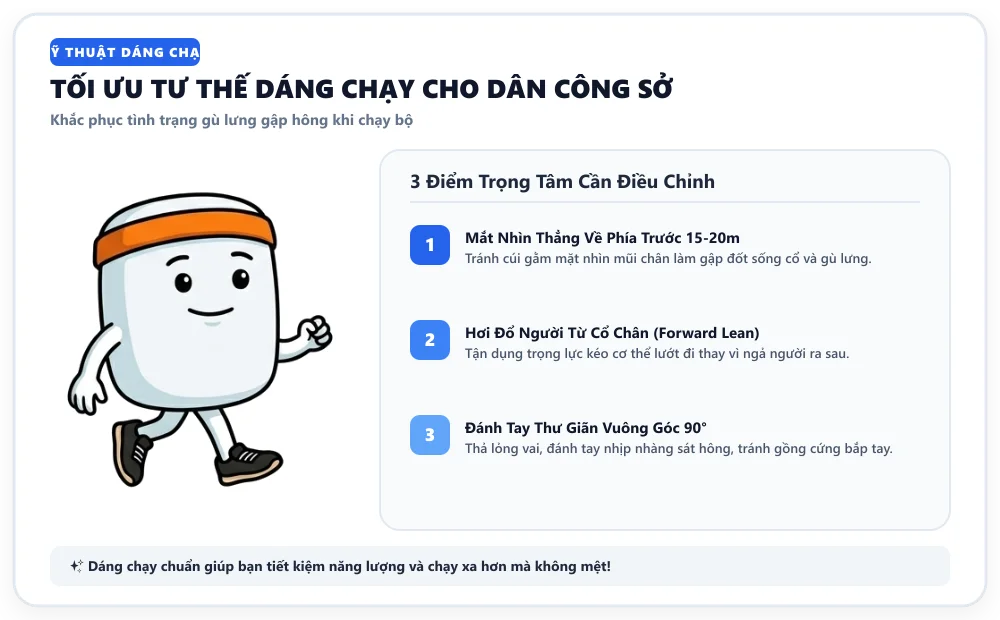
This is the classic, go-to move for re-establishing the mind-muscle connection to the gluteus maximus.
- Benefit: Wakes up the glutes and reinforces pelvic stability.
- Execution:
- Lie on your back, knees bent, feet flat on the floor.
- Brace your core (like you’re about to take a punch), keeping your lower back flush against the floor.
- Drive through your heels, squeeze your glutes, and lift your hips until your knees, hips, and shoulders form a straight line.
- Hold at the top for 2 seconds, fully engaging the glutes.
- Lower slowly to 1–2 cm off the floor. Do 12–15 reps.
🟢 Move 4: Standing Glute Kickback
Now, translate that neurological signal into a functional, weight-bearing standing position—mimicking the push-off phase of your run.
- Benefit: Trains glute firing while balancing on one leg, improving stability in the gluteus medius.
- Execution:
- Stand tall, feet hip-width apart. Lightly hold a wall for balance.
- Keep the standing leg’s knee “soft” (slightly bent).
- Keeping your back neutral, kick the other leg backward 20°–30° using only glute contraction.
- Hold for 1–2 seconds at the peak of the contraction, then return to center under control.
- Do 10–12 reps per leg.
3. The 7-Minute Pre-Run Protocol
Don’t let a busy schedule cut your warm-up. Spend exactly 7 minutes on this science-backed sequence.
| Time | Activity | Goal |
|---|---|---|
| 0:00 – 1:00 | Change shoes, ankle circles, diaphragmatic breathing | Shift nervous system from work-stress to run-ready |
| 1:00 – 2:30 | 90/90 Hip Mobility (6–8 reps/side) | Lubricate hip capsule, increase rotation |
| 2:30 – 4:00 | Half-Kneeling Hip Flexor Stretch (8–10 pulses/side) | Neutralize pelvis, release hip flexor tension |
| 4:00 – 5:15 | Glute Bridge (12–15 reps, 2s hold) | Activate Gluteus Maximus |
| 5:15 – 6:30 | Standing Glute Kickback (10–12 reps/side) | Functional strength transfer |
| 6:30 – 7:00 | A-Skips / Butt Kicks | Raise heart rate, prep Achilles |
4. Immediate Benefits on Your Run
- Effortless Stride: With “lubricated” hips, your leg swing becomes more fluid, naturally extending your stride length by 5–10 cm without added effort.
- “Goodbye” Lower Back Pain: With the glutes doing the heavy lifting, your lower back is liberated from compensatory strain.
- Energy Efficiency: Running with your body’s largest muscle group lowers your heart rate, helping you stay in your aerobic Zone 2 for longer.
Final Thoughts from the Thích Chạy Bộ Coach
Running is the best way to recharge after a stressful workday. But remember: Your body isn’t a light switch. It needs a 7-minute transition to unlock stiff joints and wake up dormant muscles.
This afternoon, before you press ‘Start’ on your GPS watch, commit to these 7 minutes. Your legs and spine will thank you with every smooth, pain-free stride!


