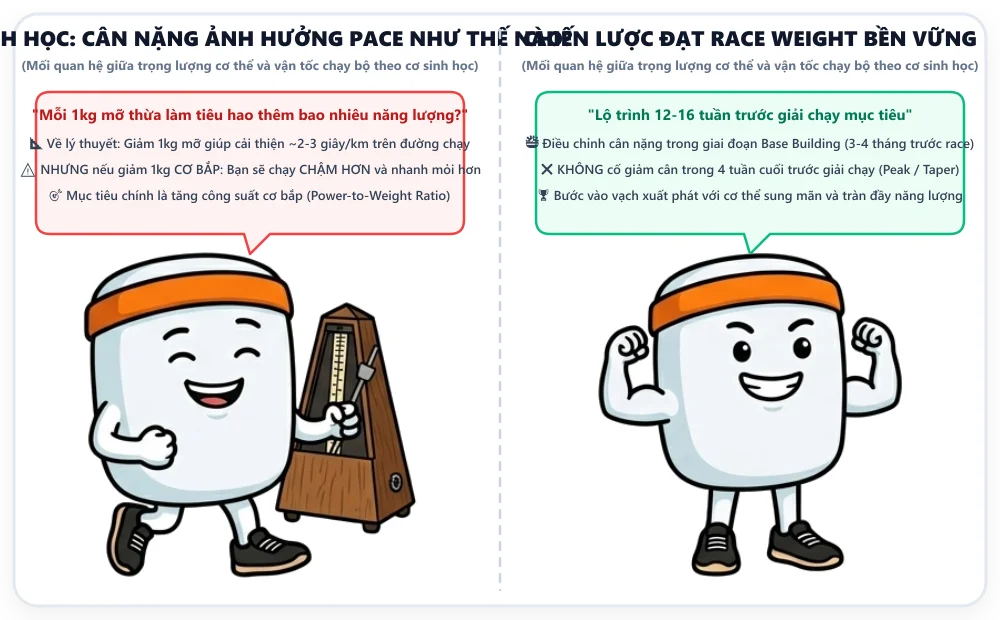
In his classic book Racing Weight: How to Get Lean for Peak Performance, sports nutritionist Matt Fitzgerald presents a compelling physics-based calculation: “Losing 1kg of pure body fat can help a runner shave 2 to 3 seconds off their pace per kilometer (equivalent to cutting 1.5 to 2 minutes off a full 42.195km Marathon time).”
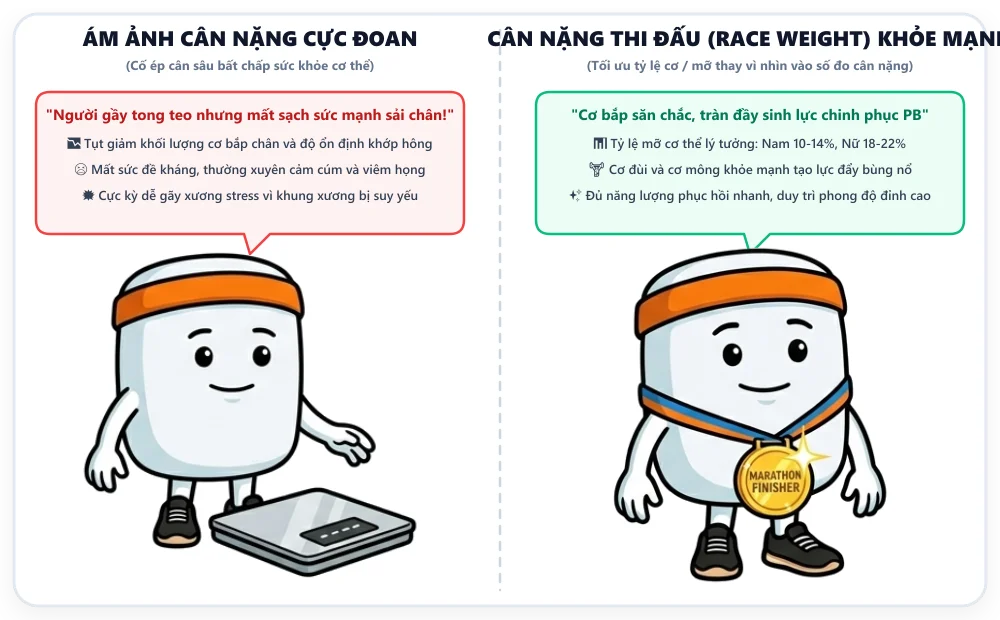
Because of this alluring statistic, many amateur runners fall into a psychological trap: becoming obsessed with every gram, weighing themselves multiple times a day, cutting carbs to the extreme, and starving themselves in the blind belief that “lighter is always faster.”
However, in elite sports physiology, the line between a Healthy Race Weight and catabolic muscle wasting is incredibly thin. Understanding the nature of your Power-to-Weight Ratio will help you find your physical “sweet spot” without sacrificing your health or longevity.
Movement Mechanics: Why Does Body Weight Affect Speed?
With every stride, the human body performs mechanical work to lift its Center of Mass vertically and propel itself forward:
$$W = m \times g \times \Delta h + F_{\text{propulsion}} \times d$$
Where:
- $m$: Total body mass (kg).
- $g$: Gravitational acceleration ($9.81\text{ m/s}^2$).
- $\Delta h$: Vertical Oscillation (typically 6–10cm per stride).
[REDUCE FAT MASS]
       │
       ▼
[Lower Total Mass (m) while MAINTAINING or INCREASING Leg Power (F)]
       │
       ▼
[Optimize Power-to-Weight Ratio (Watts/kg)]
       │
       ▼
[Oxygen Consumption (VO2) per km decreases ➔ FASTER & MORE EFFICIENT RUNNING]
However, this law of physics only holds true under one prerequisite: The weight lost must be FAT MASS, never water weight or LEAN MUSCLE MASS.
The Inverted-U Curve: The “Thinner is Weaker” Trap
Many runners mistakenly believe the relationship between weight and performance is a linear downward slope. From a sports medicine perspective, this relationship is actually an Inverted-U Performance Curve:
Running Performance
High  ┌───────────────────────────────── [THE PERFECT RACE WEIGHT]
      │                                 • Fully fueled, lean muscle tone
      │                                 • Strong immunity, deep sleep, stable heart rate
      │         ▲
      │        ╱ ╲                      [ENERGY DEFICIT ZONE - LEA/RED-S]
      │       ╱   ╲                     • Atrophy of Type II fast-twitch fibers
      │      ╱     ╲                    • Dropping Thyroid (T3) & Testosterone levels
      │     ╱       ╲                   • Stress Fractures
Low   └────┴─────────┴───────────────────────────────────────────────────────
       Overweight     Optimal Race Weight    Extreme Weight Loss (Weakness)
When you push your weight beyond the optimal point:
- Muscle Catabolism: In a calorie-starved state, the body breaks down calf and hamstring muscle tissue for amino acids, causing your toe-off power to plummet.
- Reduced Bone Mineral Density (Osteopenia): Dropping sex hormones makes bones brittle, leading to stress fractures in the tibia and femoral neck.
- Loss of Tendon Elasticity: Energy deficiency slows collagen synthesis, making the Achilles and patellar tendons prone to micro-tears.
Standard Body Fat Percentage Ranges for Runners
Instead of obsessing over the scale, modern runners should track Body Fat Percentage via DEXA scans or skinfold calipers:
| Group | Optimal Marathon Body Fat | Essential Fat Threshold |
|---|---|---|
| Male Amateur | 10% – 14% | Do not go below 5% – 6% |
| Female Amateur | 18% – 22% | Do not go below 12% – 14% |
| Male Elite | 6% – 9% | Requires constant professional medical supervision |
| Female Elite | 14% – 17% | Short-term maintenance only for A-Race day |
5 Steps to a Healthy Race Weight (The Matt Fitzgerald Method)
┌────────────────────────────────────────────────────────────────────────┐
│ 1. IMPROVE DIET QUALITY SCORE (DQS)                                    │
│    • Prioritize 100% whole foods: colorful veggies, fresh fruit,       │
│      whole grains, fatty fish, and lean protein.                       │
│    • Eliminate ultra-processed foods, fried items, and sugary drinks.  │
├────────────────────────────────────────────────────────────────────────┤
│ 2. PERIODIZED NUTRITION                                                │
│    • Increase carbohydrates on heavy training days (Intervals/Long Runs)│
│      to protect muscle and immune function.                            │
│    • Reduce refined carbs on recovery days.                            │
├────────────────────────────────────────────────────────────────────────┤
│ 3. MAINTAIN A MODERATE CALORIC DEFICIT (300 KCAL/DAY)                  │
│    • Never starve yourself. A 300 kcal/day deficit safely sheds 0.3kg  │
│      of fat per week without crashing energy levels.                   │
│    • ONLY CUT WEIGHT DURING BASE PHASE; STOP DURING PEAK & TAPER!      │
├────────────────────────────────────────────────────────────────────────┤
│ 4. HEAVY STRENGTH TRAINING TO PROTECT MUSCLE                           │
│    • Lift heavy 2x/week (Squat, Deadlift, Lunge) to signal the body to  │
│      preserve lean muscle mass.                                         │
├────────────────────────────────────────────────────────────────────────┤
│ 5. LISTEN TO BIOMETRIC FEEDBACK                                        │
│    • Track HRV, resting heart rate, and sleep quality. If HRV drops    │
│      and sleep suffers, increase your caloric intake immediately!      │
└────────────────────────────────────────────────────────────────────────┘
Comparison: Healthy Race Weight vs. Disordered Eating
| Signs | Healthy & Sustainable Race Weight | Disordered Eating / Extreme Cutting |
|---|---|---|
| Physical Feel | Light feet, explosive energy, fast recovery | Heavy legs, dizziness, frequent cramping |
| Mental & Sleep | Calm, 8 hours of deep sleep, no food obsession | Insomnia, irritability, constant hunger/guilt |
| Cold Tolerance | Normal body temperature regulation | Always freezing, even in warm weather |
| Performance | Consistent progress in Tempo/Long Runs | Unable to hit speed targets, heart rate spikes |
| Endocrine Health | Regular cycle (female), high vitality (male) | Amenorrhea ≥ 3 months (female), low libido (male) |
Frequently Asked Questions (FAQ)
1. When is the best time in a training cycle to lose weight?
The ideal time to shed fat is during the Base Building phase (12 to 16 weeks out from your race) when intensity is primarily in Zone 2. Never attempt a caloric deficit during the final 4 weeks (Peak & Taper), as your body needs maximum energy to store glycogen and repair muscle fibers.
2. Can a runner break 3:30 in the Marathon while carrying a few extra pounds?
Absolutely! A runner with a strong $\text{VO}_2\max$, a high lactate threshold, and excellent muscle durability at 15% body fat can easily outperform someone at 9% body fat who lacks a solid muscle foundation and is energy-depleted.
3. How do I know I’ve reached my optimal Race Weight?
When you reach a state where your resting heart rate is at its lowest, your stride feels naturally fluid, you feel energized throughout the day, and you can maintain this weight comfortably without starving yourself or counting every gram of food.
Core Message: “Your body is a miraculous biological machine built for movement and performance, not a sculpture to be starved. Fuel it with science-backed nutrition to shine confidently on every kilometer of the race course!”
