In the world of sports nutrition, amidst a sea of supplements with inflated claims, Caffeine (1,3,7-trimethylxanthine) is one of the few substances classified by the International Olympic Committee (IOC) and the International Society of Sports Nutrition (ISSN) as a Group A Ergogenic Aid—the gold standard with the strongest scientific evidence for enhancing endurance and power.
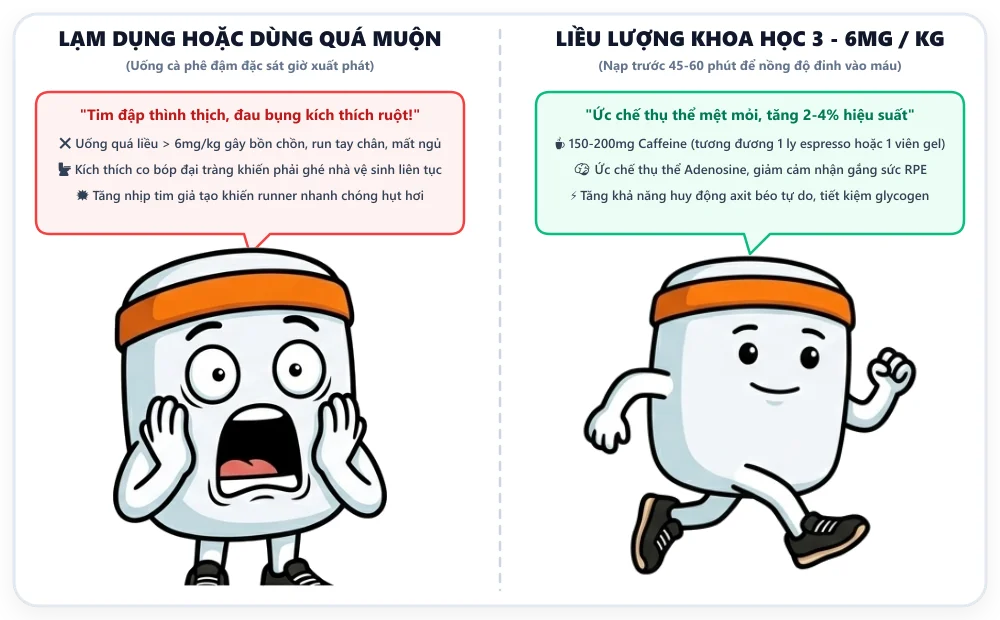
Leading meta-analyses (Guest et al., 2021, Journal of the International Society of Sports Nutrition) prove that a properly executed caffeine protocol can help runners improve finish times for 5K, 10K, Half Marathon, and Full Marathon distances by 2% to 4%, while significantly reducing the perceived exhaustion in the second half of a race.
However, miscalculating the dose, timing, or failing to understand your genetic metabolism can turn this “performance booster” into a liability—causing heart palpitations, jitters, and gastrointestinal distress mid-run.
Caffeine Pharmacokinetics: What Happens in the Brain and Muscles?
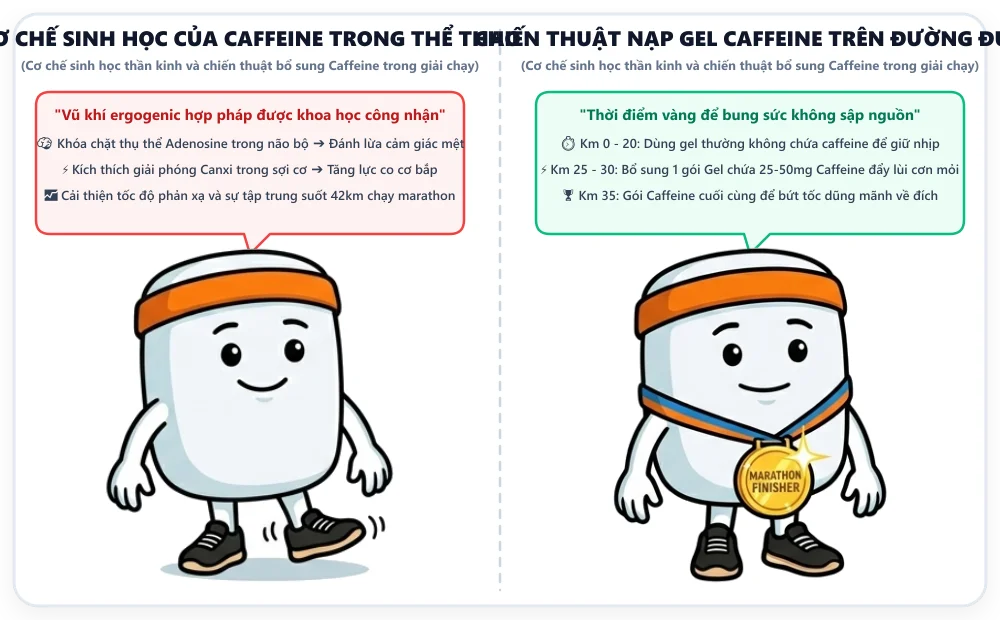
Contrary to the common myth that caffeine provides “direct energy,” it is actually a central nervous system stimulant that operates through three biochemical mechanisms:
[CAFFEINE INTAKE (COFFEE / TABLETS / GEL)]
                        │
                        ▼
[Rapid absorption via stomach & small intestine ➔ Peak plasma concentration in 45–60 mins]
                        │
                        ▼
┌───────────────────────┴───────────────────────┐
│                                               │
▼                                               ▼
[1. CENTRAL NERVOUS SYSTEM EFFECTS]             [2. DIRECT MUSCULAR EFFECTS]
• Molecular structure mimics ADENOSINE          • Activates Ryanodine receptors
• Competitively blocks A1 and A2A receptors     • Increases Calcium (Ca2+) release from sarcoplasmic reticulum
• Masks fatigue signals in the brain            • Increases explosive muscle contraction force
│                                               │
└───────────────────────┬───────────────────────┘
                        │
                        ▼
[5% – 7% REDUCTION IN RATE OF PERCEIVED EXERTION (RPE)]
└── At the same 5:00/km pace, your brain perceives the effort as lighter and smoother!- Adenosine Receptor Inhibition: During exercise, adenosine accumulates in the brain, binding to receptors to signal: “You’re tired; slow down and rest.” Caffeine shares a similar molecular structure, binding to these receptors and locking them, preventing the brain from “feeling” the fatigue.
- Muscle Calcium Stimulation: Enhances the sensitivity of actin-myosin cross-bridges, allowing muscles to contract more forcefully and efficiently.
- Lipolysis (Fat Mobilization): Stimulates adrenaline release, triggering the Hormone-Sensitive Lipase (HSL) enzyme to release fatty acids into the bloodstream as supplementary fuel.
ISSN Sports Nutrition Dosing Guidelines
Caffeine efficacy follows an inverted-U curve: too little provides no stimulation, while too much causes autonomic nervous system toxicity.
[ATHLETIC CAFFEINE DOSAGE FORMULA]
Optimal Dose = 3 mg to 6 mg of Caffeine / kg of Body Weight- 60kg runner: Effective dose is 180mg to 300mg.
- 70kg runner: Effective dose is 210mg to 350mg.
[DOSAGE ZONES & PHYSIOLOGICAL IMPACT]
├── < 2 mg/kg: Mild effect, subtle alertness (suitable for recovery runs).
├── 3 – 6 mg/kg (THE SWEET SPOT): Max endurance gains, pain reduction, improved stride power.
└── > 9 mg/kg (TOXIC ZONE): Jitters, tachycardia, anxiety, digestive distress, and insomnia.
Comparing Caffeine Sources for Runners
| Source | Approx. Caffeine | Absorption Speed | Pros | Cons / Risks |
|---|---|---|---|---|
| Espresso (1 shot) | 60mg – 80mg | 45 – 60 mins | Natural, antioxidant-rich | Inconsistent, may trigger bowel movements |
| Drip Coffee (1 cup) | 100mg – 150mg | 45 – 60 mins | Daily ritual | High volume, risk of heartburn |
| Caffeine Anhydrous Pills | 100mg – 200mg | 45 – 60 mins | Precision, cost-effective | Requires water, slower gastric transit |
| Caffeinated Energy Gel | 25mg – 100mg | 15 – 30 mins | Combined Carb/Caffeine, fast | Higher cost per unit |
| Caffeine Gum | 50mg – 100mg | 5 – 10 mins (Ultra) | Direct oral mucosal absorption | Bitter taste, must chew while running |
Genetic Factors: Why Does Caffeine Affect Everyone Differently?
Individual response is largely determined by the CYP1A2 gene, which encodes the liver enzyme responsible for metabolizing 95% of ingested caffeine:
┌────────────────────────────────────────────────────────────────────────┐
│                   CAFFEINE METABOLISM GENOTYPES                        │
├────────────────────────────────────────────────────────────────────────┤
│ 1. Fast Metabolizers (AA Genotype):                                    │
│    • ~45%–50% of the population.                                       │
│    • Rapid processing; reap 100% of performance benefits.              │
│                                                                        │
│ 2. Slow Metabolizers (AC or CC Genotype):                              │
│    • ~50% of the population.                                           │
│    • Caffeine lingers; potential for tachycardia, anxiety, AND         │
│      ACTUAL PERFORMANCE DECLINE!                                       │
└────────────────────────────────────────────────────────────────────────┘
Pro Tip: Test your caffeine strategy during weekend long runs. If you experience a racing heart or stomach pain, you may be a slow metabolizer—reduce your dose to under 100mg or switch to non-caffeinated gels.
Race Day Dosing Protocols
┌────────────────────────────────────────────────────────────────────────┐
│ 1. 5K & 10K (EXPLOSIVE SPEED)                                          │
├────────────────────────────────────────────────────────────────────────┤
│ • Timing: 1 espresso or 1 tablet (150–200mg) 45–60 mins pre-race.      │
│ • No extra caffeine needed (race duration < 60 mins).                  │
├────────────────────────────────────────────────────────────────────────┤
│ 2. HALF MARATHON (21.1KM)                                              │
├────────────────────────────────────────────────────────────────────────┤
│ • 45 mins pre-race: 100–150mg Caffeine.                                │
│ • KM 12–14: 1 gel with 50mg Caffeine to maintain focus for the finish.  │
├────────────────────────────────────────────────────────────────────────┤
│ 3. FULL MARATHON (42.195KM) - SECOND HALF STRATEGY                    │
├────────────────────────────────────────────────────────────────────────┤
│ • 45 mins pre-race: 100mg – 150mg Caffeine.                            │
│ • 0km – 20km: Use NON-CAFFEINE GELS to keep HR in Zone 2–3.            │
│ • 25km – 42km: Switch to CAFFEINE GELS (35–50mg) at km 25, 30, and 35. │
│   Break through the "Marathon Wall" and hold your cadence!             │
└────────────────────────────────────────────────────────────────────────┘
The “Caffeine Reset” (Washout) Strategy
Regular coffee drinkers develop a tolerance, as their adenosine receptors adapt. To trigger a massive performance spike on race day:
- 5–7 days pre-race: Gradually cut your daily coffee intake by 50% for the first 2 days, then stop completely for the final 3–4 days.
- Race Morning: After a 5-day “abstinence,” a 200mg dose will hit naive receptors with maximum potency, providing an unprecedented level of focus.
FAQ: Common Caffeine Questions
1. Does caffeine cause dehydration during a run?
Research by Armstrong et al. confirms that at moderate athletic doses (under 400mg/day), caffeine does not cause dehydration or electrolyte imbalance. While caffeine has a mild diuretic effect while sedentary, during exercise, blood flow is prioritized for working muscles and skin, naturally slowing renal filtration.
2. Should I drink energy drinks (Red Bull, Monster) before a run?
These contain high amounts of caffeine and simple sugars. The hypertonic concentration can cause indigestion and “rebound hypoglycemia” 30 minutes into your run. Pure black coffee or dedicated sports gels are safer, more effective choices.
3. Why does coffee make me need to use the bathroom?
Caffeine stimulates the release of gastrin and cholecystokinin, which increase colonic motility within 4–10 minutes. This is actually a massive advantage if you time your coffee for 60 minutes before the start, allowing you to clear your system before hitting the starting line!
Nutrition Resources for Runners
To optimize your performance beyond caffeine, integrate these strategies:
- How to use energy gels without stomach upset
- Vietnamese-style Carbo-Loading strategies
- Race Week nutrition guide for Marathons
- 5-minute pre-race strategy
- Auto-calculate your Gel & Hydration needs
Nutrition Tip: “Caffeine is a loyal servant but a terrible master. Master your dosage and timing to turn it into the fire that guides you to a spectacular finish!”
