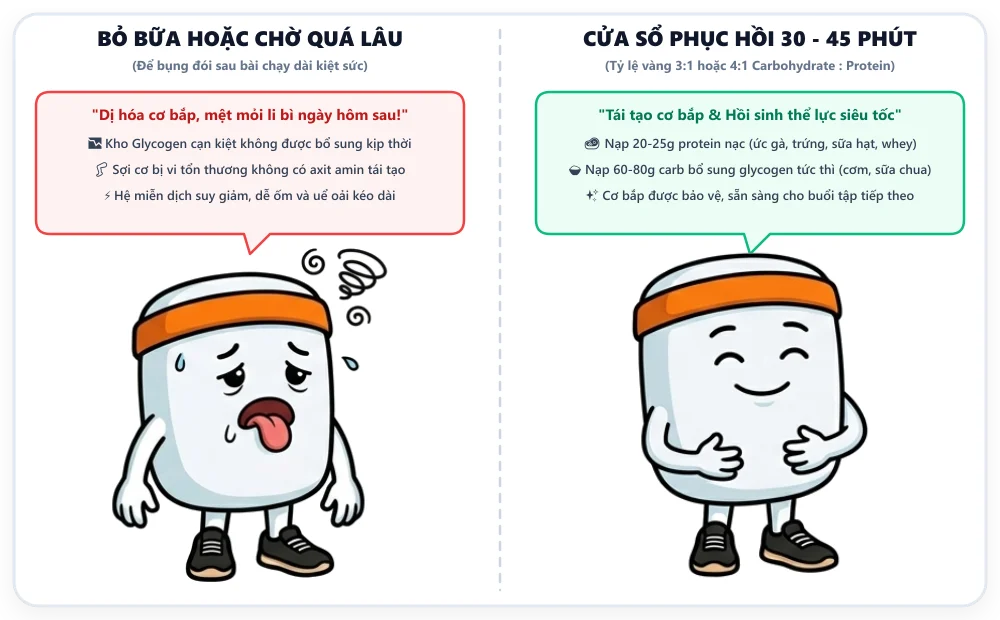
When you finish a grueling interval session or a 30km long run under the scorching sun, your body isn’t just “tired.” Biochemically, your musculoskeletal system is in a state of deep catabolism:
- Depleted Glycogen Stores: Your liver (~100g) and muscle (~400–500g) carbohydrate reserves are nearly exhausted from fueling your pace and muscle contractions.
- Micro-tears in Muscle Fibers: Eccentric loading during your run causes mechanical damage to myofilaments, releasing Creatine Kinase (CK) into the bloodstream.
- Fluid & Electrolyte Imbalance: Every liter of sweat lost carries away thousands of milligrams of sodium, potassium, and magnesium, reducing plasma volume and restricting renal blood flow.
- Cortisol Spike: Stress hormone levels peak, suppressing immune function and accelerating muscle protein breakdown if not addressed immediately.
What you put in your stomach within 45 to 60 minutes of kicking off your shoes dictates your biological recovery trajectory: Will you supercompensate and come back stronger tomorrow, or wake up with heavy legs, a compromised immune system, and an increased risk of injury?
The 45-Minute “Anabolic Window”
Decades of research from the International Society of Sports Nutrition (ISSN) and the American College of Sports Medicine (ACSM) have clarified the biology behind the “Anabolic Window”:
Stop Running ➔ Muscle Glycogen hits bottom
       │
       ▼ (First 0 - 45 minutes)
GLUT-4 receptors translocate to muscle cell membranes (Insulin-independent)
+ Glycogen Synthase enzyme activated (+300%)
       │
       ▼
Glycogen synthesis rate peaks: 7 - 10 mmol/kg muscle/hour
       │
       ▼ (After 2 - 4 hours if fasting)
GLUT-4 receptors retract ➔ Glycogen synthesis rate drops by 50%
Immediately post-exercise, GLUT-4 (Glucose Transporter Type 4) transporters move from intracellular vesicles to the surface of muscle cells, triggered by muscle contraction and AMPK enzymes. This mechanism is entirely independent of insulin.
Simultaneously, the Glycogen Synthase enzyme (responsible for binding glucose into glycogen chains) operates at triple its normal capacity. If you consume carbohydrates and protein during this window:
- Nutrients are prioritized for muscle storage and fiber repair.
- The risk of storing excess calories as body fat is virtually eliminated.
- Delaying your meal beyond 2 hours causes glycogen resynthesis rates to plummet by 50%, extending recovery time to 48–72 hours.
The 3:1 Golden Ratio and the Leucine Trigger
Simply downing lean meat or a massive whey protein shake isn’t the most effective recovery strategy. For endurance runners, neglecting carbohydrates is a critical error.
Why Combine Carbohydrates and Protein?
Carbohydrates stimulate a moderate insulin response, which acts as a “power key”:
- Closes the catabolic valve (inhibiting muscle proteolysis).
- Opens cell doors, increasing capillary blood flow to deliver amino acids deep into muscle bundles.
- Lowers serum cortisol, shifting the nervous system from a sympathetic (fight-or-flight) state to a parasympathetic (rest-and-digest) state.
Standard Dosage by Body Weight
$$\text{Target Carbohydrates} = 1.0 - 1.2\text{ g/kg body weight}$$
$$\text{Target Protein} = 0.25 - 0.4\text{ g/kg body weight (approx. 20 - 30g Protein)}$$
$$\text{Ideal Ratio} = 3:1\text{ (for runs under 90 mins) or } 4:1\text{ (for Long Runs over 2 hours)}$$
The Leucine Trigger
To activate the mTORC1 pathway (Muscle Protein Synthesis / MPS), your recovery meal must contain at least 2.5g to 3g of the amino acid Leucine. Complete protein sources like Whey Isolate, whole milk, eggs, and natural beef are the richest sources of Leucine.
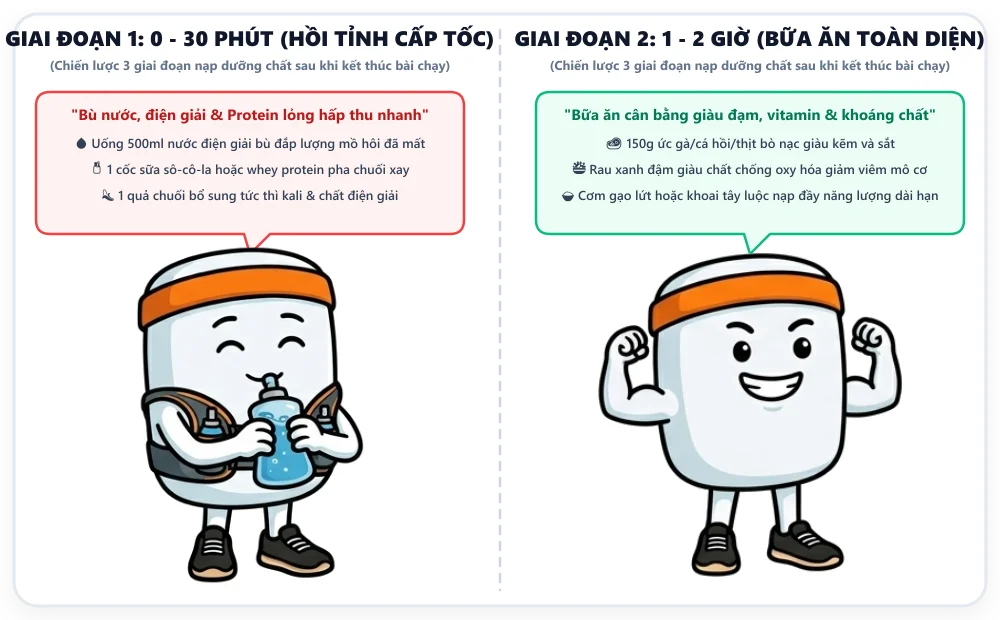
Recovery Menu: Rapid Phase (0-45 min) vs. Main Meal (1-2 hours)
| Timeframe | Biological Goal | Nutrition Components | Practical Menu Suggestions |
|---|---|---|---|
| Phase 1: Rapid (0–45 mins) | Leverage GLUT-4, lower cortisol, rapid rehydration. | 50–60g Fast Carb (High GI) + 20–25g Fast Protein. Fat < 5g. | • Chocolate Milk (400ml): Natural 3.5:1 ratio, rich in sodium & calcium. • Whey Isolate (1 scoop) + 1 ripe banana + 1 tsp honey. • Greek Yogurt (150g) + 1 diced mango. • Sugarcane juice (300ml) + 3 boiled egg whites |
| Phase 2: Comprehensive (1.5–3 hours) | Deep tissue repair, long-term glycogen loading, anti-inflammation. | Complex Carbs (Med/Low GI) + Lean Protein + Omega-3s + Micronutrients. | • Beef Pho (Noodle soup): Collagen-rich bone broth, zinc-rich beef, creatine. • Broken rice with grilled pork/chicken + Seaweed soup: Sustained energy, iodine, and minerals. • Pan-seared Salmon + Sweet potato + Garlic sautéed spinach: Omega-3s for inflammation, nitrates for vasodilation. |
The 150% Hydration Protocol
A fluid loss of just $2%$ of body weight can reduce performance by $10-15%$ and increase heart rate by 5–8 bpm at the same pace. Don’t wait until you’re thirsty.
Fluid Replacement Formula
$$\Delta W = W_{\text{pre-run}} - W_{\text{post-run (dried off)}}\text{ (kg)}$$
$$\text{Total Target (150%)} = \Delta W \times 1000\text{ (ml)} \times 1.5$$
Example: If you lose 1.0kg during a long run, you need to replace 1500ml of fluid. Drink 500ml in the first 30 minutes, then sip the remaining 1000ml over the next 2 hours with electrolytes (300-500mg/L of sodium) to ensure retention.
4 Common Post-Run Nutrition Mistakes
- Fasting to “Burn Fat”: This leads to Relative Energy Deficiency in Sport (RED-S). Without external fuel, your body breaks down skeletal muscle for gluconeogenesis, slowing your metabolism.
- High Fat Intake in the First 45 Mins: Fat slows gastric emptying, blocking the rapid delivery of glucose and amino acids to your open GLUT-4 receptors.
- Post-Race Beer: Alcohol (Ethanol) directly inhibits the mTORC1 pathway (reducing protein synthesis by up to 37%) and acts as a diuretic, worsening dehydration.
- Overusing NSAIDs: Ibuprofen or Diclofenac inhibit COX-2 enzymes, disrupting natural tendon and muscle adaptation and stressing kidneys already suffering from post-run ischemia.
Runner’s Recovery Checklist
- 0 - 15 mins: 300–500ml electrolyte solution + fast-acting carbs (coconut water, chocolate milk, or whey/banana shake).
- 15 - 30 mins: Warm shower, elevate legs, or wear compression socks.
- 45 - 90 mins: Balanced meal with lean protein, complex carbs, and dark leafy greens.
- Bedtime: Sleep before 10:30 PM for 7.5–8.5 hours to allow Growth Hormone (GH) to repair tissues.
Medical Disclaimer: These recommendations are based on international sports medicine standards. Athletes with underlying metabolic conditions (diabetes, kidney disease, gout) should consult a physician before following this protocol.
