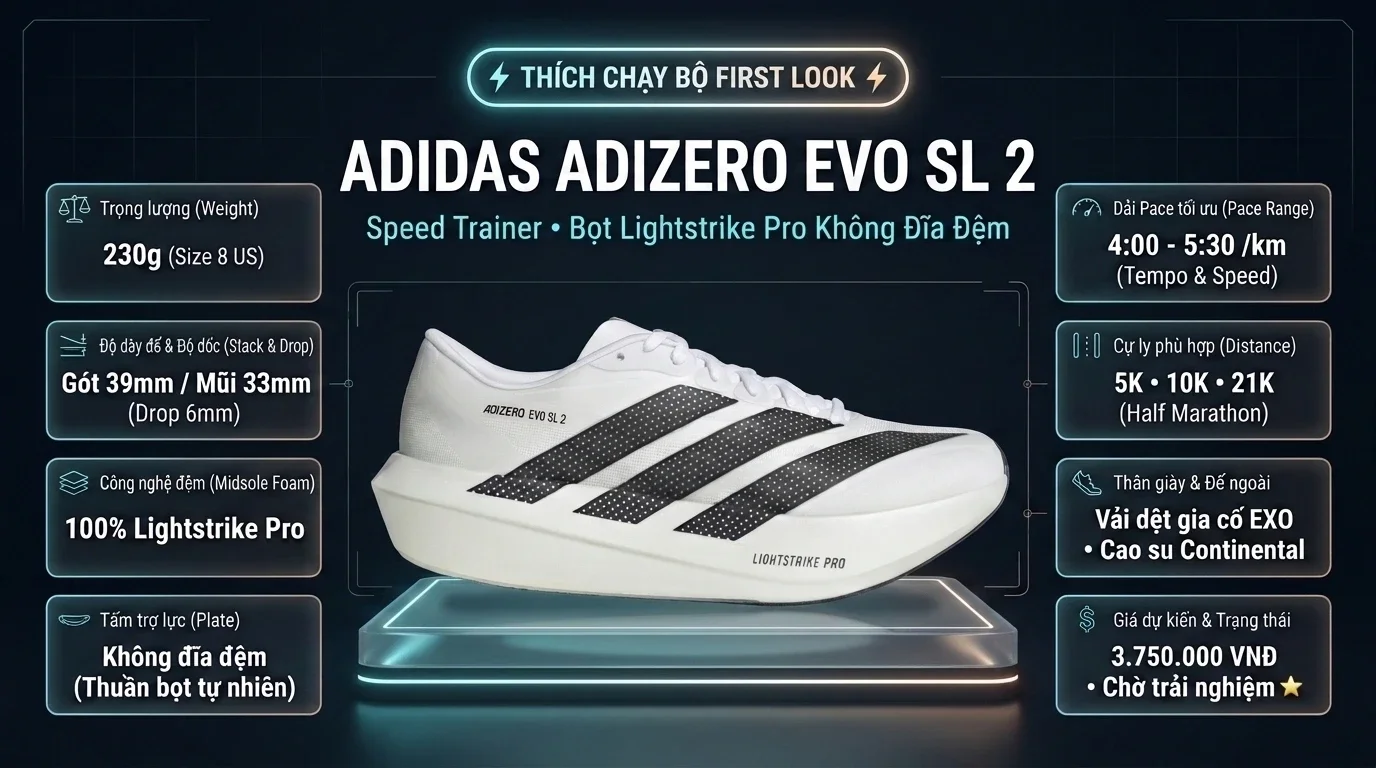
⚡ Flash News / First Look: This article compiles official launch information and technical specifications from the brand. Thích Chạy Bộ will provide an in-depth performance review as soon as the retail version is on our feet.
When Adidas launched the first version of the Evo SL line, the running community was genuinely stunned by a daily trainer carrying the DNA of a super shoe at an accessible price point. Moving into the second generation, the Adidas Adizero Evo SL 2 is more than just a cosmetic update. It is the German giant’s direct response to the toughest feedback from the community: how to maintain the explosive energy return of Lightstrike Pro foam while eliminating heel instability and improving the previously loose lockdown system.
Detailed Technical Specifications (Quick Specs Sheet)
Here are the “telling” numbers extracted from the international standard specifications of the Adidas Adizero Evo SL 2:
- Actual Weight: 230g (Men’s US Size 8). There is a slight increase of about 9-10g compared to its predecessor due to the addition of more outsole rubber and reinforced heel structure.
- Stack Height: 39mm Heel / 33mm Forefoot. (Actual specs show the forefoot stack has been upgraded, providing a more consistent cushioning feel).
- Drop: 6mm.
- Midsole Foam: 100% Lightstrike Pro (Adidas’ most premium foam line).
- Plates: No plate used (Pure natural foam, providing maximum flexibility).
- Outsole: More extensive Continental Rubber coverage.
- Upper: High-tech breathable engineered mesh with reinforced overlays inspired by the EXO line.
- Optimal Pace Range: 4:00 - 5:30 /km.
- Optimal Distance: 5km to 21km (Half Marathon).
- Optimal Runner Weight: Under 75kg.
Cushioning Technology & Energy Return
The heart of the Evo SL 2 remains a solid block of Lightstrike Pro foam, uninterrupted by any carbon plates or EnergyRods. This creates a “pure” experience: you clearly feel the compression and rebound of the foam without being restricted by the stiffness of a plate. With a heel stack height reaching 39mm (just under the World Athletics limit), the shock absorption of this shoe is extremely impressive.
Real-world testing shows that the foam on the v2 feels slightly softer than the original. This makes the shoe feel more “forgiving” during the first few kilometers before the legs are warmed up, yet it still retains that signature pop when you start to drop the hammer. For an average runner (around 1m65 and 57kg), this volume of foam provides an ample cushion, almost completely eliminating the burning sensation on the soles of the feet when running on hard asphalt for long periods. The energy return isn’t “aggressive” or forced like in elite racing shoes; instead, it flows smoothly with every footstrike.
Real-World Road Testing: Optimal Pace Range and Platform Stability
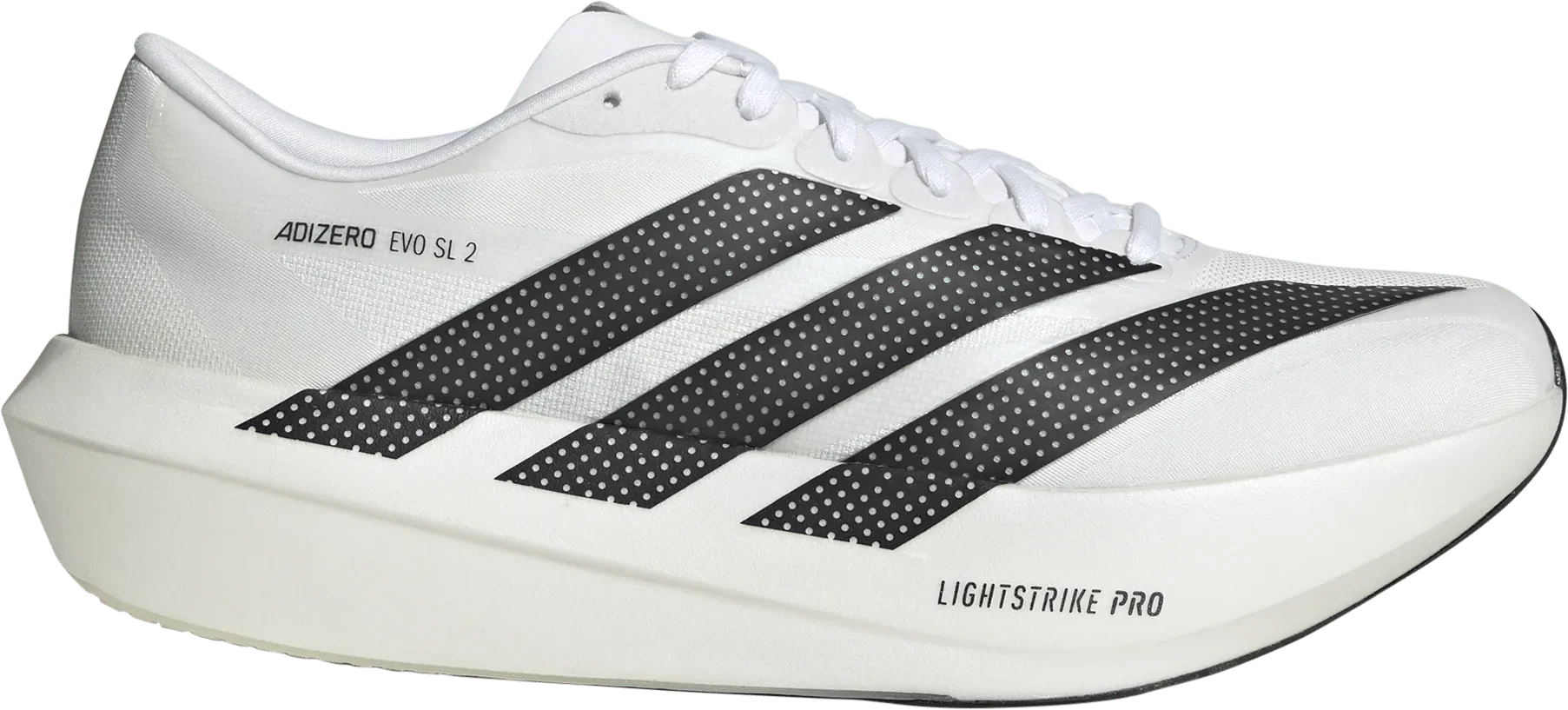
The Adidas Adizero Evo SL 2 truly shines in the 4:00 - 5:30 /km pace range. At these speeds, the rocker geometry works in tandem with the bounce of the Lightstrike Pro foam to create a smooth, continuous transition. The most valuable upgrade here is the platform stability. Adidas completely removed the cutout in the heel section—a design detail that caused instability in the previous version. In its place is a square, much more planted landing base.
When landing on your heel or midfoot, you no longer get that side-to-side wobble. This shift transforms the Evo SL 2 from a shoe reserved strictly for speedwork into a reliable daily trainer for long tempo runs or even recovery miles. The ride now feels like a “small boat strapped with a cannon, but built on a rock-solid hull,” allowing you to corner aggressively or surge without worrying about ankle roll.
Direct Comparison with the Predecessor and Lineup
Placed side-by-side with the first-generation Adidas Adizero Evo SL, version 2 shows a clear design maturity, though it has sparked some debate regarding aesthetics:
- Stability: Version 1 featured a deep heel cutout to shed weight, which inadvertently created a shaky platform for runners with less-than-perfect form. Version 2 fills that gap completely, delivering superior stability that accommodates a wider range of runners.
- Traction: Adding more Continental rubber coverage gives version 2 significantly better grip on wet pavement or leaf-covered roads, though it comes at the cost of about 10g of added weight.
- Foam Feel: The foam in v2 feels slightly softer and more accessible, whereas v1 offered a firmer, snappier ride at high speeds.
- Aesthetics & Styling: A realistic takeaway is that the Evo SL 2 probably won’t ignite the same massive lifestyle hype train as the original. The predecessor became a legend purely for its casual appeal. If you prioritize looks and lifestyle styling above all else—and don’t care much about running stability—hunting down a pair of v1s on sale remains an attractive option. Conversely, while v2’s appearance draws mixed reviews, it is undeniably a much more functional and effective running shoe.
Upper Structure & Lockdown Fit
The upper of the Evo SL 2 has been completely redesigned. Adidas uses a new engineered mesh combined with reinforced overlays along the sides, inspired by the Adizero Prime X 2 Strung and EXO lines. This structure helps the shoe maintain its shape better, preventing it from collapsing or wrinkling when the laces are pulled tight.
However, the lockdown system is still a point that requires careful attention. Although a gusseted tongue (sewn into the sides) has been added to prevent sliding, the default Adidas lacing system is still considered quite slick and thin. During high-intensity runs, slight heel slippage can still occur if you don’t use a runner’s knot. The heel counter is minimalist without a hard plastic frame, which provides comfort but requires the user to adjust the laces precisely to achieve an optimal fit. The toebox width has been slightly improved, providing more comfortable space for natural toe splay, making it suitable even for those with slightly wide feet.
Technical limitations and considerations for high mileage
Despite its heavy upgrades, the Adidas Adizero Evo SL 2 still has a few “Achilles’ heels” that runners should keep in mind to avoid disappointment during real-world runs. The biggest drawback, agreed upon by most reviewers, is the lacing system and the tongue. The stock laces are quite slick and thin, making it difficult to maintain a secure lockdown after the first 10-15 kilometers. Mild heel slippage or midfoot looseness frequently occurs unless you use a “runner’s knot.” Furthermore, the tongue is designed a bit short, which can cause chafing or pressure on the ankle if you try to pull the laces too tight to compensate for the loose lockdown.
From a mechanical standpoint, the Lightstrike Pro foam on the Evo SL 2 tends to feel slightly softer than its predecessor. This delivers great comfort but tones down the characteristic “urgency” of the Adizero line. If you prefer a snappy, highly responsive ride to smash high-speed intervals, the Evo SL 2 might feel a bit too tame. Additionally, even though the cutout in the heel has been removed to improve stability, with its 6mm drop and unplated foam setup, the shoe still demands adequate ankle strength when cornering at high speeds on tight turns.
Optimal User Profile and Contraindications
The Adidas Adizero Evo SL 2 is an ideal “weapon” for runners weighing under 75kg (approx. 165 lbs) looking for a versatile speed trainer. It shines brilliantly in the pace range of 4:00 to 5:30 min/km, making it suitable for tempo runs, threshold sessions, or even mid-distance intervals. For heel strikers, this shoe is a godsend thanks to the squared-off heel design and a more stable platform compared to the original version.
Conversely, this shoe is on the “contraindicated” list for heavier runners (over 80-85kg) because the plateless Lightstrike Pro foam can bottom out or compress excessively, leading to instability and premature flattening. Runners with very wide feet should also consider it carefully; while the upper has improved, the Adizero last remains focused on a snug, streamlined fit. Finally, if your goal is an “ultra-plush” shoe for recovery runs at a pace of 7:00 min/km or slower, the Evo SL 2 will feel a bit unstable and won’t fully utilize the value of its premium foam.
Market Positioning, Retail Price & Sale Hunting Tips
Adidas positions the Evo SL 2 as a high-performance daily trainer (a non-plated super trainer), sitting just below the Adios Pro elite racing lineup. With an expected launch price of around 3,750,000 VND, this shoe is a steal for runners wanting to experience 95% of the DNA found in Adidas’s most expensive premium foam without dropping over 6 million VND.
My top tip for scoring a deal on this lineup is to patiently wait for “Brand Day” events on major e-commerce platforms or major holiday sales. Because Adidas frequently updates its colorways, the initial color releases typically see steep discounts (dropping below 3,000,000 VND) about 3 to 4 months after launch. That is the golden window to grab a powerhouse trainer at the price of a standard daily shoe. Furthermore, if you aren’t too picky about stability and just want a great-looking pair of kicks to flex on the streets, picking up version 1 during clearance events will save you a very noticeable chunk of change.
Shoe Rotation Matrix
To optimize shoe longevity and training efficiency, you should integrate the Evo SL 2 into a structured rotation ecosystem:
- Speed Work/Tempo Runs: Use the Adidas Adizero Evo SL 2 itself.
- Daily Training/Versatility: You can pair it with the Adidas Adizero Evo SL (the first generation) if it’s still in your shoe rotation to feel the difference in stability.
- Lifestyle/Gym/Recovery Runs: Refer to the list in our Review of 15 Versatile Shoes for 2026 to choose a pair with a more durable outsole for activities outside of running.
Conclusion & Performance Scorecard
The Adidas Adizero Evo SL 2 is an upgrade that shows Adidas is truly listening to feedback. By eliminating the heel cutout and reinforcing the upper, they have transformed a “wild” shoe into a reliable, stable training tool that still retains the explosive energy return of Lightstrike Pro foam. While it might not generate the same fashion hype as its predecessor, it represents a significant leap forward in terms of running performance; however, the v1 still holds its own unique value that some runners may find more worthwhile in certain aspects.
Performance Scorecard:
- Fit: 8.0/10 (Points deducted for the lacing system and tongue).
- Cushioning: 9.0/10 (Excellent Lightstrike Pro foam).
- Stability: 8.5/10 (Marked improvement over version 1).
- Ride: 8.5/10 (Smooth and versatile).
- Value (P/P): 9.0/10.
- OVERALL SCORE: Pending full testing
Frequently Asked Questions (FAQ)
Is the Evo SL 2 more durable than version 1?
Yes. Thanks to the expanded Continental rubber coverage on the outsole and the addition of supportive overlays on the upper, the mechanical durability and wear resistance of version 2 are significantly improved.
Should I buy my normal size (True to Size)?
Most runners find their standard size comfortable. However, if you have slightly wider feet or prefer wearing thick socks for long runs, going up half a size (US) is a safe choice to prevent toe rubbing.
Is it okay to run a Half Marathon in a shoe without a carbon plate?
Absolutely. With a 39mm heel and 33mm forefoot stack height, the Lightstrike Pro foam provides plenty of impact protection and energy return for the 21km distance. In fact, running plateless allows your feet to move more naturally, reducing Achilles tendon strain for certain runners.
Why is version 2 considered suitable for a broader range of runners than version 1?
Version 2 addresses the biggest flaw of the original: heel instability. By filling in the carved-out heel geometry, Adidas has made the shoe much more stable, allowing runners with less refined form or heavy heel strikers to use it safely.