In the budget running shoe segment, BMAI has long established itself as a “disruptor” by offering specs that far exceed their price point. The arrival of the BMAI Expedition Pure 2.0 is a strategic move, focusing squarely on runners who prioritize absolute comfort for mixed activities—from walking and standing all day to gentle recovery runs. Instead of chasing the carbon plate trend or complex gimmicks, the Pure 2.0 opts to optimize foam materials and fit to deliver a “walking on clouds” sensation from the very first step.
Lab Specs & Real-World Weight (Standard US Size 8)
Below are the core technical specifications standardized for the international version:
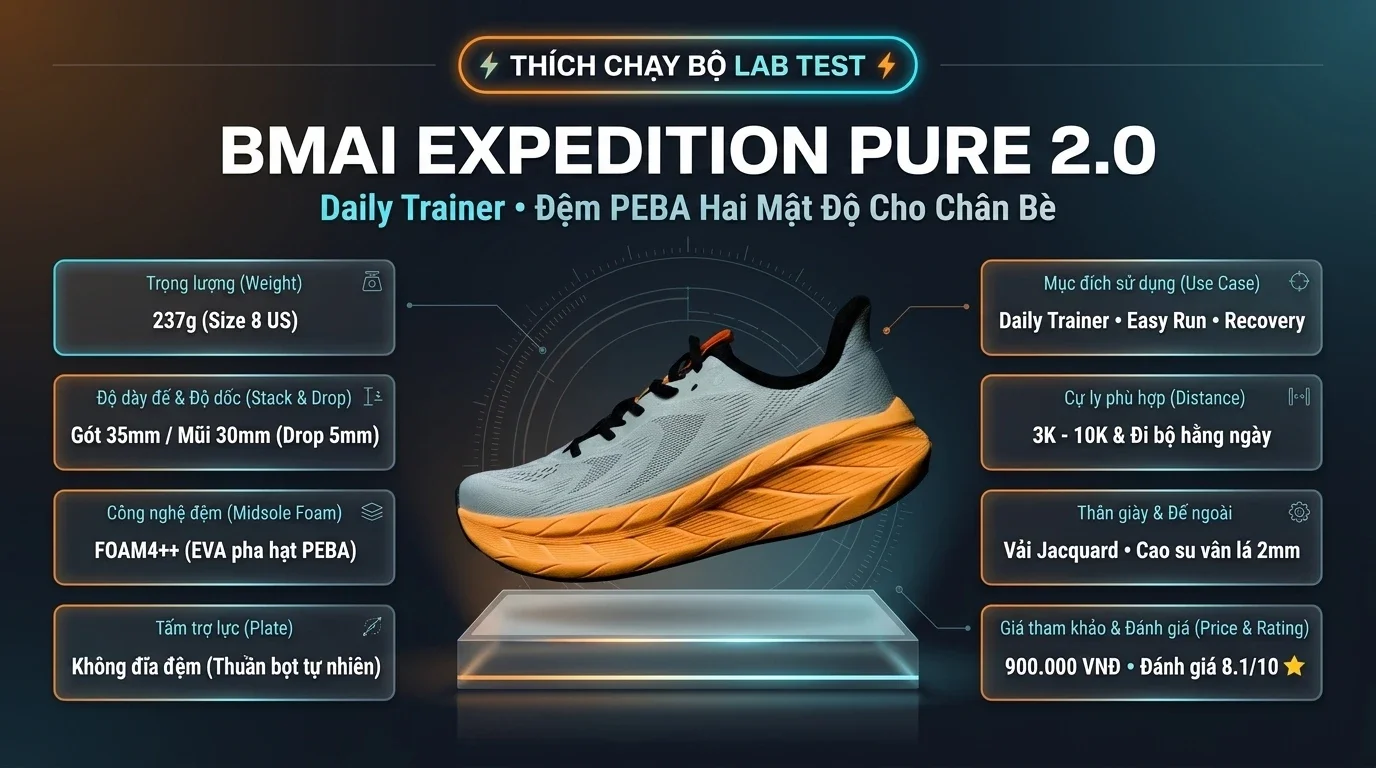
- Actual Weight: 237g (Men’s US 8 / EU 41). This is an impressive weight for a high-stack shoe, ensuring a nimble stride and reduced pressure on the ankles.
- Stack Height: 35mm Heel / 30mm Forefoot. This stack provides ample cushioning, completely isolating the foot from the harshness of the asphalt.
- Heel-to-Toe Drop: 5mm. The low drop encourages a more natural midfoot strike and reduces stress on the knees.
- Midsole Material: FOAM4++ (EVA blended with PEBA beads) featuring a dual-density structure between the forefoot and heel.
- Plate: Plateless – Prioritizing the natural flexibility of the foot.
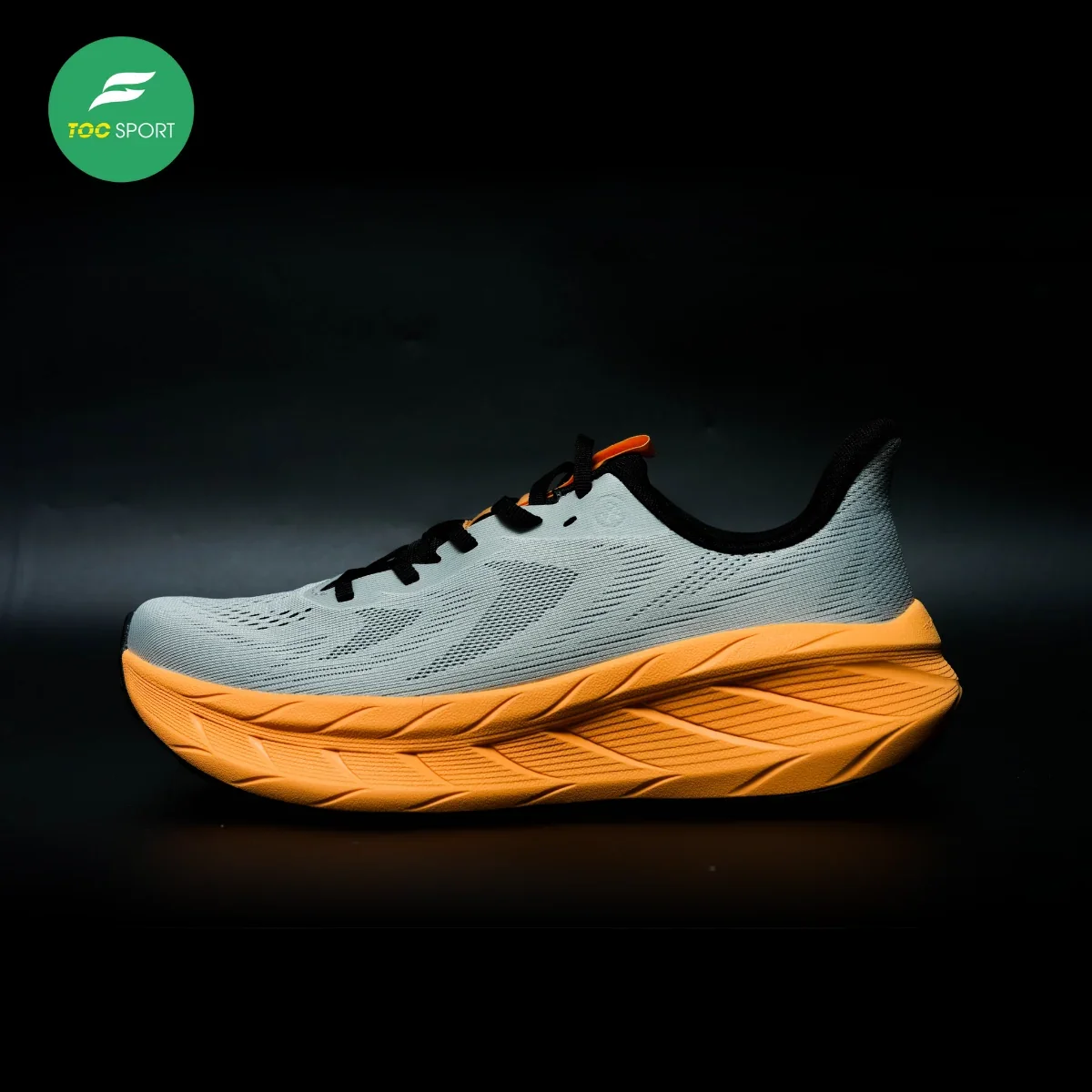
- Outsole: 2mm thin rubber with a leaf-pattern tread covering the entire contact surface.
- Upper: One-piece engineered Jacquard mesh, optimized for breathability.
Foam Technology & Impact Absorption (Cushion & Energy Return)
The standout feature of the BMAI Expedition Pure 2.0 lies in its FOAM4++ midsole. Instead of using traditional EVA foam, which tends to bottom out and feel firm quickly, BMAI has blended in PEBA beads—a premium material usually reserved for expensive racing shoes. The magic is in the Dual-Density design: the forefoot has a hardness of approximately 40°, providing a soft feel like memory foam, while the heel is tuned to 43° to provide stability and prevent uncontrolled sinking during heel strikes.
The impact absorption of this shoe is truly remarkable. For a runner with a typical build (around 1m65 and 57kg), the cushioning responds very gently, neutralizing almost all vibrations from concrete surfaces before they reach the ankles and knees. However, because there is no plate or rigid torsion shank, the energy return of the Pure 2.0 is moderate—leaning more toward “plush” than “snappy.” It doesn’t aggressively propel you forward; instead, it cradles every step, making recovery runs feel genuinely relaxing.
Road Performance: Optimal Pace Range & Stability
When taking the BMAI Expedition Pure 2.0 out for a real-world test on the road, the shoe’s personality becomes clear across different speed ranges.
- Pace 5:45 - 8:00 /km (The Sweet Spot): This is where the Pure 2.0 shines brightest. At easy run or power-walking speeds, the combination of the 237g weight and FOAM4++ creates a smooth, comfortable rhythm. The ground feel is present but never painful, and the 30mm forefoot protects the metatarsals exceptionally well.
- Pace 5:15 - 5:45 /km: The shoe remains stable, and the light weight means lifting your feet doesn’t require much effort. However, you’ll start to notice the lack of a propulsive mechanism when trying to surge suddenly.
- Paces faster than 5:00 /km: This is not the Pure 2.0’s territory. At higher speeds, the soft foam tends to compress deeply and responds slower than your cadence, resulting in a slightly “sluggish” feel and a lack of stability during sharp turns due to the absence of a midfoot torsion frame.
Regarding stability, thanks to a wide-base outsole design following a Wide-Fit philosophy, the shoe creates a large contact platform that gives runners confidence upon landing. However, due to the pure foam construction, runners who severely overpronate or oversupinate should take note, as the shoe lacks specific stability features for gait correction.
Direct Comparison with the Predecessor
Compared to the first-generation Pure, the Expedition Pure 2.0 is a revolution in cushioning. In the previous version, the pure EVA foam was often criticized for becoming firm after about 200km. With the 2.0, incorporating PEBA beads into the FOAM4++ has completely solved the durability and softness puzzle. The weight has also been better optimized, providing a much more nimble feel. The toebox on the 2.0 has been slightly widened, fixing the pinky-toe irritation some users experienced with the predecessor.
Upper Construction & Lockdown (Fit & Feel)
BMAI has always understood Asian biomechanics, and this is evident in the Wide-Fit shape of the Pure 2.0. The toebox is designed generously, allowing the toes to splay naturally—a major plus for those with wide feet or high arches.
The Jacquard mesh upper features carefully calculated breathability zones. In areas requiring stability, like the midfoot, the weave is denser to hold the shape, while the forefoot features large heat-release vents. Real-world testing shows that the Jacquard version handles moisture and heat very well in humid climates.
The lockdown system of the Pure 2.0 is solid. The heel collar is sufficiently padded—not so thick that it feels stuffy, but enough to grip the heel and prevent slippage. The flat laces have a slight stretch, helping to distribute pressure evenly across the top of the foot to avoid numbness when tied tight. However, the tongue is not gusseted, so it may occasionally slide if not adjusted carefully before your run, though this doesn’t significantly impact performance at slower paces.
Technical Limitations and Long-Distance Considerations
Despite boasting a promising PEBA-blend FOAM4++ midsole, the BMAI Expedition Pure 2.0 reveals clear physical limitations when pushed into high-intensity scenarios. The critical weakness lies in its “plateless” construction—it lacks any internal plate or midfoot torsion shank. Once your distance exceeds the 15km mark, the soft 40° durometer foam in the forefoot begins to show signs of cumulative compression, leading to a “bottoming out” sensation. Runners will notice a gradual decrease in energy return, feeling as though their legs have to work harder to maintain pace.
Stability is also a significant concern on routes with many sharp turns or uneven surfaces. Due to the lack of a supportive skeleton and the ultra-plush nature of the foam, there is a tendency for ankle instability if the runner’s foot strike isn’t rock-solid. Furthermore, the 2mm leaf-patterned rubber outsole, while providing full coverage, has its drawbacks regarding grip. On wet asphalt after rain or loose gravel paths, the actual contact area of the leaf lugs isn’t sufficient to create the necessary friction, resulting in slight slippage during sharp cornering or sudden accelerations.
Optimal User Profile and Contraindications
The BMAI Expedition Pure 2.0 is engineered to be a “people’s shoe” for daily activities, where comfort is prioritized over raw speed performance.
- Optimal For: Runners under 75kg (165 lbs) looking for a shoe for recovery runs or easy runs between 3-10km. Specifically, with its Asian-standard Wide-Fit, this is a lifesaver for those with wide feet or high insteps who frequently suffer from pinky toe pressure in Western-brand silhouettes. Beyond running, those whose jobs require standing for long periods or walking throughout the day will maximize the “memory foam pillow” comfort of the 35mm/30mm stack height.
- Contraindications: Runners over 75kg should avoid using this shoe for long runs exceeding 15km, as the high pressure will cause the midsole to lose its elasticity quickly. Additionally, those with a history of ankle rolls or weak ankles should be cautious due to the lack of stability guide rails. Finally, if your goal is interval training or tempo runs at paces faster than 5:00/km (8:00/mile), the Expedition Pure 2.0 will feel too “mushy” and lack the necessary pop.
Market Positioning, MSRP & Sale Hunting Tips
BMAI positions the Expedition Pure 2.0 in the entry-level segment, competing directly through material specs rather than flashy marketing campaigns. With a launch price ranging from 900,000 VNĐ to 1,100,000 VNĐ ($35 - $45 USD), it is one of the rare shoes on the market featuring a PEBA-blend foam—a material usually reserved for premium models.
Sale hunting experience shows that during major holidays or double-day sales (8/8, 9/9) on e-commerce platforms, the price can drop to around 700,000 VNĐ ($28 USD). At this price point, the price-to-performance (P/P) ratio of the Pure 2.0 is virtually unrivaled. However, runners should be careful to choose the right version: prioritize the standard Jacquard or the Summer (Cooling) version for tropical climates, and avoid the All-Weather version unless you live in a cold winter region or frequently run in early morning mist.
Shoe Rotation Matrix
To optimize shoe lifespan and protect your feet, integrating the Expedition Pure 2.0 into a rotation is a smart strategy:
- Recovery Days / Daily Wear: Use the BMAI Expedition Pure 2.0 to enjoy the plushness and relieve pressure on the musculoskeletal system after heavy workouts.
- Long Runs or Endurance Training: Upgrade to the BMAI Expedition 6—the big brother of the line equipped with a Probar Loc torsion shank and a more substantial midsole to maintain stability over 21km to 42km distances.
- Speed Work / Race Day: Switch to carbon-plated models to optimize propulsion and speed.
Conclusion & Performance Scorecard
The BMAI Expedition Pure 2.0 isn’t a speed demon, but it is a dedicated “companion” for 80% of daily movement needs. The upgrade to PEBA-blend FOAM4++ has elevated a budget shoe to feel more premium underfoot, delivering comfort that exceeds expectations for a sub-$40 price tag.
Performance Scorecard:
- Fit: 8.5 / 10 (Wide-Fit is extremely comfortable for wide feet).
- Cushion: 8.2 / 10 (Signature PEBA softness, but prone to bottoming out on long runs).
- Stability: 7.5 / 10 (Lacks a torsion shank, slightly bouncy/unstable at high speeds).
- Ride: 7.7 / 10 (Smooth at easy paces, lacks punch for acceleration).
- Value (P/P): 9.1 / 10 (An absolute steal for a PEBA-blend foam configuration).
OVERALL SCORE: 8.2 / 10 ⭐
Frequently Asked Questions (FAQ)
My feet are very wide and my pinky toe often gets pinched; can the Pure 2.0 fix this?
Absolutely. BMAI’s forefoot design follows Asian Wide-Fit standards. The toe box is very spacious, allowing toes to splay naturally and eliminating the friction that causes common pinky toe blisters.
Does the shoe have good grip in the rain?
Not particularly. The 2mm rubber with thin leaf patterns tends to lose traction on wet asphalt or smooth tiles. You should slow down during turns and avoid extremely slippery surfaces when it rains.
Can I use this for a Half Marathon (21km)?
It’s possible if you have a lighter build (under 65kg) and run at a slow pace (6:30 - 8:00 min/km). However, for most runners, the Pure 2.0 will start to cause foot fatigue after the 15th kilometer due to foam compression and lack of torsional support.
How long does the PEBA-blend FOAM4++ last?
Under daily running conditions of 5-7km, the midsole maintains its best bounce for the first 400-500km. After that, the foam will gradually firm up but remains perfectly stable for walking or gym use.